


While we were busy watching humanoids struggle to walk up stairs, China just deployed a robot that can outrun most humans. Not in a lab. Not on a perfectly controlled track. In the real world.
Meet Bolt, the humanoid robot from MirrorMe Technology that just clocked 10 meters per second. That’s 22.4 mph. Fast enough to complete a 100-meter dash in 10 seconds flat. And here’s the crazy part? This company didn’t exist before spring 2024.
The previous record holder, Unitree’s H1, maxed out at 3.3 m/s (7.4 mph). Bolt just tripled that. This isn’t an incremental improvement. This is a fundamental leap in how fast bipedal robots can move while maintaining dynamic balance.
The Black Panther Blueprint
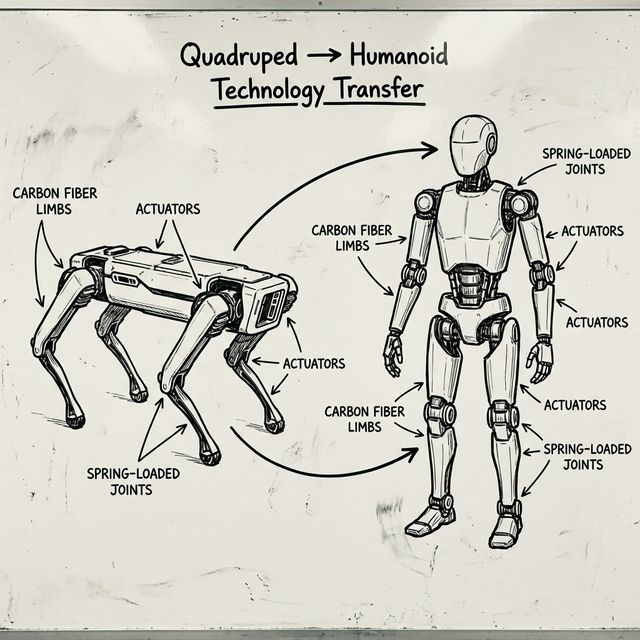
Here’s what most people don’t realize: MirrorMe didn’t start with humanoids.
The company, spun out of Zhejiang University’s robotics lab in Shanghai, made their name with the Black Panther 2.0 – a quadruped robot that completed 100 meters in 13.17 seconds. Peak speed? 10.9 m/s. Yeah, faster than Bolt.
But here’s where it gets interesting. MirrorMe took everything they learned from making a four-legged robot sprint and reverse-engineered it for two legs. The actuators. The carbon fiber limb structures. The spring-assisted joints. The impact-resistant leg design.
Think about that for a second. They didn’t design a humanoid from scratch. They adapted proven quadruped technology to bipedal locomotion. That’s why they went from founding to world record in under two years.
The Engineering Deep Dive
The Black Panther 2.0 gave them critical insights:
Carbon fiber shins modeled after jerboa desert rodents for stiffness without weight
Spring-loaded knee joints with 3000 Nm coil springs acting as shock absorbers
High torque-to-weight actuators delivering power without sacrificing agility
Ground reaction force management – sprinting robots experience massive impact forces that destroy most designs
When you’re pushing a bipedal robot to 22 mph, you’re not just solving for speed. You’re solving for controlled catastrophe. Every footfall is a potential disaster. The robot needs to predict impact, absorb shock, and maintain balance at speeds where millisecond delays mean total failure.
Bolt stands 175 cm tall (5’9″) and weighs 75 kg (165 lbs) – nearly identical to human proportions. This isn’t coincidence. Human biomechanics are optimized for bipedal locomotion. MirrorMe mimicked the form because the physics work.
The Speed Hierarchy
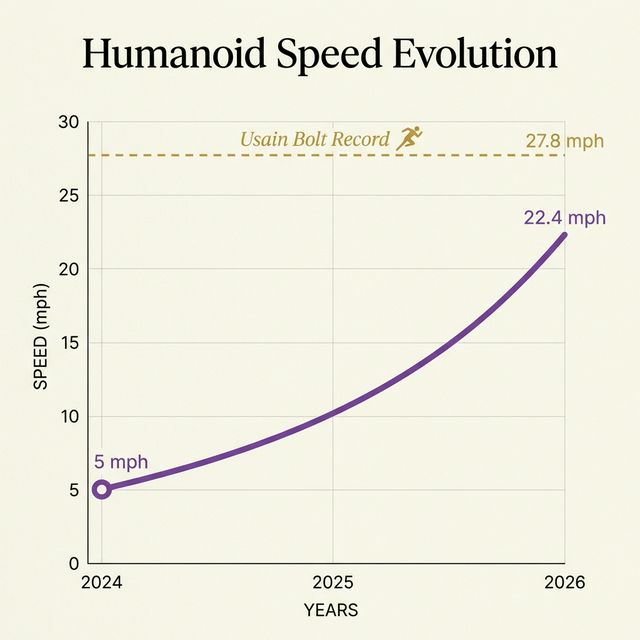
Let’s put Bolt’s speed in perspective:
| Runner | Top Speed | Notes |
|---|---|---|
| Average Human Sprint | 12 mph | Recreational runner |
| Unitree H1 (2024) | 7.4 mph (3.3 m/s) | Previous humanoid record |
| Boston Dynamics Atlas | 5.5 mph (2.5 m/s) | Pre-2024 record |
| Bolt Humanoid | 22.4 mph (10 m/s) | Current world record |
| Usain Bolt (Human) | 27.8 mph | Fastest human ever |
Bolt is now faster than 90% of humans. It’s not faster than Olympic sprinters. Yet.
But look at the growth curve. In 2024, the best humanoid could barely break 5 mph. Two years later? We’re at 22 mph. If this trajectory continues, we’ll see humanoids matching Usain Bolt’s peak speed by late 2026 or early 2027.
The Mr. Beast Factor
You might have seen MirrorMe’s Black Panther quadruped in a Mr. Beast video. Noah Lyles, the American Olympic sprinter, raced against three robots in a 50-meter dash.
The Black Panther hit 35 km/h (21.7 mph) and almost caught Lyles at the finish line. The robot had a slower start – it takes time to ramp up to top speed – but it was rapidly closing the gap in the final meters.
That demonstration mattered because it showed real-world performance. Not a treadmill. Not a controlled environment. An actual race with an Olympic athlete.
Now MirrorMe has that same locomotion engine in a humanoid form factor with Bolt.
What This Actually Means

Fast robots aren’t just cool demos. Speed unlocks entire categories of real-world applications:
Emergency Response: A robot that can sprint at 22 mph can reach disaster zones faster than human responders in many scenarios.
Industrial Logistics: Warehouse robots currently move at walking pace. Bolt-level speed changes throughput calculations for last-mile delivery and facility operations.
Search and Rescue: Covering ground quickly in collapsed structures or hazardous environments where human speed is limited by safety constraints.
Military Applications: Let’s be direct – a humanoid that can sprint faster than most soldiers while carrying equipment changes tactical calculations.
But here’s the constraint nobody talks about: stopping.
At 22 mph, Bolt can’t just deploy airbags. The robot needs active deceleration control without destroying itself. That’s why you see it tested on a suspended harness rig. MirrorMe hasn’t solved crash prevention at speed yet. When they do, that’s when deployment scenarios shift from “controlled testing” to “real world operations.”
The Bigger Picture
Physical AI is having its ChatGPT moment. NVIDIA’s Jensen Huang said as much at CES 2026. The combination of advanced actuators, real-time sensor fusion, and agentic AI for motion planning is creating robots that can operate in unstructured environments.
Bolt represents a specific breakthrough in the speed-stability tradeoff. Historically, you could have a fast robot or a stable robot. Not both. MirrorMe proved you can achieve both by borrowing from quadruped design principles.
This connects directly to the broader shift toward embodied AI, where intelligence isn’t just language models – it’s physical systems that interact with the world at human-competitive speeds.
The Bottom Line
A Chinese startup went from founding to world-record holder in under two years. They did it by reverse-engineering quadruped sprint mechanics for bipedal robots.
Bolt’s 22.4 mph isn’t just a benchmark. It’s a signal that humanoid capabilities are accelerating faster than most people realize. If the current trajectory holds, we’ll see robots matching human Olympic sprint speeds within 18 months.
The real question isn’t whether robots will get faster. It’s what happens when they’re faster than us and deployed at scale.
FAQ
How fast is the Bolt humanoid robot?
Bolt has achieved a top speed of 10 meters per second, which equals 22.4 miles per hour. This makes it nearly three times faster than the previous humanoid robot speed record of 3.3 m/s (7.4 mph) held by Unitree’s H1.
Who makes the Bolt robot?
Bolt is developed by MirrorMe Technology, a Shanghai-based robotics startup founded in spring 2024. The company has strong ties to Zhejiang University and draws its core team from elite researchers at the institution.
Can humanoid robots run faster than humans?
Currently, the fastest humanoid robot (Bolt at 22.4 mph) is slower than elite human sprinters like Usain Bolt (27.8 mph), but it’s already faster than average human sprint speeds of around 12 mph. At current development rates, robots could match Olympic-level human speeds by 2027.
What was the previous humanoid robot speed record?
Before Bolt, the record was held by Unitree’s H1 humanoid robot, which achieved 3.3 meters per second (approximately 7.4 mph). Prior to that, Boston Dynamics’ Atlas held the record at around 2.5 m/s (5.5 mph).
What is the Black Panther robot?
The Black Panther 2.0 is a quadruped (four-legged) robot developed by MirrorMe Technology that can complete a 100-meter sprint in 13.17 seconds with a top speed of 10.9 m/s. The company used the engineering insights from this quadruped to develop the Bolt humanoid.
How did MirrorMe Technology develop such fast robots so quickly?
MirrorMe achieved rapid development by first mastering high-speed locomotion with their quadruped Black Panther robot, then adapting the proven actuator designs, carbon fiber structures, spring-assisted joints, and impact management systems to bipedal humanoid architecture. This technology transfer approach allowed them to go from founding to world record in under two years.