
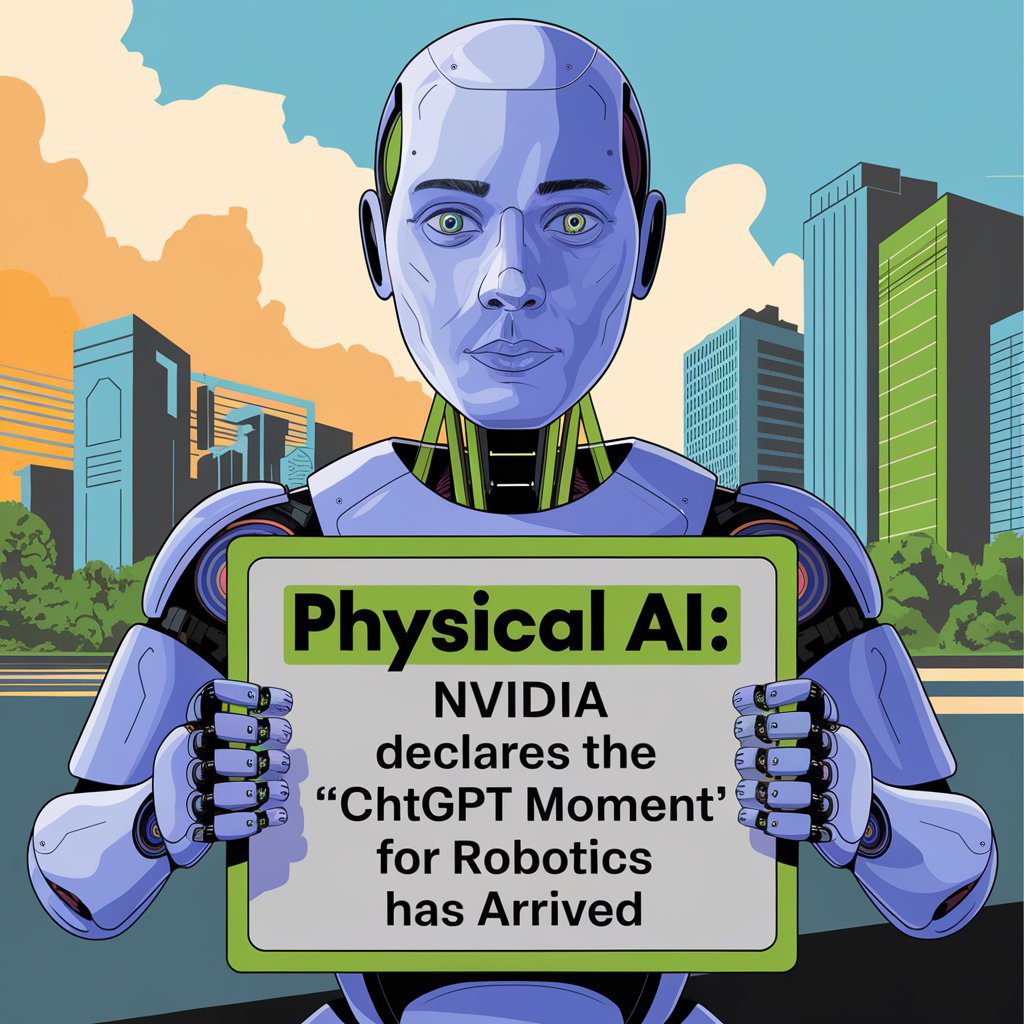

At CES 2025, Jensen Huang said the ChatGPT moment for robotics was “just around the corner.”
At CES 2026, he said it’s here. That’s not a subtle shift. NVIDIA’s $4.5 trillion bet on becoming the infrastructure provider for intelligent machines is accelerating. And the partnerships announced—Boston Dynamics, Caterpillar, Toyota, BMW, LG Electronics—suggest this isn’t just keynote theater.
So what does “ChatGPT moment for Physical AI” actually mean? And should you believe it?
What Physical AI Actually Is
Physical AI refers to artificial intelligence systems that interact with the physical world. Unlike ChatGPT (which processes text) or Midjourney (which generates images), Physical AI controls actuators, interprets sensor data, and makes real-time decisions about physical actions.
The core components:
| Component | Function | Example |
|---|---|---|
| Perception | Understanding environment | Camera vision, LIDAR, force sensors |
| World Model | Predicting physics and causation | NVIDIA Cosmos |
| Planning | Deciding on actions | Navigation, manipulation paths |
| Control | Executing movements | Motor commands, joint coordination |
Traditional robotics had these components too. What’s changed is the AI layer. Instead of hard-coded behaviors (“if sensor reads X, do Y”), modern Physical AI uses learned models that generalize across situations—much like how LLMs generalize across language tasks.
NVIDIA’s contribution is infrastructure: simulation environments (Omniverse, Isaac), foundation models (Cosmos, GR00T), and chips (Rubin platform) that enable this stack.
NVIDIA’s 2026 Robotics Platform
The CES 2026 announcements were substantial:
NVIDIA Cosmos: World foundation models that understand physics. These simulate how objects move, fall, collide, and interact—essential for robots that need to predict what happens when they take an action.
Isaac GR00T N1.6: The latest version of NVIDIA’s humanoid robot platform. It provides the learning foundation for bipedal movement, object manipulation, and human interaction.
Isaac Lab-Arena: A benchmark framework for evaluating robot policies. Now open on GitHub, it lets researchers compare approaches objectively—the ImageNet moment for robotics research.
OSMO: Cloud-native orchestration for robotics development. Essentially DevOps for robots.
Rubin Platform: The next-generation chip architecture, now in production. Five-fold performance increase over current generation.
Alpamayo: Open reasoning models for autonomous vehicles. Critical for the self-driving stack.
NVIDIA’s strategy is clear: become the “Android of robotics.” Just as Android provided the foundation that let smartphone manufacturers focus on hardware design, NVIDIA wants to provide the AI foundation that lets robotics companies focus on their specific applications.
Who’s Actually Using This
The partnership list is telling:
- Boston Dynamics: Electric Atlas is designed for industrial applications, now with NVIDIA AI integration
- BMW and Audi: Piloting humanoid robots in vehicle manufacturing
- Toyota: Co-developing autonomous vehicle systems
- Caterpillar: Industrial machinery automation
- LG Electronics: Consumer and commercial robotics
- Franka Robotics: Precision manipulation systems
These aren’t startups chasing hype. These are established industrial players making production commitments. When BMW puts a humanoid robot on their assembly line—even as a pilot—that signals genuine industrial intent.
The applications breaking through first:
Assembly and Manipulation: Complex tasks like screw tightening, cable insertion, and part alignment. AI-powered robots show higher success rates than humans in some precision scenarios.
Material Handling: Loading, unloading, palletizing, and logistics. Warehouses are the first large-scale deployment context.
Quality Inspection: Vision systems with AI interpretation for defect detection. Already deployed at scale in semiconductor and automotive manufacturing.
Cobot Collaboration: Robots working alongside humans, adapting in real-time to human movements and spoken instructions.
The Realism Check
Let me apply the skeptic’s filter. Jensen Huang is brilliant at keynotes, but his “moment” declarations require scrutiny.
The CES 2025 → 2026 shift. One year ago: “around the corner.” Now: “is here.” Some observers noted that NVIDIA’s press releases and Huang’s keynote had inconsistent language—”nearly here” vs “is here.” This matters because it suggests the marketing is outpacing reality.
Pilots ≠ Production. BMW and Audi have humanoid robot pilots. That’s different from having humanoid robots in production at scale. The gap between “impressive demo” and “cost-effective deployment” remains wide.
Simulation vs Reality. NVIDIA’s tools are exceptional for simulation. Synthetic data generation is genuinely valuable. But the “sim-to-real” transfer problem—making robots trained in simulation work in actual factories—remains the bottleneck.
Cost constraints. Humanoid robots cost $50,000-$200,000+. That’s fine for high-value manufacturing but prohibitive for most applications. The economics need another order of magnitude improvement for mass deployment.
Goldman Sachs estimates a $38 billion market for humanoid robots by 2035. That’s substantial but implies gradual, not explosive, growth over the next decade.
What’s Actually Different Now
Despite the hype-checking, something real is happening:
Transformer architecture for robotics. The same foundation that enabled LLMs is enabling generalizable robot policies. Models can now learn from diverse demonstrations and transfer skills across tasks.
Synthetic data maturity. Tools like Cosmos generate millions of training scenarios that would be impossible to collect in the real world. This solves the data bottleneck that limited previous robotics ML.
Hardware cost curves. Sensors, actuators, and compute are all getting cheaper. Moore’s Law may be slowing for traditional chips, but robotics hardware is still on steep improvement curves.
Foundation model investment. OpenAI, DeepMind, and multiple well-funded startups are pouring resources into embodied AI. The research intensity is unprecedented.
The pattern is similar to LLMs circa 2020: the technical foundations are in place, the investment is flowing, but the consumer applications haven’t landed yet. ChatGPT didn’t emerge from nothing—it was built on years of transformer research, scaling laws, and RLHF development.
Physical AI is following the same trajectory, just three to five years behind.
What This Means For You
If you’re in manufacturing, treat 2026 as the year to run serious pilots. Not to save money immediately, but to develop organizational competence. The companies that understand how to integrate robots effectively in 2028 will be the ones experimenting in 2026.
If you’re a developer, the tools are accessible. Isaac, Omniverse, and Cosmos are available for experimentation. The robotics AI field needs talent, and the on-ramps are better than they’ve ever been.
If you’re an investor, understand the timeline. The $38 billion 2035 estimate is likely in the right ballpark. This is a multi-year build, not a 2026 breakthrough. Patience matters more than momentum-chasing.
If you’re following the AI agent trend, Physical AI is the extension into the real world. Today’s web agents become tomorrow’s robot controllers. The skills are transferable, even if the domains seem different.
The Bottom Line
Jensen Huang declared that the ChatGPT moment for Physical AI has arrived. The partnerships, chip launches, and platform announcements at CES 2026 provide evidence of real momentum.
But “ChatGPT moment” is doing a lot of work in that sentence. ChatGPT was an instant consumer success. Physical AI will be a gradual industrial transformation. The analogy captures the technical inflection but potentially misleads on the adoption timeline.
Robot pilots in factories in 2026. Scaled production in 2028-2030. Consumer robots beyond that.
The moment is real. The timeline is longer than the keynote suggests.
FAQ
What is Physical AI?
AI systems that interact with the physical world—robots, autonomous vehicles, drones, and smart machinery. Unlike chat AI, Physical AI perceives real environments and controls real actuators.
Why is NVIDIA so important in this space?
NVIDIA provides the computing infrastructure (chips), simulation tools (Omniverse/Cosmos), and AI models (GR00T) that underpin most physical AI development. They’re positioning as the essential platform provider.
When will humanoid robots be affordable for small businesses?
Not soon. Current humanoid robots cost $50,000-$200,000+. Simpler task-specific robots are more accessible, but general-purpose humanoids remain premium industrial products.