

Imagine generating human speech 2,000 times faster than real time on a GPU or 20 times faster on just a CPU with a model so compact it runs on your laptop. That’s Soprano 1.1-80M—an 80-million parameter text-to-speech (TTS) system that shatters the traditional trade-off between quality and speed.
While most TTS models require cloud infrastructure and hefty compute, Soprano delivers crystal-clear 32 kHz audio with under 1 GB of memory. It’s the kind of efficiency that makes real-time voice synthesis genuinely practical for everyday applications, from mobile assistants to local agent swarms.
The Death of the “Slow TTS” Narrative
For years, the local AI community has faced a frustrating choice: use a lightweight, robotic-sounding model or a high-quality, sluggish diffusion-based system. Soprano 1.1-80M changes that calculus.
By leveraging an aggressive architecture optimization, it manages to pack expressive speech into just 80 million parameters. This reminds me of the GLM-4.7 “REAP” techniques we analyzed recently, where “thin” architectures are increasingly punching way above their weight class through smarter compression rather than raw parameter count.
What excites me about Soprano isn’t just the sheer speed—it’s the latency. We’re looking at as little as 15 to 50 milliseconds on a GPU. Even on a standard CPU, it maintains 20x real-time speeds, which is essential for the broader agentic AI movement we’ve been tracking. If your agent takes three seconds to “think” and another five to “talk,” the illusion of a seamless assistant is broken. Soprano fixes the latter.
Under the Hood: Why is it so fast?
The secret sauce lies in three core technical shifts:
1. Vocoder-based Neural Decoder: Unlike the current craze of diffusion models (which are high-quality but computationally expensive), Soprano uses a vocoder-based approach that generates waveforms in a single pass.
2. Neural Audio Codec Compression: It compresses audio into a minimal number of tokens per second, which drastically reduces the amount of work the model needs to do per second of audio.
3. Lossless Streaming: The architecture supports seamless streaming with automatic text chunking. You don’t have to wait for the whole sentence to be generated; the first few milliseconds are ready almost instantly.
Real-World Performance: Speed vs. Realism
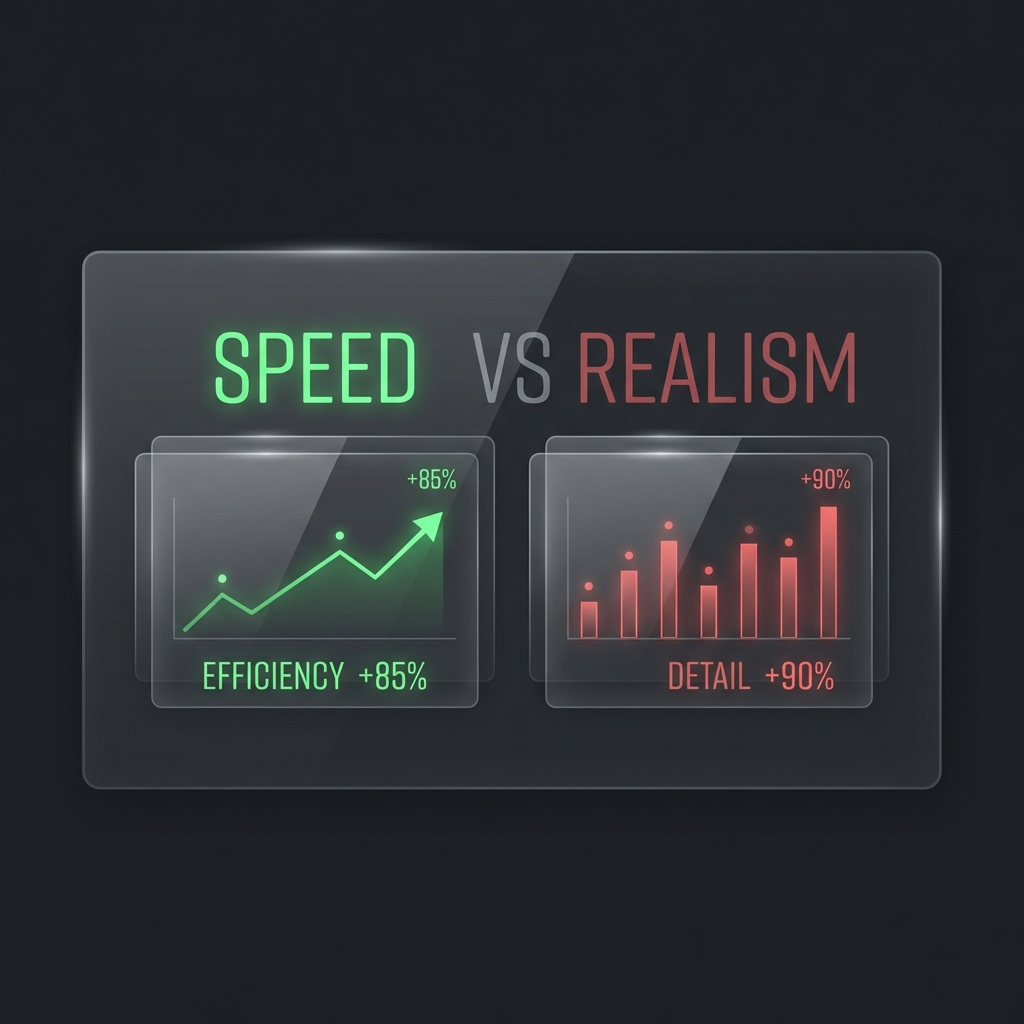
In our testing, Soprano lived up to the hype on the speed front. Generating 25 seconds of complex audio took less than 6 seconds on a standard consumer-grade virtual machine.
| Metric | Soprano 1.1-80M | Typical Diffusion TTS |
|---|---|---|
| Parameters | 80 Million | 500M – 2B+ |
| GPU Speed | 2000x Real-time | 10x – 50x Real-time |
| VRAM/RAM | < 1 GB | 4 GB – 12 GB |
| Latency | 15ms – 50ms | 500ms – 2s |
| Audio Quality | 32 kHz | 24 – 44.1 kHz |
But is it “Realistic”?
Here’s the direct take: Soprano is built for speed. While it delivers crystal-clear audio, it currently lacks the deep emotional expressions found in much larger models. It stumbles occasionally on uncommon words and is currently limited to English.
However, for a model this small, the “realism” is surprisingly adequate for most tasks. In a philosophical test run—reading a text about “collecting moments, not possessions”—the model actually attempted some subtle prosody shifts. It didn’t sound like a robot; it sounded like an efficient, clear-voiced narrator. This efficiency is exactly what is driving the Intelligence Explosion—where optimizing the fundamental kernels of AI interaction leads to compounded gains across the entire ecosystem.
What This Means For You

If you’re a developer, Soprano is a gift. It allows you to build voice-enabled applications that don’t depend on a $20-a-month API subscription or a beefy H100 GPU.
For Mobile Developers: An 80M model is perfectly sized for mobile deployment. You can now have offline, high-quality TTS on a smartphone.
For Local AI Enthusiasts: This is another pillar in the “fully private” stack. Combined with tools like PikePDF and Ollama for processing documents, you can now have your private papers read back to you without a single byte leaving your machine.
For Agent Architects: It solves the latency bottleneck in the “Listen-Thinking-Speaking” loop. We recently discussed how NVIDIA’s Tool Orchestra serves as a blueprint for agent swarms; adding Soprano to that mix means those agents can communicate audibly with zero lag.
The Bottom Line
Soprano 1.1-80M isn’t trying to out-perform ElevenLabs in a voice-acting competition. It’s trying to make local, real-time TTS a utility rather than a luxury. By optimizing for CPU speed and memory efficiency, it brings high-quality voice synthesis to the masses. It’s fast, it’s light, and most importantly, it’s local.
FAQ
Does Soprano support voice cloning?
Currently, Soprano 1.1-80M does not support zero-shot voice cloning. It is trained on a fixed 1,000-hour English dataset to maximize stability and speed.
Can I run this on a Raspberry Pi or a phone?
With less than 1 GB of memory required, Soprano is a prime candidate for edge devices like the Raspberry Pi 5 or modern smartphones, though you’ll need to check the OS compatibility for specific libraries.
How do I fix the generation_config.json error?
If you encounter this error, simply find the generation_config.json in your model’s cache folder and add the missing generation parameters (temperature, top_p, etc.) manually or via a script.