

Today, Sarvam AI announced “Sarvam Akshar.” No benchmarks. No architecture details. No demos. Just a single line on their website: “Introducing Sarvam Akshar.”
That’s it. That’s the whole announcement. After ten months with government GPUs, $41 million in funding, and a mandate to build “India’s sovereign LLM,” we get a webpage.
So here’s the question nobody’s asking: Is this innovation or just sophisticated vaporware?
The$41 Million Question
Sarvam AI raised $41 million in Series A funding from Lightspeed, Peak XV, and Khosla Ventures in December 2023. Big names. Real money. In April 2025, India’s IT Minister selected them to build the country’s first sovereign LLM under the IndiaAI Mission, with access to 4,000 GPUs for six months. That was ten months ago.
So where’s the model? Not a press release. A model. Something you can test. Compare. Break. Run locally. The kind of thing DeepSeek R1 gave us—full weights, Apache 2.0 license, reproducible benchmarks. Or what MiniMax M2.5 delivered—80.2% on SWE-bench Verified, one-shot app generation, $1.20/1M tokens.
Sarvam Akshar? A webpage. And honestly? That should make you suspicious.
The Sarvam-M Disaster: A Cautionary Tale
Let’s rewind to May 2025. Sarvam AI unveiled Sarvam-M, their “24-billion-parameter multilingual LLM for Indian languages.” The headlines were optimistic. The reality was brutal.
The Numbers Don’t Lie:
- 334 downloads on Hugging Face in the first two days
- 23 downloads according to some reports
- Compare that to a Korean open-source model by college students: 10,000+ downloads in the same timeframe
Investor Deedy Das of Menlo Ventures didn’t mince words. He publicly called the launch “embarrassing.” His critique: “No one is asking for a slightly better 24B Indic model.” Especially when Google and TWO.ai already offer cost-effective models proficient in Indian languages.
But here’s the kicker: Sarvam-M isn’t even a new model. It’s Mistral Small—a French open-source LLM—fine-tuned for Indian languages. Sarvam AI didn’t build it from scratch. They wrapped someone else’s work.
Is that sovereign AI?
What Exactly IS Sarvam Akshar?
According to Wikipedia (citing official sources), Sarvam Akshar is a large language model with “capabilities in reasoning, voice, and fluency across various Indian languages.”
That’s it. That’s all we know.
No parameter count. No training dataset. No benchmark scores. No research paper. No GitHub repo. No API access. Not even a screenshot of the model in action.
For context, when GLM-5 launched, we got:
- 744B parameters (32B active MoE)
- 1M token context window
- 95.7% on AIME 2025
- 73.8% on SWE-Bench Verified
- Full technical paper
- Open weights
When Claude Opus 4.6 dropped, we got:
- 1M token context window
- 74.4% on SWE-Bench
- Terminal-Bench 2.0 scores
- API access immediately
- Developer community exploding with use cases
Sarvam Akshar? A one-line announcement. Ten months after getting government GPUs.
The Pattern: Overpromise, Underdeliver
Let’s map Sarvam AI’s track record:
| Announcement | Date | Promise | Delivery |
|---|---|---|---|
| Sarvam-M | May 2025 | “Sovereign LLM for India” | Fine-tuned Mistral Small, 334 downloads, investor-criticized |
| Sarvam Vision | Feb 2026 | “Beats ChatGPT & Gemini” | 84.3% olmOCR (Indian media only, no official benchmark release) |
| Sarvam Akshar | Feb 15, 2026 | “Reasoning, voice, fluency” | Zero technical details, no benchmarks, no demo |
Notice the trend?
Sarvam Vision’s benchmarks—84.3% on olmOCR-Bench and 93.28% on OmniDocBench v1.5—are only cited by Indian media outlets. I couldn’t find an official benchmark release, independent verification, or GitHub repo. Compare that to how Anthropic publishes Claude benchmarks with full methodology and reproducible tests.
When a company claims to beat ChatGPT and Gemini but doesn’t release the model or publish the methodology, what are we supposed to believe?
The Wrapper Playbook
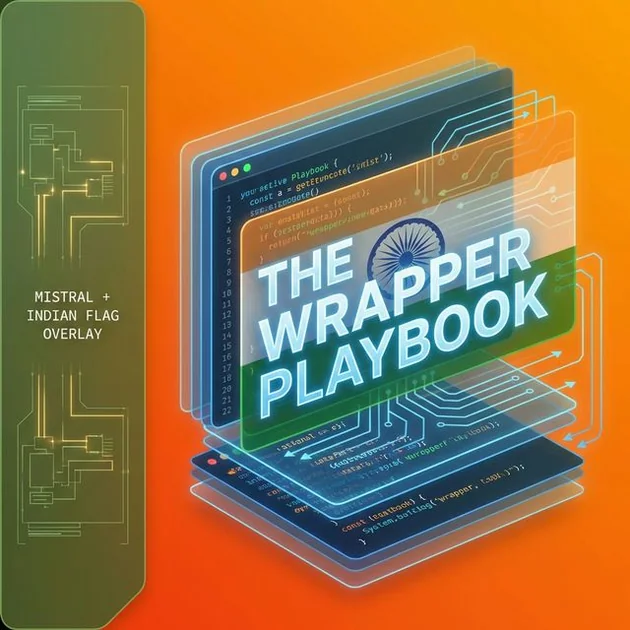
Here’s how you build a “sovereign AI” without building anything:
- Fine-tune an existing open-source model (Mistral, Llama, Qwen)
- Train on Indian language datasets (legitimate but not novel)
- Market it as “India-first sovereign AI”
- Announce with vague capabilities, no benchmarks
- Repeat
This isn’t innovation. It’s iteration. And there’s nothing wrong with iteration—if you’re honest about it.
DeepSeek fine-tuned Llama for reasoning and was transparent about it. Step 3.5 Flash built on MoE principles but published everything. Kimi K2.5 used agent swarms but gave us the architecture.
Sarvam? Crickets.
How Real AI Companies Prove Their Work
Want to see what transparency looks like? Let’s compare Sarvam to how Chinese AI labs operate.
DeepSeek: The Gold Standard
When DeepSeek launched DeepSeek-R1, here’s what they gave us:
Research Papers on ArXiv:
- “DeepSeek-V3 Technical Report” (arXiv:2412.19437) – Full architecture with 671B parameters
- “DeepSeek-R1: Incentivizing Reasoning Capability in LLMs via Reinforcement Learning” (arXiv:2501.12948) – Complete RL methodology
- “DeepSeek-V3.2: Pushing the Frontier of Open Large Language Models” (arXiv:2512.02556) – Scalable RL framework details
GitHub:
- Multiple public repositories with model weights
- DeepSeek-V3 Public, DeepSeek-R1 Public, DeepSeek-VL2 Public
- Distilled smaller models open-sourced
Licensing:
- MIT License for commercial use
- Full model checkpoints available
- Reproducible benchmarks
GLM-5: China’s Sovereign AI (Done Right)
Zhipu AI released GLM-5 on February 11, 2026. Here’s their transparency:
Technical Details:
- 744B total parameters, 44B active (MoE architecture)
- 28.5 trillion training tokens
- 200,000 token context window
- Trained on domestic Huawei Ascend chips
Open-Source:
- MIT License
- Full technical report published
- 77.8% on SWE-Bench Verified (reproducible)
- GitHub release with weights
Community:
- Immediate dev adoption
- Independent benchmark verification
- Reddit, Twitter discussions exploded
What About Sarvam?
I searched ArXiv for “Sarvam AI” research papers. Zero results.
What they DO have:
- Sarvam-M: A blog post titled “Sarvam-M: Open Source Hybrid Indic LLM” on sarvam.ai (not a peer-reviewed paper)
- API Documentation: Usage guides for developers (not technical specs)
- GitHub: A “cookbook” repo with API usage examples (not model weights)
No arXiv papers. No technical reports. No reproducible methodology.
| Company | ArXiv Papers | GitHub Model Weights | Open License | Reproducible Benchmarks |
|---|---|---|---|---|
| DeepSeek | 3+ papers | ✅ Multiple repos | MIT License | ✅ Full methodology |
| GLM-5 | Full technical report | ✅ Open weights | MIT License | ✅ Independent verified |
| Sarvam AI | ❌ Zero | ❌ Only API examples | ❌ Proprietary | ❌ Media citations only |
This is the difference between sovereign AI and sovereign marketing.
The Tough Questions

Here’s what Sarvam AI needs to answer:
1. Is Sarvam Akshar a from-scratch model or another fine-tuned wrapper?
If it’s built on an existing foundation (Llama, Mistral, Qwen), just say so. Transparency builds trust. Vagueness breeds skepticism.
2. What are the benchmark scores?
Not “reasoning, voice, fluency.” Give us numbers:
- GPQA Diamond (reasoning)
- SWE-Bench Verified (coding)
- AIME 2025 (math)
- MMLU (general knowledge)
- India-specific benchmarks with published methodology
Without benchmarks, this is marketing, not engineering.
3. Where’s the research paper?
I searched ArXiv for “Sarvam AI” papers. Zero found.
DeepSeek published 3 ArXiv papers for DeepSeek-R1 alone. GLM-5 has a full technical report with MIT license. Qwen published everything. Even Mistral (whose model Sarvam wrapped) publishes technical documentation.
Sarvam? A blog post. Research papers aren’t optional for “sovereign AI.” They’re how you prove you did the work.
4. Why no developer community?
I searched Reddit, Twitter (X), and Hacker News. Zero mentions of Sarvam Akshar. Compare that to the explosion around Canvas-of-Thought or Gemini 3 Flash launches.
If developers aren’t excited, that’s a red flag.
5. What happened to the IndiaAI Mission timeline?
April 2025: Selected to build India’s sovereign LLM with 6 months of GPU access (4,000 H100s).
February 2026: Announce a model with zero details.
That’s 10 months. With government GPUs. And we get a webpage?
6. What’s the moat?
Sovereign AI needs a technical moat. DeepSeek has inference optimization. Anthropic has Constitutional AI. Google has multimodal fusion. What does Sarvam have besides Indian language data?
Fine-tuning on regional datasets is valuable. But it’s not a $500M moat. It’s a $5M feature.
The Only Thing Sarvam Has Proven
Sarvam Vision’s OCR benchmarks are impressive if true:
- 84.3% on olmOCR-Bench (beats Gemini 3 Pro at 80.20% and GPT-5.2 at 69.80%)
- 93.28% on OmniDocBench v1.5
- Specialized for Indian languages and complex document layouts
But here’s the problem: I can’t verify these claims. There’s no official benchmark release. No GitHub repo. No reproducible tests. Just Indian media citations.
Compare that to how AirLLM’s performance was validated—community tested it, benchmarked it, complained about the 35-100 second token latency. That’s transparency. That builds credibility.
Sarvam? Still waiting.
What This Means for India’s AI Ambitions
India deserves a sovereign AI ecosystem. Real sovereignty means:
- Control over training data and compute
- Data residency within Indian infrastructure
- Linguistic coverage for 22 official languages
- Cost-effectiveness for 1.4 billion people
- Technical innovation, not just fine-tuning
If Sarvam AI is building this, great. Show us.
But if they’re wrapping Mistral and slapping “Sovereign AI” on top, that’s not sovereignty. That’s dependency with extra steps.
China built GLM-5 (744B parameters, Apache 2.0). They published everything. They competed with GPT-5 on reasoning benchmarks. That’s sovereign AI.
Sarvam? We’re still waiting for a parameter count.
The Bottom Line
I want Sarvam AI to succeed. India needs indigenous AI platforms. Competition drives innovation. Regional focus matters.
But here’s the thing: vaporware wrapped in nationalism isn’t sovereign AI.
Sarvam Akshar was announced today with zero technical details. No benchmarks. No demos. No community reception. Just a press release 10 months after getting government compute.
Their last model (Sarvam-M) got 334 downloads and was publicly called “embarrassing” by a major investor. It was a fine-tuned Mistral wrapper, not a from-scratch LLM.
So here’s my question for Sarvam AI: Prove me wrong.
Release the benchmarks. Publish the architecture. Open-source the weights. Let the developer community test it. Show us this isn’t just another wrapper with a flag.
Until then, I’m calling it: Sarvam Akshar is vaporware until proven otherwise.
FAQ
What is Sarvam Akshar?
According to Sarvam AI’s announcement on February 15, 2026, Sarvam Akshar is a large language model with “capabilities in reasoning, voice, and fluency across various Indian languages.” No technical specifications, benchmarks, or demos have been released.
Is Sarvam Akshar a from-scratch model or fine-tuned?
Unknown. Sarvam AI has not disclosed the architecture. Their previous model, Sarvam-M, was a fine-tuned version of Mistral Small, leading to speculation that Sarvam Akshar may also be based on an existing foundation model.
What are Sarvam Akshar’s benchmark scores?
None have been published. Compare this to competitors like Claude Opus 4.6 (74.4% SWE-Bench), GLM-5 (95.7% AIME 2025), and MiniMax M2.5 (80.2% SWE-Bench Verified).
Why was Sarvam-M criticized?
Sarvam-M, announced in May 2025, garnered only 334 downloads on Hugging Face in two days. Investor Deedy Das called it “embarrassing,” and critics noted it was a fine-tuned Mistral Small rather than an original model.
Can I test Sarvam Akshar?
No. There is no API access, GitHub repo, or demo available as of February 15, 2026.
How is Sarvam AI funded?
Sarvam AI raised $41 million in Series A funding from Lightspeed Venture Partners, Peak XV Partners, and Khosla Ventures in December 2023. In April 2025, they were selected for the IndiaAI Mission with access to 4,000 GPUs.
Is Sarvam Vision legitimate?
Sarvam Vision’s claimed benchmarks (84.3% olmOCR, 93.28% OmniDocBench v1.5) are widely reported in Indian media but lack official benchmark releases or independent verification. The model’s specialization in Indian language OCR appears genuine, but transparency is limited.
Has Sarvam published any research papers?
No. A search of ArXiv for “Sarvam AI” returns zero results. Sarvam-M has a blog post on sarvam.ai describing it as a fine-tuned Mistral Small, but this is not a peer-reviewed research paper. Compare this to DeepSeek (3+ ArXiv papers), GLM-5 (full technical report + MIT license), and other Chinese labs that publish comprehensive documentation.
What’s the difference between sovereign AI and fine-tuned models?
Sovereign AI implies building foundational models from scratch with indigenous compute, data, and research. Fine-tuning existing models (like Mistral or Llama) for regional languages is valuable but doesn’t achieve full technological sovereignty.