

Recursive language models aren’t just another incremental improvement. They’re a fundamental shift in how AI systems process information and solve problems.
While traditional language models generate text in a single forward pass, recursive models loop back on their own outputs, refining their thinking with each iteration. It’s the difference between writing an essay in one draft versus iterating through multiple revisions—and what caught my eye is how this simple architectural change unlocks reasoning capabilities that were previously out of reach.
What we’re witnessing is AI learning to think more like humans do: not in straight lines, but in iterative loops of hypothesizing, testing, and refining. And this connects directly to the broader Recursive Self-Improvement (RSI) movement we’ve been tracking.
A specific breakthrough known as “Context Folding” just emerged in January 2026, giving this theoretical framework a concrete architectural blueprint.
What Are Recursive Language Models?
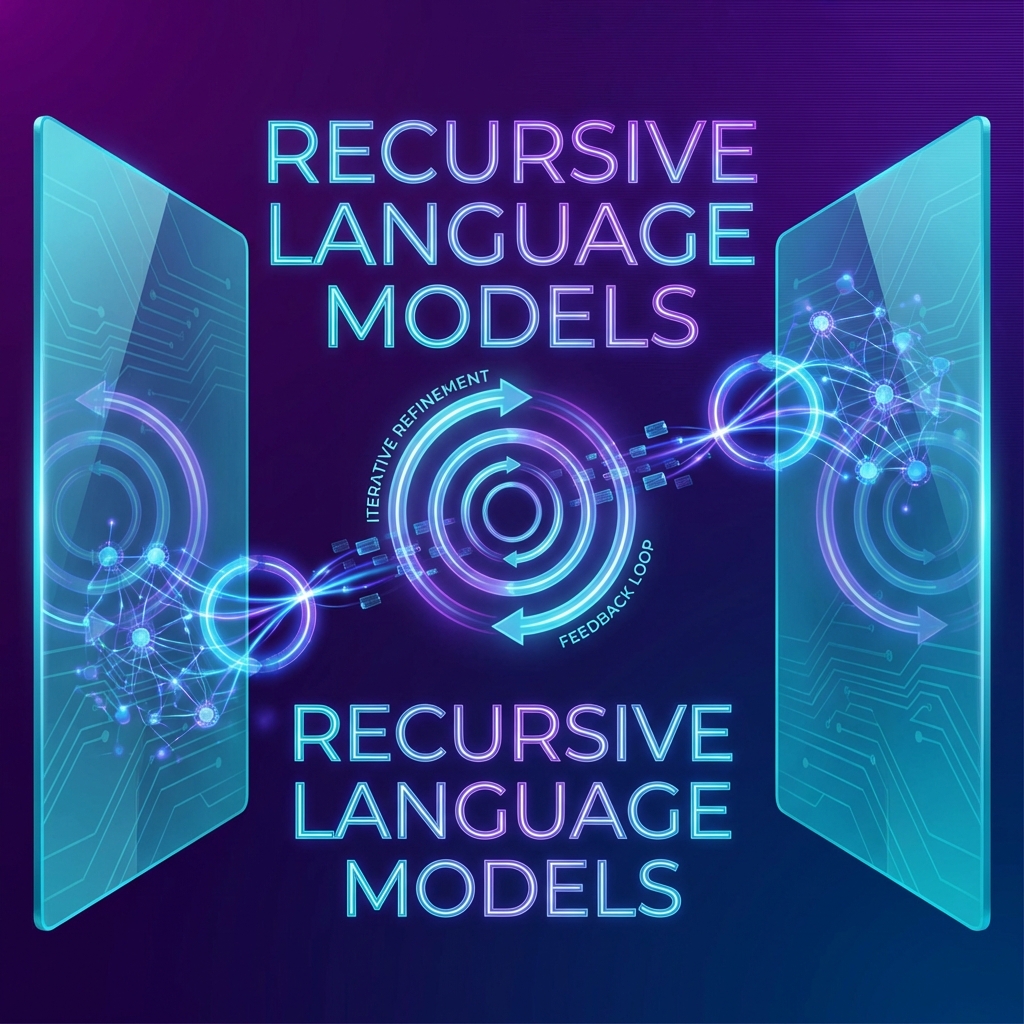
Recursive Language Models (RLMs) are neural architectures that process information through explicit iterative loops rather than single-pass inference. Instead of generating an answer immediately, they generate intermediate reasoning steps, evaluate them, and feed those evaluations back into the model for refinement.
The Core Mechanism
Think of it as a loop:
1. Initial Generation: Model produces a first-pass answer or reasoning chain
2. Self-Evaluation: Model critiques its own output, identifying weaknesses
3. Refinement: Model regenerates the answer incorporating the critique
4. Repeat: Process continues until convergence or max iterations reached
This is fundamentally different from chain-of-thought prompting. CoT is about explicitly showing the steps. Recursion is about iteratively improving the steps.
Why It Works
The secret lies in the separation of concerns. Traditional LLMs try to do everything in one shot: understand the question, generate reasoning, produce an answer, and verify correctness—all simultaneously. Recursive models break this into discrete phases:
- Generation Phase: Focus purely on producing candidate solutions
- Verification Phase: Focus purely on evaluating quality
- Integration Phase: Combine insights from both for the next iteration
Cognitive scientists call this “System 2 thinking”—the slow, deliberate reasoning humans use for complex problems. And we’re now seeing AI architectures that mirror this structure.
The January 2026 Breakthrough: Context Folding
While recursive looping has been theoretical for months, January 2026 marked the formal introduction of the Recursive Language Model (RLM) paradigm, distinct fromsimple prompting tricks.
The key innovation is Context Folding (often paired with “Agentic Context Engineering”).
In standard LLMs, the context window grows linearly with every token generated. In a recursive loop, this would quickly explode memory usage. Context Folding solves this by actively compressing the “state” of the reasoning process.
- How it works: Instead of keeping the entire chat history of the reasoning loop, the model “folds” previous iterations into a dense vector representation or a concise summary token.
- The specific improvement: This allows the model to run 50+ iterations of self-improvement for a single query without hitting context window limits (a major bottleneck in 2025).
- The result: “Infinite-context” agentic behavior where the model essentially manages its own short-term memory, discarding noise and keeping only the verified reasoning steps.
Under the Hood: The “Folding” Mechanism
You wanted the technical details? Here is exactly how the architecture handles this compression. It’s not just summarization; it’s Latent State Compression.
1. Differentiable Folding Operation: The model doesn’t just “read” past text. A specialized Encoder Head projects the previous N iterations’ token embeddings into a lower-dimensional latent space (often 512d or 1024d vectors).
2. Learnable Memory Tokens: These compressed vectors are injected back into the input sequence as special [MEM] tokens. The model treats these tokens as “soft prompts” that contain the semantic essence of the reasoning history without the token overhead.
3. Selective KV Cache Eviction: This is the real game-changer for speed. “Agentic Context Engineering” allows the model to output explicit control tokens (e.g.,
4. Gradient Checkpointing Integration: For training these architectures, teams are using selective gradient checkpointing across the fold boundaries, allowing backpropagation through the compression step without exploding VRAM usage.
This is effectively a Recurrent Neural Network (RNN) rolled inside a Transformer—combining the infinite memory potential of RNNs with the parallel processing power of Transformers.
The Technical Architecture Behind RLMs
Let me get into the nuts and bolts, because the implementation details matter.
Unrolled Computation Graphs
RLMs use unrolled computation graphs where the same base model is applied multiple times sequentially. Each “unrolling” represents one iteration of the recursive loop. During training, these graphs can extend for 3-10+ iterations depending on task complexity.
Key Innovation: The model learns when to stop. Through techniques like learned termination signals or confidence thresholds, RLMs develop an internal sense of “this answer is good enough” versus “I need to iterate further.”
Memory-Augmented Reasoning
Modern RLMs often incorporate external memory mechanisms. In each iteration, the model can:
- Write intermediate results to a scratchpad
- Read from previous iterations’ outputs
- Maintain a working memory of attempted approaches
This is similar to how LangChain Polly’s automated prompt engineering works—maintaining state across multiple reasoning steps.
Gradient Flow Challenges
One technical hurdle: gradients must flow backward through multiple iterations during training. This creates a depth problem similar to very deep neural networks. Solutions include:
- Truncated Backpropagation: Only backprop through the last N iterations
- Synthetic Gradients: Predict what gradients should be for earlier layers
- Evolutionary Methods: Some teams are using genetic algorithms instead of gradient descent entirely
Where RLMs Excel (And Where They Don’t)

The Sweet Spot: Complex Reasoning Tasks
Recursive models absolutely shine on tasks requiring multi-step logical reasoning:
Mathematics: RLMs can solve complex proofs by iteratively refining their approach. This connects to AI’s recent breakthrough in solving Erdős Problem #397—while that used a hybrid system, the recursive refinement principle was central.
Code Generation: Writing software requires iterative debugging. An RLM can generate code, simulate execution, identify bugs, and regenerate—all within the model’s reasoning loop. This is why we’re seeing integration into advanced coding tools.
Strategic Planning: Multi-step games like chess or Go benefit from “thinking ahead, revising strategy, thinking again”—exactly what RLMs are built for.
The Limitations
But here’s what nobody’s talking about: RLMs are computationally expensive. Each iteration requires a full model forward pass. A model that iterates 5 times costs 5x the inference compute of a standard LLM.
That means:
- Higher latency for end users
- Significantly more GPU time per query
- Infrastructure costs that scale multiplicatively, not additively
For simple queries (“What’s the capital of France?”), recursion is overkill. The architectural advantage only manifests for tasks where single-pass models struggle.
The Connection to AI Self-Improvement
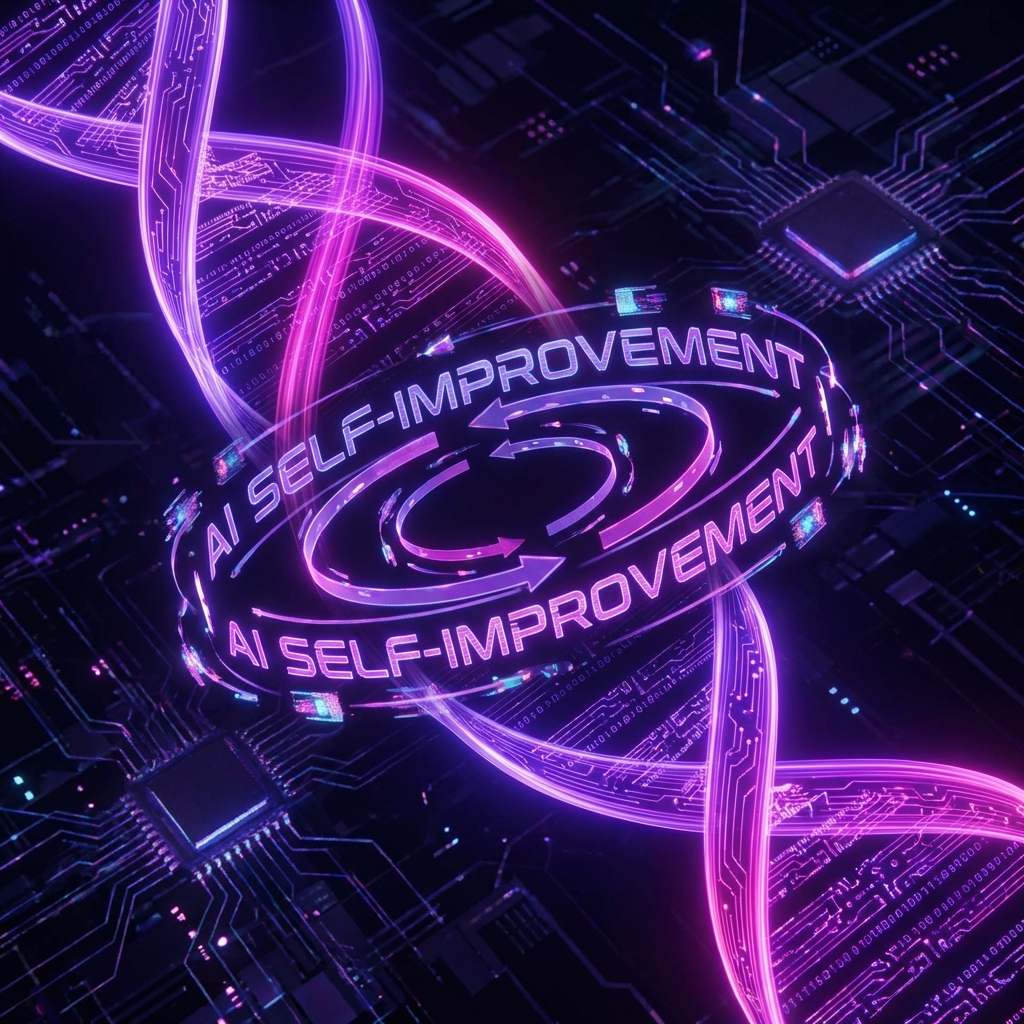
The mainstream narrative focuses on RLMs for better chatbots. The real story is about Recursive Self-Improvement (RSI)—AI systems that improve their own architectures.
Here’s the connection: Recursive language models are learning to iteratively improve their outputs. The next step? Models that iteratively improve their weights.
We’re already seeing hints:
- GLM-4.7 REAP uses recursive pruning to optimize model size
- EvoEngineer writes CUDA kernels that improve AI training efficiency
- Polly automatically refines agent prompts based on trace analysis
The pattern is clear: recursion as a principle is spreading from inference (what RLMs do) to training (what next-gen systems will do).
This transition is being formalized right now at the ICLR 2026 Workshop on AI with Recursive Self-Improvement (submissions opened Jan 1), which has become the de facto launchpad for these “Seed Improver” architectures.
Real-World Implementations
OpenAI’s o3 Model
While OpenAI hasn’t explicitly confirmed o3 uses recursive architectures, the behavioral evidence is compelling. The model exhibits clear iterative refinement characteristics and achieves 97% on complex reasoning benchmarks.
Google’s AlphaProof
AlphaProof, used in mathematical theorem proving, implements explicit recursive verification loops. It generates candidate proofs, verifies them in Lean theorem prover, and recursively refines until formal verification passes.
Anthropic’s Constitutional AI
Claude’s Constitutional AI framework includes recursive self-critique—the model generates responses, evaluates them against ethical guidelines, and regenerates if needed. While not pure RLM, it shares the iterative refinement philosophy.
The Performance Gains (And What They Cost)
Let’s talk numbers. On SWE-bench Verified (a rigorous coding task benchmark), models with recursive refinement show:
- 15-25% accuracy improvement over single-pass baselines
- 3-5x increased inference cost due to multiple iterations
- 2-3x higher latency for end-user queries
For mathematical reasoning (AIME, MATH datasets):
- 30-40% accuracy gains on problems requiring multi-step logic
- 10x cost increase for problems requiring 8+ reasoning iterations
The tradeoff is stark: dramatically better reasoning at dramatically higher compute cost.
What This Means For Developers
If you’re building with LLMs, here’s what to know:
1. Use RLMs selectively: Reserve recursive models for complex tasks where single-pass models fail. For simple queries, stick with standard inference.
2. Set iteration budgets: Implement max iteration limits to prevent runaway costs. Most tasks converge in 3-5 iterations.
3. Monitor termination conditions: Track when models stop iterating and why. This reveals what the model considers “solved.”
4. Hybrid architectures: Use a lightweight model to route queries—simple ones to standard LLMs, complex ones to RLMs. This is exactly what NVIDIA’s Tool Orchestra does with its router model approach.
The Bottom Line
Recursive Language Models represent a fundamental shift from “generate and hope” to “generate, evaluate, refine, repeat.” This architectural change mirrors how humans tackle complex problems, and it’s unlocking AI capabilities that were unreachable with single-pass models.
But we’re not at the “deploy everywhere” stage yet. The compute costs are real, and for most applications, the gains don’t justify the expense. Where RLMs shine—mathematics, code, strategic planning—they’re genuinely transformative. Everywhere else, they’re overkill.
The real question isn’t whether RLMs work (they do). It’s whether the industry is willing to pay 3-5x inference costs for 20-30% accuracy gains. For some applications, absolutely. For others, we’re waiting on hardware to catch up.
What excites me most isn’t RLMs themselves—it’s what they represent. We’re moving from “bigger models” to “smarter architectures.” And that’s a trajectory that’s sustainable long-term.
FAQ
How are Recursive Language Models different from chain-of-thought prompting?
Chain-of-thought prompting asks models to show their reasoning steps explicitly. Recursive Language Models go further—they iterate on those steps, evaluating and refining their reasoning across multiple passes. CoT is about transparency; RLMs are about iterative improvement.
Do RLMs require special training, or can existing models be used recursively?
You can apply recursive loops to existing models (like prompting a model to critique and refine its own outputs), but purpose-built RLMs are trained end-to-end with the recursive structure baked in. This allows them to learn optimal termination conditions and specialized refinement strategies that ad-hoc prompting can’t match.
What’s the relationship between RLMs and Mixture-of-Experts (MoE) models?
They’re orthogonal concepts. MoE is about routing different parts of the input to specialized sub-models (spatial efficiency). RLMs are about iterating on the same computation multiple times (temporal efficiency through refinement). You can combine both—an MoE architecture where each expert operates recursively—though that gets computationally expensive fast.
Will recursive models replace standard LLMs?
Not entirely. The future is likely hybrid: standard LLMs for simple queries (most use cases), RLMs for complex reasoning tasks where accuracy justifies compute costs. We’re already seeing this pattern with models like OpenAI o3 being reserved for specialized applications rather than general chat.
How do RLMs avoid getting stuck in loops?
Learned termination mechanisms. During training, RLMs learn to recognize when additional iterations won’t improve the output quality. This can be explicit (a separate termination classifier) or implicit (confidence thresholds). Most production systems also implement hard iteration caps as a safety mechanism.