
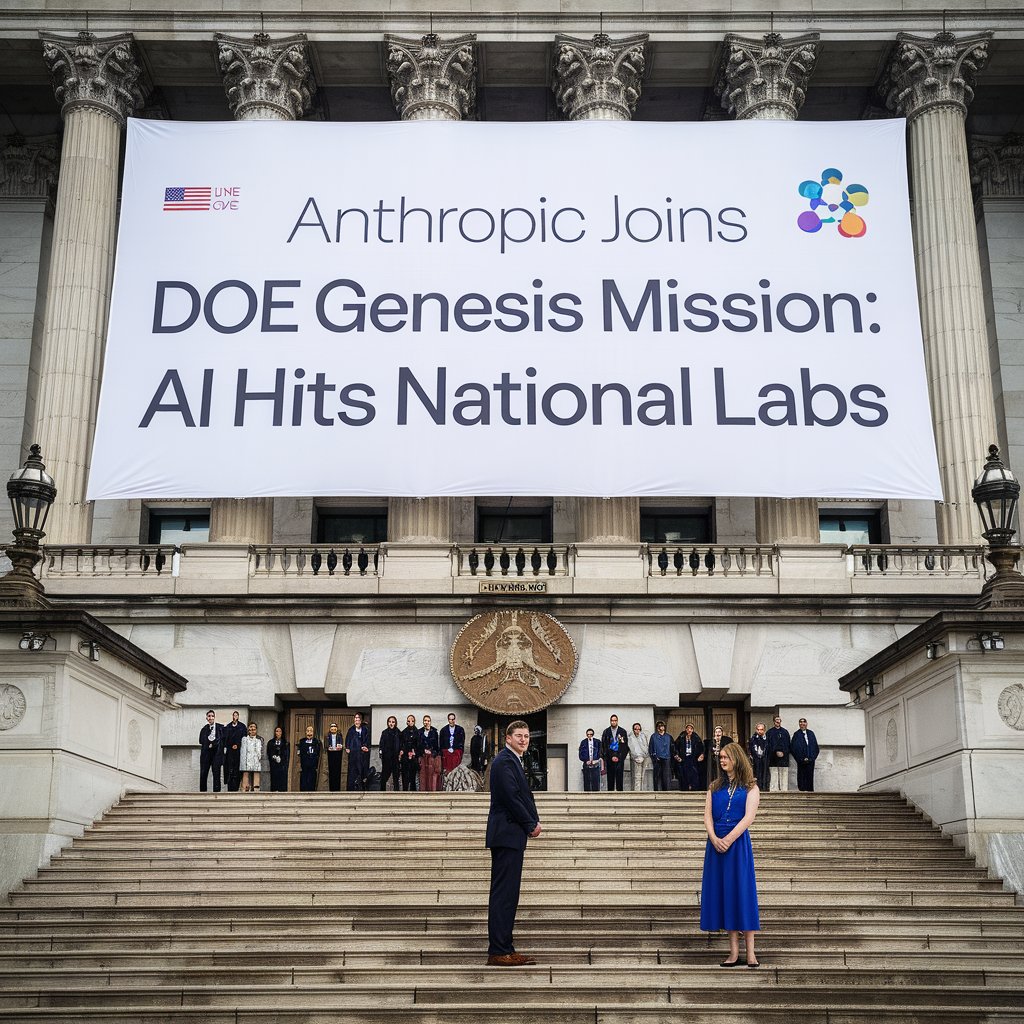

The US government just made its biggest AI bet ever. And Anthropic is right at the center of it.
The Department of Energy announced the Genesis Mission on December 17, 2025, calling it the “largest mobilization of American scientific infrastructure since the Manhattan Project.” That’s not hyperbole. The initiative brings AI directly into 17 national laboratories with 40,000 scientists working on everything from nuclear energy to pandemic prevention.
Anthropic is one of 24 technology partners in this effort, but their role stands out. Claude will be deployed across all 17 labs, with dedicated Anthropic engineers building custom AI tools for research teams. This isn’t a licensing deal—it’s a deep integration.
What the Genesis Mission Actually Is
Genesis is a White House-backed initiative launched via Executive Order on November 24, 2025. The stated goal: build an integrated AI-powered discovery platform connecting DOE’s supercomputers, scientific instruments, and decades of research datasets.
The scope is massive. Three main focus areas:
1. American Energy Dominance
Claude will help accelerate permitting reviews for energy infrastructure expansion and assist with nuclear technology research. The DOE has historically been bottlenecked by paperwork—AI could compress review timelines from months to weeks.
2. Biological Sciences
Drug discovery acceleration and early warning systems for pandemics and biological threats. Given what we just lived through, this one has obvious value.
3. Scientific Productivity
The meta-goal: find patterns in historical data that humans missed. Decades of research papers, experimental results, and failed approaches are sitting in archives. AI can surface connections that no individual scientist could identify.
Why Anthropic? (And Not Just OpenAI)
Here’s what caught my attention: Anthropic already has a track record with the DOE.
They co-developed a nuclear risk classifier with the National Nuclear Security Administration. Claude is already deployed at Lawrence Livermore National Laboratory. This partnership isn’t starting from scratch—it’s expanding an existing relationship.
The Genesis Mission includes 24 technology partners: OpenAI, Google, Microsoft, NVIDIA, and others. But Anthropic’s announcement emphasizes a specific capability mix that suggests they’re the primary model provider for hands-on research work:
| What Anthropic Will Provide |
|---|
| Claude access for all 17 labs |
| Dedicated engineering team |
| Custom AI agents for high-priority challenges |
| Model Context Protocol (MCP) servers connecting Claude to scientific instruments |
| “Claude Skills” for specialized scientific workflows |
That MCP integration is significant. We covered the Agentic AI Alliance last week—MCP is Anthropic’s open standard for connecting AI to external tools. Applying it to scientific instruments means Claude could directly interact with lab equipment, not just analyze data after the fact.
The Bigger Pattern Here
I’ve been tracking the Microsoft-NVIDIA-Anthropic alliance for weeks now. This DOE partnership fits a clear pattern: Anthropic is positioning itself as the enterprise and government AI backbone while OpenAI chases consumer attention.
Consider the timing. OpenAI is dealing with Code Red reorganization, Disney partnerships, and consumer app store launches. Anthropic is quietly locking in multi-year federal contracts with the largest scientific infrastructure in the country.
The Trump AI Executive Order that launched Genesis explicitly prioritizes American AI leadership. Having a US company (Anthropic) rather than Microsoft’s partner (OpenAI, which is essentially a Microsoft subsidiary now) as the primary model provider serves that narrative.
What This Means for AI Research
Don’t underestimate the data access this creates. DOE national labs have:
- Exascale supercomputers (Frontier at Oak Ridge, Aurora at Argonne)
- Massive research datasets spanning physics, chemistry, biology, and materials science
- Unique experimental facilities (particle accelerators, nuclear reactors, biofactories)
Claude will be trained—or at least fine-tuned—on some of the most valuable scientific data in the world. The skills and patterns learned here will eventually flow back into Claude’s general capabilities.
For scientists, this could genuinely accelerate research. The bottleneck in most labs isn’t ideas—it’s execution. Reading the literature, writing grants, analyzing results, debugging experiments. AI assistance for these tasks could free researchers to focus on what humans actually excel at: asking new questions.
Risks and Concerns
Let’s not pretend this is purely uplifting.
Data security: National lab research includes classified and sensitive information. Connecting AI to these systems creates attack surfaces that didn’t exist before.
Vendor lock-in: Once Claude is embedded in research workflows across 17 labs, switching to a different AI provider becomes extremely expensive. Anthropic will have significant leverage in future contract negotiations.
Dual-use concerns: Some of this research has military applications. AI-accelerated nuclear technology research sounds great until you consider proliferation risks.
Anthropic knows this. Their Bloom framework, which we covered today, specifically tests for concerning AI behaviors. Genesis effectively puts that commitment to the test in high-stakes environments.
The Bottom Line
The Genesis Mission represents the largest government investment in AI-powered science to date. Anthropic’s role as a primary technology partner gives them direct access to unprecedented research infrastructure and data.
This is a bet that AI can genuinely accelerate scientific discovery. If it works, the implications for energy policy, healthcare, and American competitiveness are enormous. If it creates security vulnerabilities or locks taxpayer-funded research into proprietary systems, the backlash will be severe.
Either way, the era of AI in government science has officially begun.
FAQ
Is Claude the only AI being used in Genesis?
No. The Mission includes 24 technology partners, including OpenAI, Google, and Microsoft. But Anthropic’s announcement suggests Claude will be the primary model deployed across all 17 national labs for research workflows.
How is this different from DOE’s existing AI efforts?
Previously, individual labs experimented with AI tools independently. Genesis creates a coordinated, government-wide platform with standardized AI integration across all facilities.
Will the research data be used to train Claude?
Anthropic hasn’t explicitly stated this, but it’s reasonable to assume insights from scientific applications will improve Claude’s general capabilities over time. Security classifications would limit what data can be used for training.