

While Google and IBM fight over million-qubit roadmaps, a defense contractor you might not know is quietly building a quantum computer for the battlefield.
On January 23, 2026, ZenaTech revealed details of its proprietary 5-qubit quantum prototype. The goal isn’t to break encryption or simulate caffeine molecules. It’s to optimize flight paths for their ZenaDrone IQ Nano fleet in real-time.
Simple goal. Complex physics.
In a market obsessed with “Artificial General Intelligence,” ZenaTech is betting on something far more specific: Quantum-Enhanced Logistics. And if they pull it off, they won’t just be selling drones to the Pentagon; they’ll be selling the operating system for the next generation of autonomous warfare.
Why 5 Qubits Matter (When Everyone Wants 1,000)

In the quantum race, we’re obsessed with scale. But for tactical defense, specificity wins.
ZenaTech’s play here is vertical integration. By building a purpose-built 5-qubit system, they aren’t trying to be a general-purpose cloud provider like AWS or Azure. They are building a Quantum ASIC for Logistics.
The Problem: Swarm Complexity
Controlling a swarm of 100 autonomous drones (like the IQ Nano) isn’t a bandwidth problem; it’s a combinatorial optimization problem.
Imagine a warehouse with 50 drones. Each drone has a battery level, a payload, a current location, and a target destination. Now add dynamic variables:
- Sudden wind gusts (indoor drafts)
- Moving obstacles (forklifts, people)
- Network latency
- Active RF jamming (in a military context)
This is the “Traveling Salesman Problem” on steroids. As the number of drones ($N$) increases, the computational power required to optimize their paths increases exponentially ($N!$).
Classic GPUs choke on this. They solve it by “brute forcing” possibilities or using heuristic approximations that are “good enough” but computationally expensive. A small quantum processor—even a noisy, intermediate-scale quantum (NISQ) 5-qubit one—can theoretically solve these optimization landscapes faster than a supercomputer by exploiting quantum superposition.
It’s using a sledgehammer to crack a nut, sure. But sometimes the nut is titanium.
The Hardware: ZenaDrone 1000 vs. IQ Nano
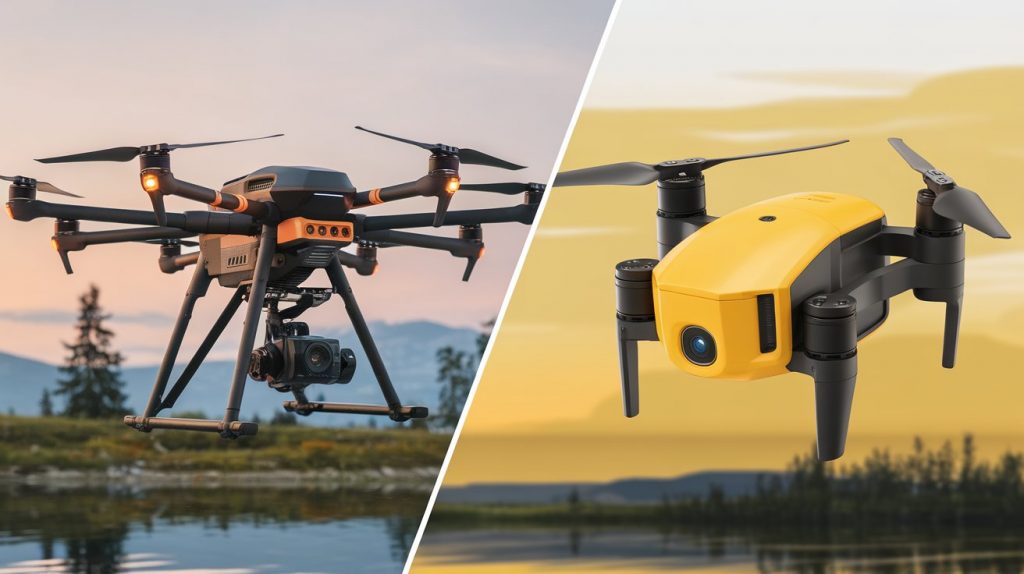
To understand the software, you have to understand the hardware it controls. ZenaTech isn’t a paper tiger; they have metal in the air. Their portfolio is split into two distinct classes, both of which feed into this quantum strategy.
1. ZenaDrone 1000: The Heavy Lifter
This is the flagship. The ZenaDrone 1000 is an octaquad (8-rotor) beast designed for the field.
- Payload: Up to 40kg (88 lbs).
- Flight Time: ~60 minutes.
- Mission Profile: Critical cargo delivery, agricultural scanning, and wide-area surveillance.
- VTOL: Vertical Take-Off and Landing capability allows it to operate from Forward Operating Bases (FOBs) without a runway.
In a defense context, the ZenaDrone 1000 is the “truck.” It carries the blood bags, the ammo, or the heavy LIDAR sensors. It needs optimization for endurance and survivability against wind and weather.
2. IQ Nano: The Indoor Infiltrator
This is where the quantum optimization likely shines first. The IQ Nano is a 10×10-inch, 1.5kg tactical drone designed for GPS-denied environments.
- Mission Profile: Indoor inventory, bunker clearing, tunnel reconnaissance.
- Navigation: Proprietary indoor GPS (non-satellite based) and LIDAR-based obstacle avoidance.
- Structure: Carbon fiber cage for impact resistance.
The IQ Nano is designed to operate in swarms. In a massive logistics warehouse or a subterranean complex, you might have dozens of these operating simultaneously. Optimizing their traffic flow to prevent collisions while maximizing coverage is exactly the type of problem a 5-qubit annealer excels at.
The “Blue UAS” Moat
Technology is only half the battle. In the defense sector, procurement is the other half.
ZenaTech is aggressively pursuing Blue UAS certification. For those outside the “beltway,” Blue UAS is the Pentagon’s gold standard. It’s a list of pre-approved, NDAA-compliant drones that have been vetted for cybersecurity and supply chain safety (read: no Chinese chips).
But the landscape shifted in July 2025. Secretary of Defense Pete Hegseth issued a directive loosening requirements for “Group 1-2 expendable assets,” allowing field commanders to buy non-Blue UAS drones for testing.
This is a double-edged sword for ZenaTech:
- The Pro: It allows them to sell the ZenaDrone 1000 immediately to commanders with discretionary budgets, bypassing years of red tape.
- The Con: It opens the door to cheaper competitors who haven’t done the rigorous supply chain vetting.
However, ZenaTech’s pivot to Quantum Security is the ultimate moat. Even if a cheaper drone can fly, can it communicate via Quantum Key Distribution (QKD)?
ZenaTech’s quantum roadmap includes using their proprietary hardware not just for optimization, but for encryption. In an era where “Harvest Now, Decrypt Later” is a standard adversarial strategy, a drone fleet that generates its own quantum keys is infinitely more valuable than a generic DJI clone.
The “Embedded Quantum” Thesis
ZenaTech CEO Shaun Passley is betting on a future where quantum computers aren’t just in the cloud—they are at the edge.
> “We aren’t building a science experiment. We are building a guidance system.”
This aligns with a broader trend we’ve tracked at AI505: the Decentralization of Intelligence. Just as we see LLMs moving from the cloud to local devices (like GLM-4.7 REAP), compute—even quantum compute—is moving closer to the data source.
If ZenaTech succeeds, the architecture of a drone swarm changes.
Today: Drones send data to the cloud → Cloud optimizes path → Cloud sends commands back. (High latency, vulnerable to jamming).
Tomorrow: Drones send data to a local ground control station with a 5-qubit chip → Station optimizes locally → Commands sent instantly. (Zero latency, air-gapped).
This is the “Android of War” moment. You don’t need a supercomputer; you need a dedicated chip that does one thing perfectly.
Financial & Strategic Implications
For investors and defense watchers, ZenaTech (NASDAQ: ZENA) represents a high-risk, high-reward play on the convergence of three bubbles: AI, Drones, and Quantum.
The risk is obvious: Building quantum hardware is notoriously difficult. Delays are standard. If their 5-qubit prototype turns out to be a “noisy intermediate-scale” flop, they are left with just a drone company in a crowded market.
But the upside is asymmetric.
If they demonstrate a functional “Quantum Advantage” for swarm logistics—even a 10% efficiency gain—they become an acquisition target for every major prime contractor. Lockheed Martin, Northrop Grumman, and Palantir are all desperate for edge-compute advantages.
Connecting this to the broader landscape:
- Ukraine’s Brave1 Dataroom proved that software defines modern warfare.
- China’s Cognitive AI push is forcing the US to adopt “attritable mass” (swarms).
- ZenaTech is building the nervous system for that mass.
The Bottom Line
ZenaTech is signaling the beginning of “Embedded Quantum.” We are moving away from the era where quantum computers are only massive refrigerators in IBM basements. We are approaching the era where “QPU” (Quantum Processing Unit) becomes just another spec sheet line item for defense hardware.
If ZenaTech pulls this off in late 2026, they won’t just be selling drones. They’ll be selling the most efficient swarm logic on the market.