

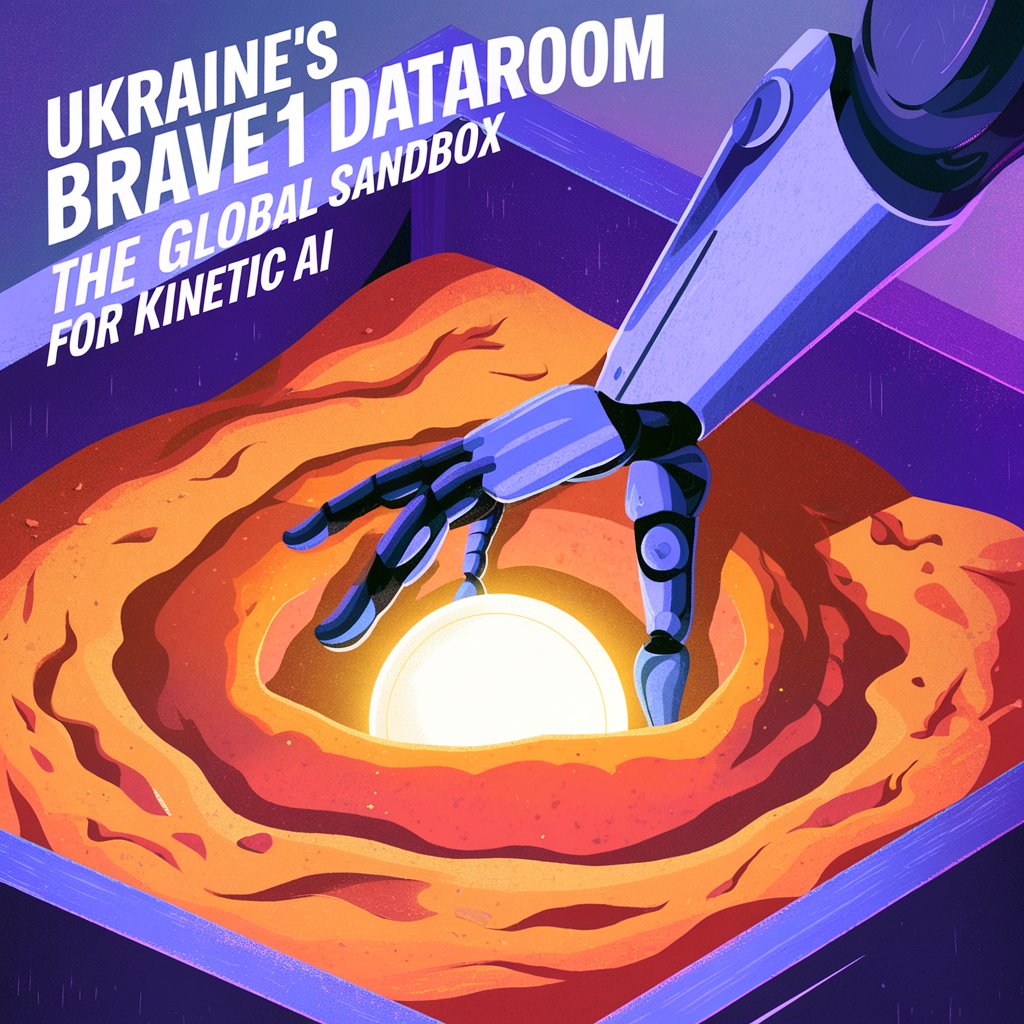

The “laboratory of war” just got an API key. On January 21, Ukraine’s Ministry of Defence officially launched the Brave1 Dataroom, a secure digital environment built on Palantir’s Foundry. The hook? It gives vetted developers access to the most valuable dataset on earth: real, high-fidelity data from the active frontline, starting with the thermal signatures of Shahed drones.
It’s not just a database. It’s a pipeline.
The “Data Famine” is Over (For Some)
For three years, I’ve been saying that the next bottleneck in defense AI isn’t compute—it’s relevant data. You can train a computer vision model on a million stock photos of a DJI drone. It doesn’t matter. It will fail when facing a blackened, diving Shahed-136 in the sleet of a Kharkiv winter.
The Brave1 Dataroom solves this. It isn’t just a shared Google Drive; it’s a classified development sandbox. And frankly, it’s about time.
How It Works
1. The Foundation: Built on Palantir Foundry, utilizing its “decisively unsexy” but critical data lineage and access control features (Gotham-style).
2. The Asset: Access to curated “Shazam for Drones” datasets—visual, acoustic, and thermal signatures of enemy hardware.
3. The Compliance: Developers don’t just get a zip file. They train inside the environment. Palantir’s audit logs track every query, ensuring that sensitive intel stays sensitive.
4. The Output: Models are trained, validated against ground truth, and exported as compact inference weights ready for the edge.
Why This Matters: The DevOps of Destruction

This is the industrialization of “software-defined warfare.”
Until now, getting new tech to the front involved a chaotic mix of flash drives, Signal chats, and ad-hoc testing. Not anymore.
The Dataroom standardizes this chaos. It allows a small startup in Kyiv (or potentially London/DC, if cleared) to benchmark their interception algorithm against actual flight paths from last week’s air raid. Real data. Real constraints. Real validation.
Palantir has even embedded pre-configured notebooks, effectively creating a “Hugging Face for Kinetic Ops.”
The Bottom Line
Ukraine is effectively offering War-as-a-Service (WaaS) to its defense industry. By sanitizing and structuring combat data, they are accelerating the loop between “threat identified” and “patch deployed.”
For the rest of the world, usage of the Dataroom will likely become the gold standard certification. If your counter-drone AI hasn’t been validated in the Brave1 Dataroom, does it even work?