
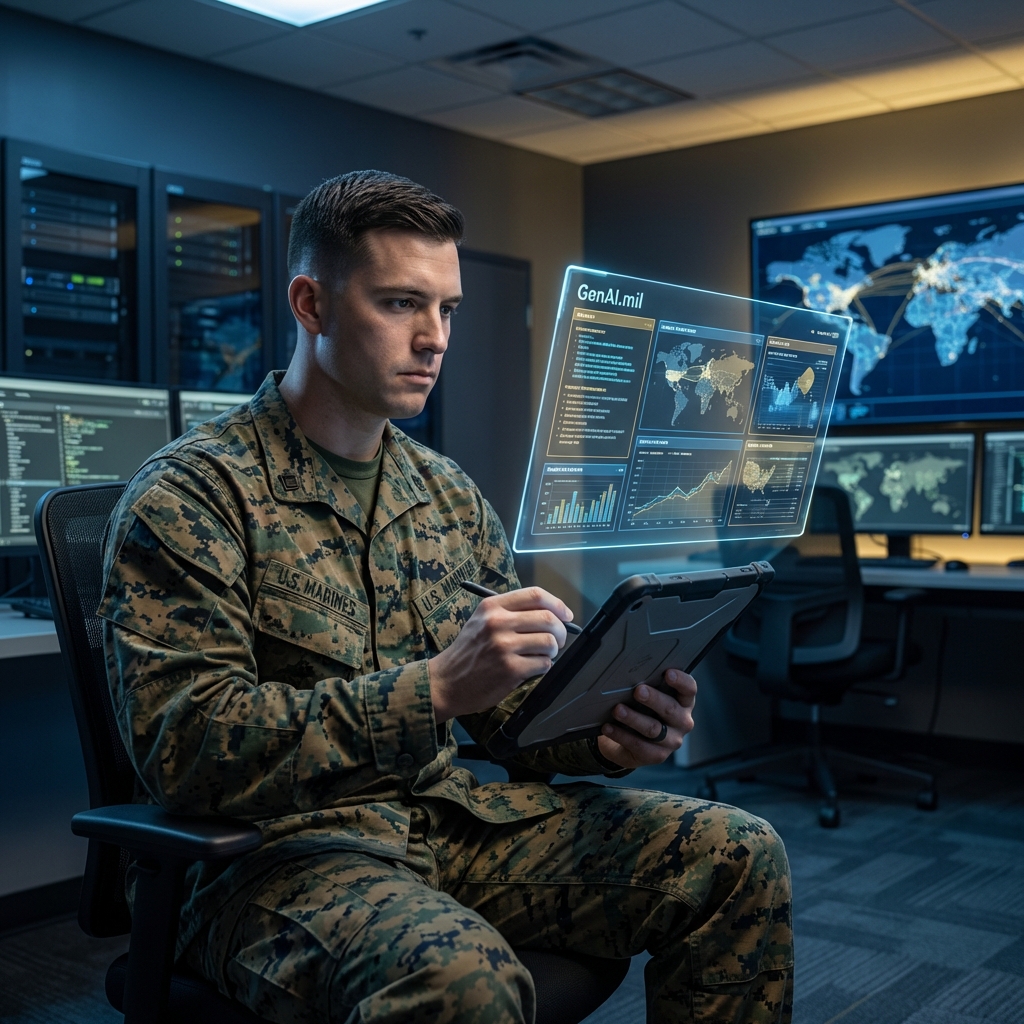

While the Army experiments with distributed agents (see our coverage of AI Flow) and the Air Force sunsets legacy pilots like NIPRGPT, the United States Marine Corps (USMC) has executed a perfect strategic pivot. According to MARADMIN 018/26, released on January 21, 2026, GenAI.mil is now the designated enterprise AI platform for the Corps.
This isn’t a pilot program. It is a “Program of Record” style mandate that standardizes how every Marine—from the rifleman to the logistician—interacts with Large Language Models (LLMs). By centralizing on a single, secure stack, the Corps has effectively killed “Shadow AI” and built the digital foundation for Force Design 2030.
In this technical breakdown, we analyze the $200 million Google contract behind the curtain, the Impact Level 5 (IL5) security architecture, and how this software platform connects to the Project Tripoli live-training environment.
The Policy: Decoding MARADMIN 018/26
The release of MARADMIN 018/26 is a watershed moment. It explicitly supersedes previous guidance (MARADMIN 496/24), moving the Corps from a “cautionary exploration” phase to “enterprise adoption.”
The “Distrust and Verify” Doctrine
The guidance establishes a unique operational doctrine: “Distrust and Verify.” Unlike commercial AI use where hallucination is an annoyance, in a kill chain, it is a liability. The policy mandates that every AI output must be treated as “unverified intelligence” until a human operator confirms it.
This “Human-on-the-Loop” requirement isn’t just bureaucratic cover; it’s a structural necessity for integrating probabilistic models into deterministic military planning.
Authorized Usage
The platform is cleared for:
- NIPRNet Access: It runs on the Non-Secure Internet Protocol Router Network.
- CUI Data: It is authorized to process Controlled Unclassified Information (CUI).
- Prohibitions: It is explicitly NOT cleared for PII (Personally Identifiable Information), PHI (Health Information), or Classified (SIPRNet) data yet.
Technical Architecture: Google Gemini & IL5 Security
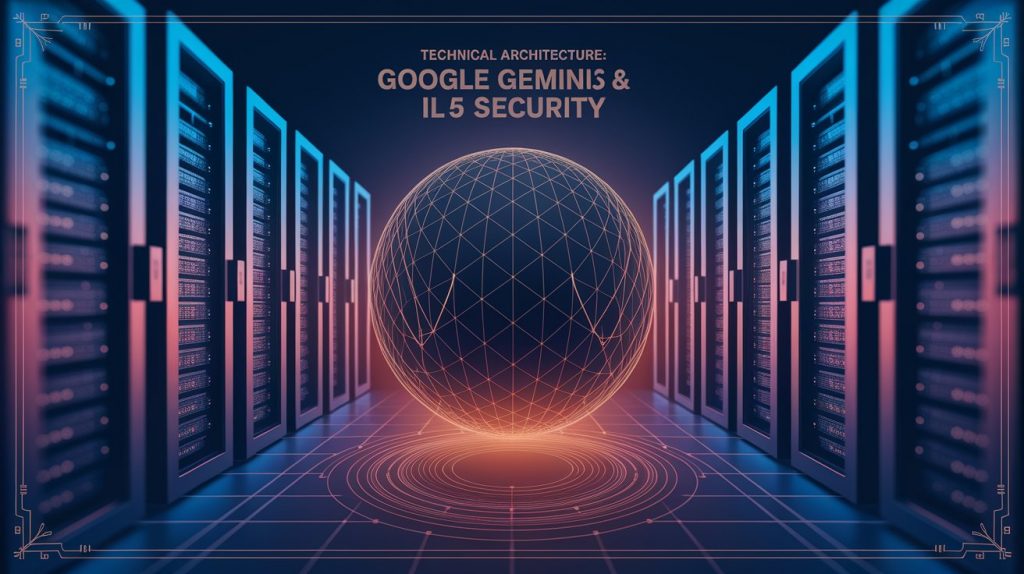
Under the hood, GenAI.mil isn’t a homegrown government model. It is a militarized wrapper around Google Gemini for Government.
The $200 Million Contract
This deployment is powered by a massive deal awarded by the Chief Digital and Artificial Intelligence Office (CDAO). Google Public Sector secured a ceiling of $200 million (part of a broader multi-vendor vehicle including OpenAI and Anthropic) to provide the compute and tokens.
This validates the “Government-as-a-Platform” model. The USMC didn’t try to build its own LLM. It bought the best commercial model (Gemini) and paid for the security wrapper.
Impact Level 5 (IL5) Explained
For civilian developers, “security” means encryption at rest. For the DoD, it means Impact Levels.
GenAI.mil operates at IL5: This means it is physically and logically separated from the public internet. The data governance ensures that USMC queries are not used to train Google’s base model.
The IL6 Roadmap: While currently on NIPRNet (IL5), the architecture is built on Google Distributed Cloud (GDC), which has already achieved IL6 (Secret) accreditation. This suggests a roadmap where GenAI.mil will eventually bridge to SIPRNet, allowing for classified operational planning.
RAG-Native Design
The platform’s primary value isn’t “chatting”; it’s Retrieval Augmented Generation (RAG). Marines can upload PDFs, DOCX files, and maintenance manuals. The system vectorizes this data securely, allowing a Marine to ask, “Based on the uploaded T&R Manual, what are the ammo requirements for a live-fire squad attack?” and get a citation-backed answer in seconds.
Project Tripoli: When Software Meets Simunitions
The launch of GenAI.mil is not an isolated IT event. It is the cognitive layer for Project Tripoli, the Marine Corps’ massive “Live, Virtual, and Constructive” (LVC) training modernization.
Project Tripoli aims to fix a critical breakage: the Corps cannot afford to fire live missiles for every training event.
The “AI Replicant”
Using the reasoning capabilities of GenAI.mil, Project Tripoli introduces “AI Replicants”—virtual entities that exist in the training simulation but behave with human-like tactical cunning.
- Low-Density/High-Demand Assets: A commander can train with a virtual NMESIS (Navy Marine Expeditionary Ship Interdiction System) battery commanded by an AI. The GenAI system handles the comms traffic, fire missions, and logistics reporting for the virtual unit, making it indistinguishable from a human unit on the network.
- Thinking Red Air: Instead of scripted enemy behavior, GenAI agents control virtual enemy drones and loitering munitions, adapting their tactics based on the Marine unit’s movements.
This integration transforms training from “checking the box” to “fighting a thinking enemy.”
Strategic Implications: The “North Star” Workshop
The USMC is moving fast. The Service Data Officer has already scheduled a “Generative and Agentic AI Workshop” for March 9-12, 2026, in Quantico.
The inclusion of the word “Agentic” is the tell. The Corps knows that chatbots are just the interface. The goal is Agents—software that can execute workflows.
- Current State: “Write an operations order for a convoy.” (Generative)
- Future State: “Route this convoy, request the fuel, and updates the maintenance logs.” (Agentic)
This aligns with the Agentic AI Alliance standards, suggesting the DoD is preparing for a world where AI doesn’t just talk, but does.
Why This Wins Wars: The OODA Loop
Col. John Boyd’s famous OODA Loop (Observe, Orient, Decide, Act) is the bible of maneuver warfare. GenAI.mil compresses the first two stages:
1. Observe: It ingests massive amounts of unstructured data (reports, logs, manuals).
2. Orient: It synthesizes that data into a coherent picture for the commander.
In a conflict with a peer adversary (like the scenario described in our China’s Swarm Soldier coverage), the side that can process information faster wins. While China focuses on autonomous execution (deciding and acting), the USMC is using AI to enhance human orientation.
What This Means For You
For Defense Contractors:
Your deliverables just changed. “RAG-Readiness” is the new standard. If your technical manuals aren’t formatted for vectorization by GenAI.mil, you are selling the Corps a broken product.
For Enterprise CIOs:
The USMC’s “Distrust and Verify” governance model is the gold standard for corporate AI. If the Marines—who deal in life and death—can find a way to securely deploy commercial LLMs, your compliance department has no excuse.
For Developers:
The “Google Distributed Cloud” architecture used here is a blueprint for air-gapped deployments. Watch this space for patterns on how to deploy agents in disconnected (DDIL) environments.
The Bottom Line
The Marine Corps is often the “First to Fight,” and with GenAI.mil, they are the “First to Standardize.” By rejecting the chaos of shadow IT and purchasing a hardened, commercial-grade platform, they have leapfrogged the other services.
The question for the Army and Navy is no longer “Should we build our own?” It’s “Why haven’t we adopted the Marine model yet?”
FAQ
Can I run GenAI.mil on my personal device?
No. Access is restricted to government-furnished equipment (GFE) via CAC authentication. This is an air-gapped logical environment, not a web app.
Does it support coding?
Yes, within limits. It can generate code snippets (Python, SQL) to assist data officers, but it cannot directly deploy that code to production systems without human review.
What about secret data?
Currently, GenAI.mil is NIPRNet only (Unclassified). Classified workloads must wait for the SIPRNet integration of the Google Distributed Cloud IL6 environment.