

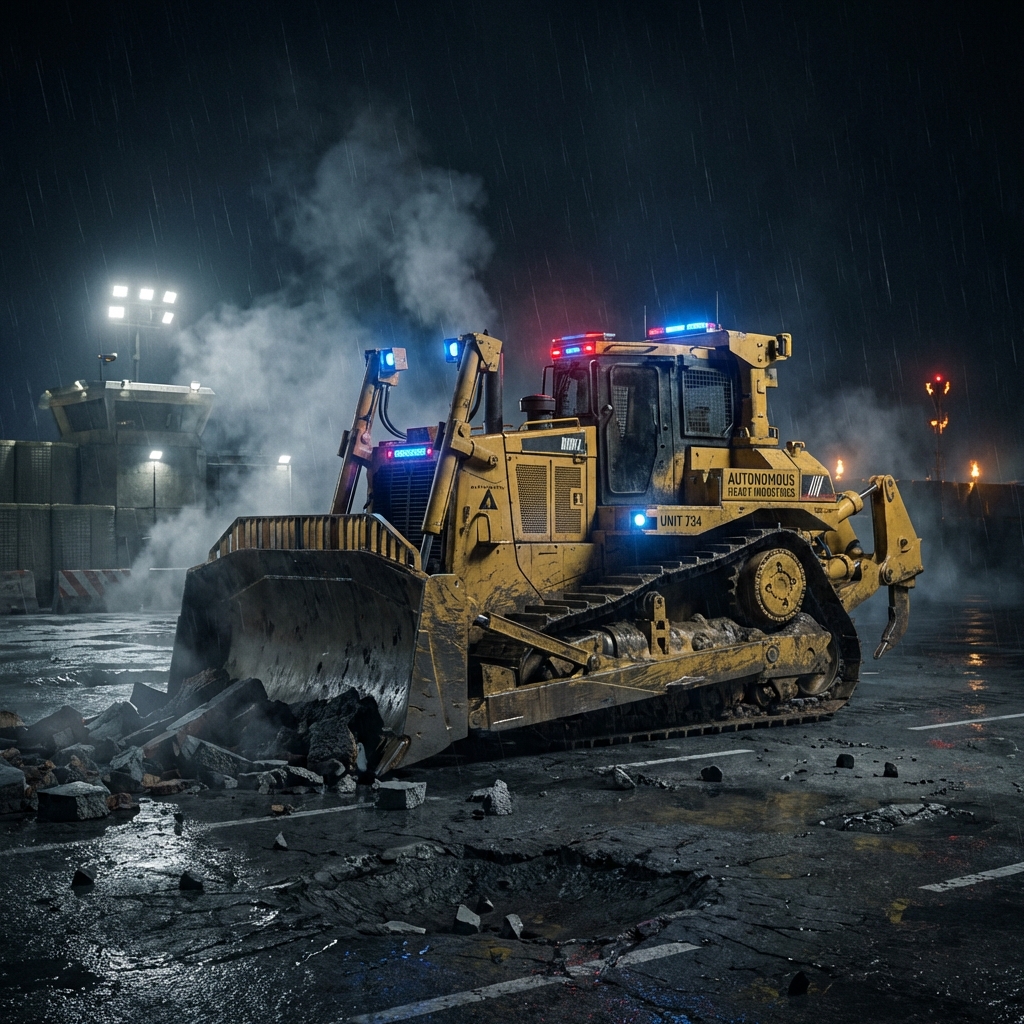

If a conflict kicks off in the Pacific, the first thing to go won’t be the satellites—it will be the runways. In a peer-conflict scenario, US forward operating bases (FOBs) in the First Island Chain will be subjected to massive missile salvos. And if you can’t fix a runway in under 4 hours, your F-35s are just expensive paperweights.
That’s why the Air Force’s latest $4.9 million contract to AIM, announced this January 2026, is more critical than it looks. It is not just about buying some smart bulldozers; it is about automating the most dangerous job in the Air Force: Rapid Airfield Damage Recovery (RADR).
This initiative targets a concept known as “Zero-Entry Worksites”—a doctrine where heavy machinery repairs the tarmac while the humans stay in the bunker.
In this deep dive, we break down the AIM technology stack, the chemistry of rapid-setting concrete, and the strategic necessity of “Air Base Resiliency.”
The “Get The Man Out” Strategy
Current RADR operations are a nightmare scenario. After a strike, Civil Engineer (CE) squadrons must rush onto a bombed-out runway—potentially while under active fire, chemical attack, or surrounded by Unexploded Ordnance (UXO)—to cut concrete and pour filler.
The “Man-in-the-Loop” is the bottleneck. Humans need light. Humans need hazmat suits. Humans get tired.
The AIM Solution: Retrofitting Intelligence
AIM (Autonomous Intelligent Machines) doesn’t just build new robots; they retrofit existing heavy iron. Their platform turns a standard Caterpillar excavator or John Deere loader into a Level 4 Autonomous Agent.
The contract focuses on enabling these machines to perform the “Dirty Triad” of repair without human intervention:
1. Assessment: Scanning the damage.
2. Preparation: Breaking and removing debris.
3. Repair: Backfilling and capping the crater.
The Tech Stack: Navigation Without GPS
In a contested environment, you have to assume GPS is jammed. A standard autonomous tractor that relies on RTK-GPS (Real-Time Kinematic) will fail the moment the jamming starts.
AIM’s stack solves this with a “Sensor Fusion” approach that mirrors the visual navigation systems we analyzed in our China’s Swarm Soldier coverage.
LiDAR + Vision Perception
The system uses a combination of high-definition LiDAR (Light Detection and Ranging) and stereoscopic cameras to build a real-time, 3D point cloud of the environment.
Localization: Instead of asking satellites “Where am I?”, the machine asks “What does the terrain look like?” It compares the real-time scan to a stored digital twin of the airfield, calculating its position with centimeter-level accuracy.
Obstacle Avoidance: The perception engine can differentiate between a pile of rubble (to be moved) and a jagged piece of UXO (to be avoided), adjusting its path planning in milliseconds.
This allows the fleet to operate in “Blackout Mode”—no GPS, no internet, just local mesh networking.
The Physics of Speed: Rapid-Set Concrete
Automation solves the movement problem, but chemistry solves the time problem.
A traditional runway takes 28 days to cure to full strength. In war, you have about 2 hours. The USAF has standardized on Rapid-Setting Concrete (RSC) mixes (like CTS Cement’s Rapid Set) that defy standard construction physics.
The “4-Hour” Rule
The goal is to achieve a compressive strength of 3,000 psi (pounds per square inch) within 2 hours of placement. This is the structural threshold required to support the landing gear of a heavy transport aircraft like the C-17 Globemaster III without cracking the patch.
Exothermic Reaction: These mixes don’t just dry; they react chemically, generating intense heat.
The Temperature Variable: The cure time is highly sensitive to ambient temperature. At 70°F, it might take 60 minutes. At 30°F, it could take 4 hours.
The Autonomous Advantage: An AI mixing truck can monitor the ambient temperature and humidity sensors in real-time, adjusting the water-to-cement ratio and admixture dosage instantly to guarantee the specific cure time. A human crew guessing the ratio might result in a patch that crumbles under an F-22’s wheels.
The Kill Chain: How Automated RADR Works
Let’s walk through the “Kill Chain” of a crater repair using the AIM system.
Phase 1: Rapid Damage Assessment (RDA)
Immediately after the “All Clear” (or even during the attack), autonomous rovers and drones scan the airfield. They generate a “Crater Map,” identifying every hit.
The MOS Selection: Most people think you repair the whole runway. Wrong. You only repair the Minimum Operating Strip (MOS)—a specific 50ft x 5,000ft section needed to get jets in the air. The AI calculates the “Path of Least Resistance,” selecting the strip that requires the fewest repairs.
Phase 2: Automated Preparation
Autonomous excavators roll out.
- Saw Cutting: Robots cut a square around the crater to create clean edges (essential for bond strength).
- Excavation: Debris is scooped out.
UXO Handling: If a sensor detects metal signatures consistent with a fuse, the machine flags it for EOD (Explosive Ordnance Disposal) bots, bypassing the human risk entirely.
Phase 3: The Repair
- Backfill: Flowable fill or polyurethane foam is pumped in to replace the sub-base.
- Capping: The autonomous paver lays the rapid-set concrete cap, screeding it level with the existing runway to a tolerance of less than 0.25 inches (bumps destroy landing gear).
Strategic Implications: Air Base Resiliency
This technology changes the math of deterrence.
If an enemy knows it takes 3 days to fix a runway, they only need to bomb you once. If they know you can fix it in 3 hours, they have to bomb you every 3 hours. This imposes a massive “magazine tax” on the adversary—forcing them to expend hundreds of expensive ballistic missiles just to keep one airfield suppressed.
As we discussed in USMC Launches “GenAI.mil”, the US military is moving toward systems that don’t just “fight” but “sustain.”
This is “Resiliency-as-a-Service.” It means the USAF can generate combat sorties inside the enemy’s engagement cycle.
What This Means For You
For the Construction Industry:
This is the “Alpha Test” for the future of construction. The tech stack AIM is refining on bomb craters—GPS-denied navigation, autonomous earthmoving, precise material placement—will eventually pave your highways. The “Zero-Entry” jobsite is coming to the civilian sector, solving the chronic labor shortage in skilled heavy equipment operators.
For Defense Investors:
Look for the “enablers.” It’s not just about the robot; it’s about the Digital Twin providers who map the airfields, the Edge Compute makers (like NVIDIA/Jetson) that power the inference, and the Advanced Materials companies making the concrete.
The Bottom Line
The USAF isn’t just buying robots; they are buying time. In the next war, the difference between launching a counter-strike and being grounded will be defined by how fast your AI can pour concrete.
While the politicians talk about “Hypersonics” and “Lasers,” the war might actually be won by a yellow bulldozer that knows how to think.
FAQ
Is this fully autonomous?
Yes. The contract specifies “fully autonomous operations.” The machines handle the loop from assessment to repair without a joystick operator, though a “Human-on-the-Loop” likely monitors the fleet from a bunker.
What if the AI gets it wrong?
In RADR, “perfect” is the enemy of “good enough.” A rough repair is better than a hole. The tolerance is “flush plus/minus 0.75 inches.” AI is actually better at hitting these consistent tolerances than exhausted humans in chem-gear.
Can it work at night?
Yes. LiDAR and Thermal cameras see perfectly in total darkness and through smoke/fog, giving the autonomous units a 24/7 operational capability that human crews simply can’t match.