
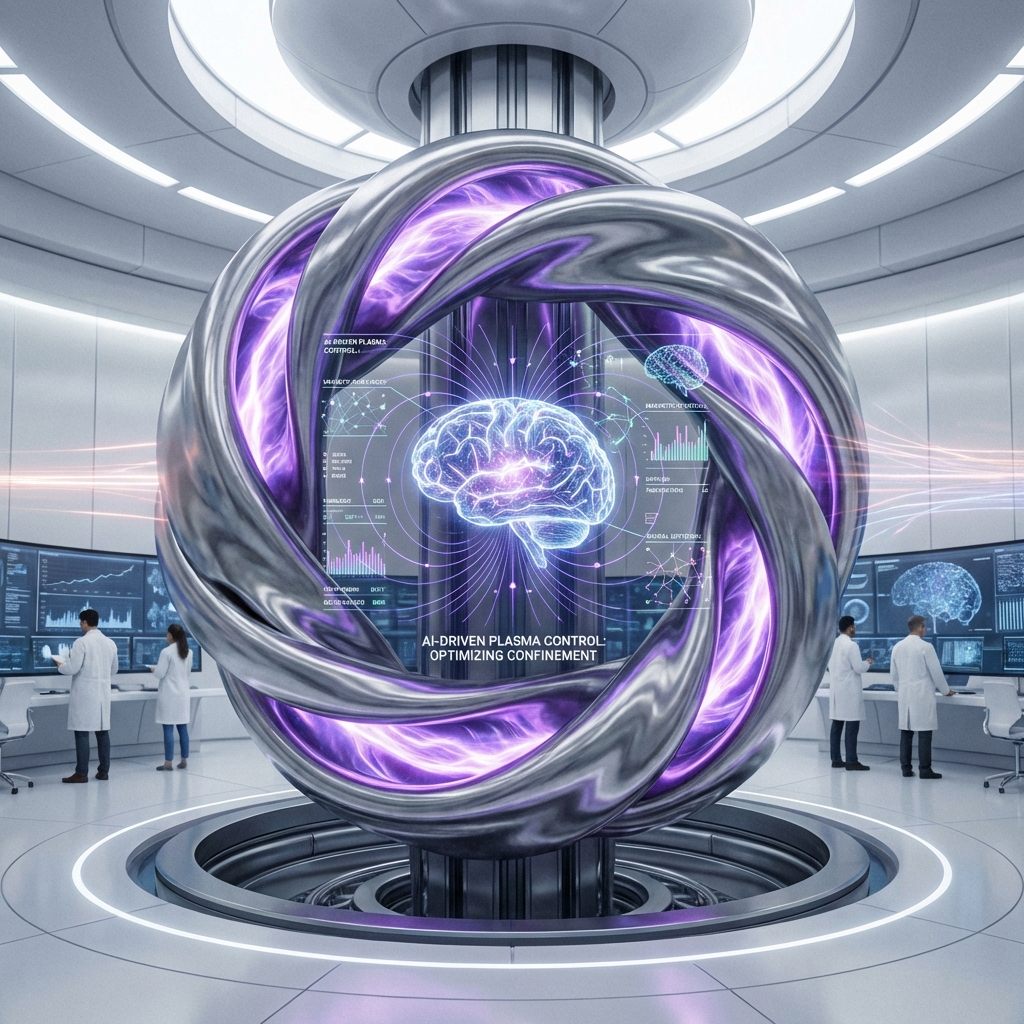

For 70 years, Nuclear Fusion—the process that powers the sun—has been “30 years away.” It is the holy grail: infinite, clean, carbon-free energy with no meltdown risk. But it is famously difficult. Containing a plasma at 100 million degrees requires magnetic fields so complex that no human can calculate them perfectly in real-time.
In January 2026, the timeline compressed. The joke about “30 years away” is dead. We are looking at “3 years away.”
Why? Because Artificial Intelligence has entered the reactor.
This month, the Princeton Plasma Physics Laboratory (PPPL) unveiled STELLAR-AI, a breakthrough platform that uses AI to control fusion plasma in real-time. Simultaneously, Helion Energy—backed by Sam Altman and Microsoft—is preparing its “Omega” factory to mass-produce the world’s first commercial fusion generators. AI isn’t just buying the power (as seen in our Nuclear article); AI is designing the machine that makes the power.
Scenario: The “First Plasma” at Helion
To understand the shift, we must look at Helion Energy in Everett, Washington. The vibe isn’t academic; it’s industrial.
In late 2026, Helion is scheduled to fire up “Polaris,” their 7th generation prototype.
The Shot: Unlike a tokamak (the donut-shaped reactor) that runs continuously, Helion’s machine pulses. It fires two plasmoids at each other at 1 million miles per hour. They collide, fuse, and expand.
The AI Role: In the nanoseconds of that collision, the plasma wants to tear itself apart via “instabilities” (kinks in the magnetic field). A human operator cannot react. A traditional PID controller is too slow. But Helion’s AI control system—trained on millions of simulations—predicts the instability before* it happens and tweaks the magnets to suppress it. It’s like balancing a pencil on your finger, but the pencil is made of lightning and your finger moves at the speed of light.
The Technical Deep Dive: STELLAR-AI and the Infinite Loop
The breakthrough at Princeton (PPPL) is about solving the “Simulation Bottleneck.”
The Problem: Navier-Stokes is Slow
To design a fusion reactor, you have to solve fluid dynamics equations that are notoriously hard. A single high-fidelity simulation of plasma turbulence used to take a supercomputer 3 days to run. If you want to test 10,000 magnet shapes, you need 80 years.
The Solution: AI Surrogate Models
STELLAR-AI replaces the physics equation with a Neural Network.
The Training: They trained the AI on the slow, accurate physics simulations. The AI learned the pattern* of how plasma behaves.
- The Inference: The AI can now predict the outcome of a design in milliseconds, not days. It is 100,000x faster than the supercomputer.
- The Loop: Engineers can now run “Evolutionary Algorithms.” They tell the AI: “Design a magnet that holds plasma for 10 minutes.” The AI iterates through 50 million designs overnight, finding weird, organic shapes that no human would have ever conceived. This is how we got the twisted “Stellarator” designs that are now being built.
AI Control Systems: Reinforcement Learning
Google DeepMind isn’t just playing Go. They partnered with the Swiss Plasma Center to control the TCV tokamak.
- Deep Reinforcement Learning (DRL): They taught an AI to “drive” the plasma. They gave it a reward function (keep the plasma hot, don’t let it touch the walls). The AI learned to juggle two separate droplets of plasma simultaneously inside the reactor—a feat previously thought impossible.
- The “Zero-Shot” Transfer: The most impressive part? The AI learned in a simulator, and when they connected it to the real $100M reactor, it worked on the first try. This proves that our Digital Twins are finally accurate enough to train safety-critical AI.
Market & Industry Analysis: The Private Fusion Landscape
The capital markets have decided Fusion is real. It is attracting the kind of VC money previously reserved for crypto or SaaS.
The “Fusion Unicorns”
Commonwealth Fusion Systems (CFS): Spun out of MIT, they are building “SPARC” using HTS (High-Temperature Superconductor) magnets. They have raised over $2 billion.
Helion Energy: They have a binding contract to sell power to Microsoft by 2028. If they fail, they pay penalties. This “put your money where your mouth is” deal shocked the energy industry.
Zap Energy: Pursuing “Z-Pinch” fusion (no magnets, just current). They are the dark horse, betting on simplicity.
General Fusion: Based in Canada, using “Magnetized Target Fusion”—basically a steampunk reactor that squishes plasma with pistons. It’s crazy, but with AI control, it might just work.
The Supply Chain: HTS Tape and Tritium
The gold rush isn’t just reactors; it’s the magnets.
REBCO Tape: The industry needs thousands of kilometers of Rare Earth Barium Copper Oxide (REBCO) tape for the magnets. Manufacturing capacity is exploding in Japan, Russia, and the US. This is the “Lithium” of the fusion age.
The Tritium Bottleneck: Deuterium is plentiful. Tritium is rare. The world supply is only 20kg. Future commercial reactors must “breed” their own tritium (using Lithium blankets). If the breeding ratio is < 1.0, the industry dies. AI is heavily focused on optimizing these “Breeder Blankets” to ensure we don’t run out of fuel.
Scenario: The 2035 Grid
What happens when fusion actually turns on?
- The “Base Load” Shift: Solar and Wind become “peaker” plants. Fusion becomes the baseload.
- The Price Collapse: The marginal cost of fusion electricity is effectively zero (fuel is seawater). Once the CAPEX of the plant is paid off, electricity becomes a “Post-Scarcity” resource.
- The Urban Plant: Because fusion is safe (no meltdown), we will see 500MW plants inside city limits (e.g., replacing a coal plant in downtown Chicago). This eliminates the need for thousands of miles of transmission lines.
Geopolitical & Societal Impact: Energy Infinity
If Fusion works, the geopolitical map changes instantly.
The Death of “Resource Wars”
Fission needs Uranium (rare). Fossil fuels need oil (localized). Fusion needs Deuterium (from water) and Tritium (bred from Lithium).
The Shift: Every nation with a coastline has infinite fuel. The concept of “Energy Independence” becomes trivial. The strategic value of the Strait of Hormuz drops to zero. A nation’s power is no longer defined by its geology, but by its technology.
The “Jevons Paradox”
Economists warn of the Jevons Paradox: As energy becomes cheaper, we will use more of it.
The Outcome: If energy is effectively free (fusion fuel costs are negligible), we won’t just power lights. We will power desalination plants to turn the Sahara green. We will power direct air capture to scrub CO2. We will power massive AI clusters to solve biology. The ceiling on human economic output—which has always been energy—is removed.
Future Outlook (2026-2030): The Pilot Plant Era
We are leaving the “Science” era and entering the “Engineering” era.
2026-2028: Proof of Net Energy
The milestone to watch is Q > 1 (getting more electricity out than you put in).
The Prediction: Most experts believe CFS or Helion will achieve net electricity (not just net plasma heat) on the grid by 2028-2029.
The Regulatory Framework
The US Nuclear Regulatory Commission (NRC) recently ruled that Fusion plants will be regulated like particle accelerators (hospitals), not fission plants (nuclear bombs).
Why it matters: This means you can build a fusion plant near a city. You don’t need a 10-mile evacuation zone because there is no meltdown risk. If the containment breaks, the plasma just cools down and stops.
FAQ
Q: Is this cold fusion?
A: No. Cold fusion was a debunked science (Fleischmann-Pons). This is hot fusion—replicating the sun. It is real physics, just incredibly hard engineering.
Q: Why 2026?
A: Because AI allowed us to optimize the magnets and control the plasma. We finally have the brainpower (Artificial) to control the star.
Q: Will it be too cheap to meter?
A: No. The fuel is free, but the machine is expensive. It will likely sell power at competitive commercial rates ($0.06/kWh), but it will be inflation-proof because the fuel cost never rises.
We are building a star in a bottle. For 70 years, the bottle kept breaking. Now, thanks to AI, we finally know how to hold it steady.