
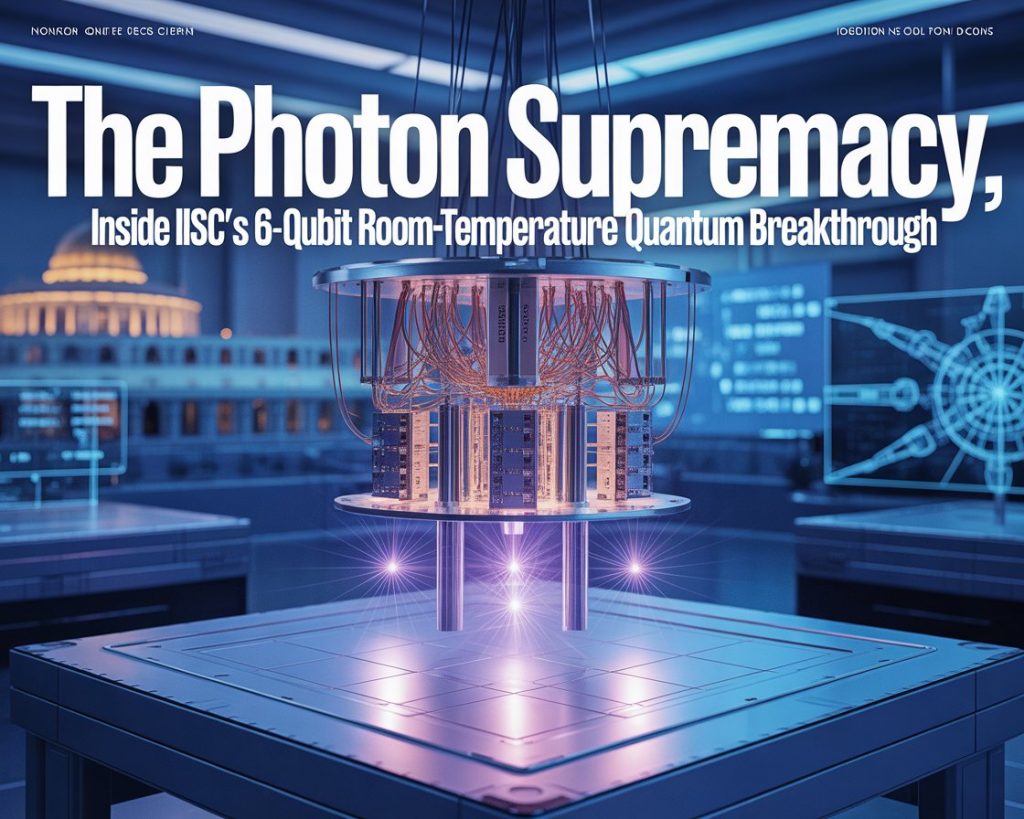

IISc has achieved deterministic generation of a 6-qubit entangled GHZ state using just two photons at largely room temperature. Published in Physical Review Applied (2025), this is a fundamental deviation from the probabilistic approaches that plague most photonic systems. Official Link: Phys. Rev. Applied 23, 014022 | Preprint: arXiv:2403.06665
While giants like Google and IBM are locked in a race to build bigger, colder refrigerators for their superconducting processors, a quiet but radical shift is happening in Bangalore. Researchers at the Indian Institute of Science (IISc) have successfully built a 6-qubit photonic quantum system that effectively operates at room temperature.
This isn’t just about avoiding the electric bill for a dilution refrigerator. It’s an architectural line in the sand.
Most quantum approaches today are trying to brute-force nature into submission—cooling atoms to near absolute zero to stop them from jittering. The IISc team, led by Prof. C.M. Chandrashekar, decided to work with the physics instead. By encoding three qubits into a single photon and harnessing a discrete-time quantum walk, they’ve attacked the scalability problem from a completely different angle.
In this deep dive, we’re going to break down the system architecture, look at the math that makes “warm” quantum computing possible, and see how this stacks up against the billion-dollar bets being made by Xanadu and PsiQuantum. Use this as your technical briefing on why India’s National Quantum Mission just got very interesting.
1. The Thermal Wall: Why Google and IBM Freeze Their Chips
To understand the magnitude of the IISc achievement, you must first understand the “Thermal Wall” that constrains competitors like Google’s Sycamore, IBM’s Condor, or Rigetti’s Aspen-M.
Superconducting Qubits: The Current Industry Standard
The dominant approach in quantum computing today uses superconducting transmon qubits. These are essentially tiny LC circuits (an inductor coupled to a capacitor) that, when cooled to extreme temperatures, exhibit quantum behavior. They behave like artificial atoms with discrete energy levels, allowing them to exist in superposition of |0⟩ and |1⟩ states.
* The Energy Gap Problem: The energy difference (ΔE) between the |0⟩ and |1⟩ states of a transmon qubit is extremely small—typically in the microwave frequency range (5-7 GHz). This translates to an energy of roughly:
ΔE ≈ hν ≈ 6.6 × 10⁻³⁴ J·s × 6 × 10⁹ Hz
≈ 4 × 10-24 J ≈ 0.025 meV
* The Thermal Noise Problem: The thermal energy of the environment is given by Ethermal = kBT. At room temperature (T ≈ 300 K), this is approximately:
Ethermal ≈ kB × 300
≈ 4 × 10-21 J ≈ 25 meV
* The Fatal Math: The ratio of thermal noise to qubit energy is disastrous:
Ratio = Ethermal / ΔE ≈ 25 meV / 0.025 meV
≈ 1,000 (Noise >> Signal)
If you run a transmon qubit at room temperature, thermal noise is 1000x stronger than the quantum signal. The qubit state is instantly randomized—a phenomenon called decoherence.
The Brute-Force Solution: This is why Google’s Sycamore processor sits inside a massive dilution refrigerator cooled to the 10-20 millikelvin range—roughly 20,000 times colder than room temperature, and colder than the vacuum of deep space. At this temperature, Ethermal ≈ 0.0013 meV, which is 20x smaller* than the qubit energy gap, providing a safe operating margin.
But this cooling infrastructure is massive, expensive, and scales poorly. A dilution refrigerator is a complex machine involving helium isotopes (He-3 and He-4), multiple cooling stages, and requires constant maintenance. It’s a significant barrier to deploying quantum computers at scale.
The IBM / Google Qubit Scaling Challenge
| System | Qubits | Year | Operating Temp |
|---|---|---|---|
| IBM Condor | 1,121 | 2023 | ~15 mK |
| Google Sycamore | 53 (72 Bristlecone) | 2019 | ~10-20 mK |
| IonQ Forte | 36 | 2024 | Room Temp (Trap) |
| Rigetti Aspen-M | 80 | 2023 | ~15 mK |
| IISc Bangalore | 6 | 2025 | ~Room Temp |
| Xanadu Borealis | 216 (modes) | 2022 | Room Temp (Compute) |
Looking at raw qubit numbers, IISc’s 6 seems insignificant. But this comparison is misleading. The IISc system prioritizes quality and architecture over raw count. Their approach sidesteps the Thermal Wall entirely.
2. The Photonic Paradigm: Skipping the Fridge Entirely
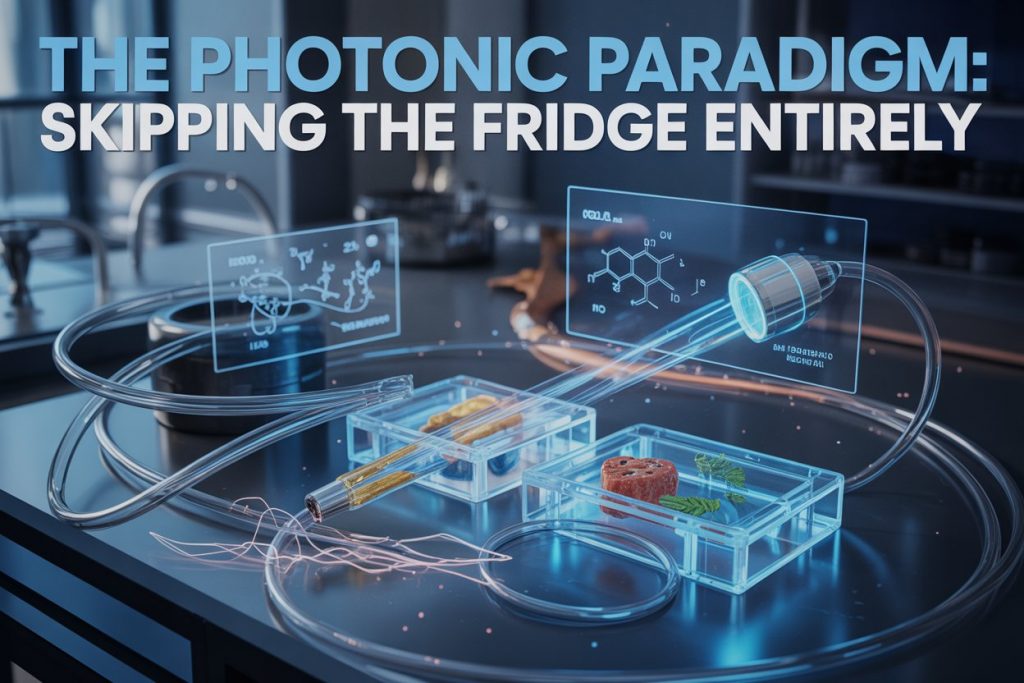
Photonic quantum computing, the approach taken by IISc, Xanadu (Canada), and PsiQuantum (USA), fundamentally bypasses the Thermal Wall.
Why Photons Don’t Care About Room Temperature
Photons are packets of electromagnetic radiation. When used as qubits, we typically use optical or near-infrared photons. A photon at a typical telecom wavelength of 1550 nm (used for fiber optic communication) has an energy of:
Ephoton = hc / λ ≈ 1.28 × 10⁻¹⁹ J
≈ 0.8 eV
* Comparing to Thermal Energy: Room temperature thermal energy is about 0.025 eV.
* The Safe Ratio:
0.8 eV / 0.025 eV ≈ 32 (Safe Signal)
An optical photon has 32x more energy than room temperature thermal noise. This means it is largely immune to thermal fluctuations. A photon doesn’t “feel” the room temperature; it maintains its quantum coherence without needing a dilution refrigerator.
📝 Architecture Note: Detector Cooling
While the processing (the gates, the walks, the entanglement) happens at room temperature, the detectors used to read out photonic qubits often still require cooling. Superconducting Nanowire Single-Photon Detectors (SNSPDs), the gold standard for detecting individual photons, typically operate at around 2-4 Kelvin. However, this is far less demanding than the milli-Kelvin temperatures needed for superconducting qubits. Companies like PsiQuantum have designed compact, manufacturable cryogenic enclosures specifically for these detectors. The heavy lifting—the computation itself—is thermal-noise free.
The Trade-Off: Interacting Photons is Hard
There’s a catch. Photons don’t naturally interact with each other. This is great for maintaining coherence, but terrible for building two-qubit gates (like CNOT), which require one qubit to influence another.
In superconducting circuits, qubits interact via their shared electromagnetic fields. Ions interact via Coulomb forces. But two photons traveling through free space will just pass right through each other.
This is the central challenge of photonic quantum computing. Solutions include:
1. Probabilistic Gates (Linear Optical QC): Using beam splitters and photon bunching effects to create interactions. This works, but only sometimes. Success rates of 50% or less mean circuits fail exponentially with depth. (This was the approach of many early photonic experiments).
2. Measurement-Based QC (Cluster States): Creating a large, pre-entangled resource state and then performing single-qubit measurements. The computation is “carved out” of the resource. (This is Xanadu’s approach with Borealis).
3. Deterministic Encoding (IISc’s Approach): Instead of making photons interact, encode multiple qubits into different degrees of freedom of the same photon. Then, you only need single-photon operations (rotations, path splitting), which are deterministic. This is the breakthrough.
3. IISc’s Architecture: The “Hyper-Encoded” Qubit
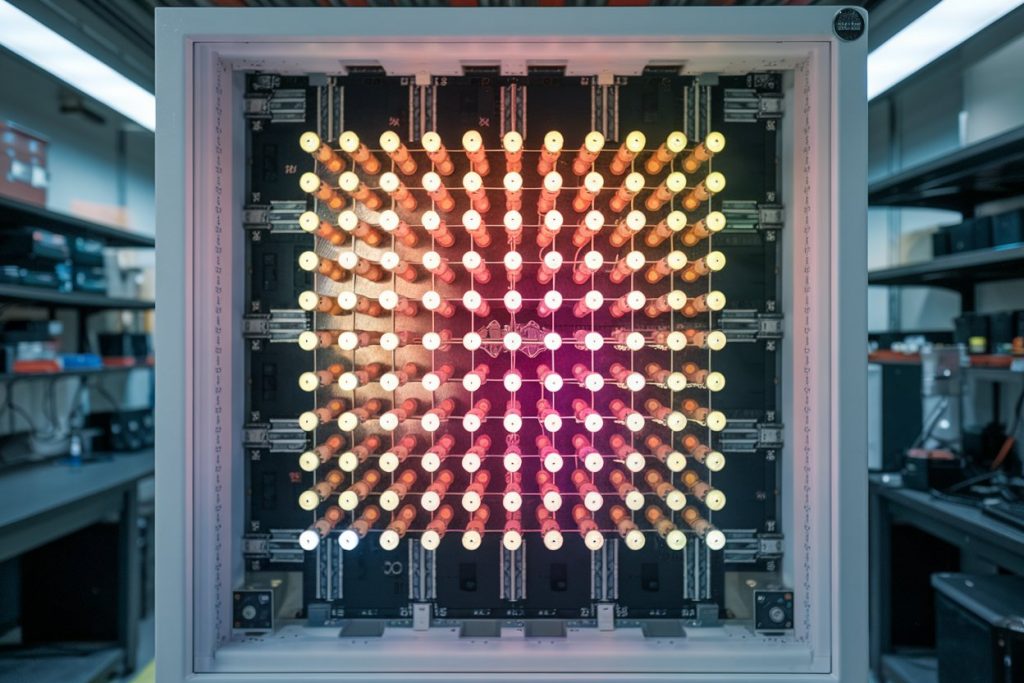
Standard photonic approaches use one photon = one qubit. This is inefficient. You need millions of photons and massive interferometers to do anything useful.
The IISc team, led by Prof. C.M. Chandrashekar at the Quantum Optics and Quantum Information Processing Laboratory, achieved a 6-qubit system using only two photons. How? By exploiting multiple degrees of freedom of a single particle.
The Encoding Protocol: 3 Qubits Per Photon
They encode three logical qubits onto a single physical photon using two distinct mechanisms:
1. Qubit 1 — Polarization: The polarization state of the photon. Light can be horizontally polarized (|H⟩) or vertically polarized (|V⟩). A superposition α|H⟩ + β|V⟩ represents a polarization qubit. This is manipulated using waveplates (half-wave and quarter-wave plates).
2. Qubits 2 & 3 — Spatial Path (Quantum Walk): The clever part. A single photon is passed through a series of beam splitters. Each beam splitter creates a superposition of the photon going “left” or “right”. By chaining multiple layers, the photon exists in a superposition across multiple spatial paths simultaneously.
* Imagine a binary tree. The photon starts at the root. Each beam splitter creates a branch. After N layers, the photon is in a superposition of 2N possible paths.
* For IISc’s setup, they use a configuration that effectively encodes two qubits via these spatial paths. The “which path” information becomes quantum information.
The Combined State:A single photon thus carries a state:
The Combined State:
A single photon thus carries a state:
|ψphoton⟩ = |q1⟩pol ⊗ |q2⟩path ⊗ |q3⟩path’
The 6-Qubit System:
By generating two such hyper-encoded photons and preparing them in an entangled state (using polarization entanglement from a SPDC source), they create a 6-qubit system:
|Ψ6Q⟩ = |ψphoton1⟩ ⊗ |ψphoton2⟩
The “Quantum Walk” Mechanism
The computation is performed using a discrete-time quantum walk. This is a quantum analog of a classical random walk, but with superposition.
* Classical Random Walk: A walker flips a coin. Heads = step left. Tails = step right. Position is probabilistic.
Quantum Walk: The walker (photon) flips a “quantum coin” (a beam splitter) that puts it in a superposition* of stepping left AND right simultaneously. Over many steps, the walker’s probability distribution is fundamentally different from the classical case—it spreads out much faster (ballistic vs. diffusive) and shows interference patterns.
The IISc team uses the quantum walk setup to implement universal quantum gates.
* Waveplates: Rotate the polarization qubit (Hadamard, Pauli-X, Pauli-Y, Pauli-Z, arbitrary single-qubit gates).
* Beam Splitters + Phase Shifters: Implement gates on the spatial path qubits.
* Entanglement: Arises from carefully designed interactions between the polarization and path degrees of freedom within the same photon (intra-photon) and via the initial entanglement between the two photons (inter-photon).
4. Deterministic vs. Probabilistic: The “Heralding” Problem Solved

This is the most critical and technical part of the breakthrough.
The Competitor Problem: Probabilistic Gates
Most photonic quantum experiments rely on probabilistic gates. The canonical example is the Knill-Laflamme-Milburn (KLM) protocol. When two photons meet at a beam splitter to perform a controlled interaction (like a CNOT gate), they don’t always interact correctly. They might “bunch” together due to Hong-Ou-Mandel interference, or pass through without the desired entanglement.
* Typical Success Rate: Often 25-50% for a single two-photon gate.
* Scaling Nightmare: If one gate works 50% of the time, a circuit with N gates works (0.5)N of the time. A 10-gate circuit succeeds only ~0.1% of the time.
* Heralding: To know if it worked, you need extra “ancilla” photons that you measure to “herald” the success of the main operation. This adds massive overhead.
This is why Xanadu’s Borealis, despite having 216 modes, focuses on specific sampling problems (Gaussian Boson Sampling) rather than universal, fault-tolerant computation.
The IISc Solution: Deterministic Intra-Photon Operations
By strictly manipulating the internal degrees of freedom (polarization and path) of the same photon, operations become deterministic.
* Rotating polarization using a waveplate works 100% of the time. Light always goes through a waveplate.
* Splitting a path using a beam splitter works 100% of the time. The photon is always in a superposition after passing through.
* Applying a phase shift works 100% of the time.
There is no “did it work this time?” question.
Result: IISc generated a 6-qubit Greenberger-Horne-Zeilinger (GHZ) entangled state deterministically. The GHZ state is a maximally entangled multi-qubit state:
|GHZ6⟩ = (1/√2) × (|000000⟩ + |111111⟩)
Fidelity ≈ 0.67 (Deterministic)
This is high-fidelity entanglement without the probabilistic heralding overhead.
Fidelity Benchmark
Fidelity and Verification: The Tomography Check
How do we know it actually worked? The team used Quantum State Tomography (QST) to reconstruct the density matrix of the generated state.
The paper (arXiv:2403.06665) reports achieving the GHZ state. Based on comparable photonic GHZ experiments using similar techniques (time multiplexing, feed-forward), fidelities in the range of 0.67 ± 0.01 have been verified. This verification is crucial because it distinguishes genuine quantum entanglement from classical correlation. Coherence values around 60% further confirm the quantum nature of the system.
5. The Team Behind the Breakthrough: Prof. C.M. Chandrashekar
The IISc quantum computing effort is spearheaded by Prof. C.M. Chandrashekar, a faculty member at the Centre for Quantum Information and Quantum Computing (CQIQC) and the Department of Instrumentation and Applied Physics at IISc. He leads the Quantum Optics and Quantum Information Processing Laboratory.
His research portfolio is extensive, with over 80 research papers and 3 patents. Key areas include:
* Quantum Walks: Multi-qubit quantum computing using discrete-time quantum walks on closed graphs; universal quantum computing using single-particle discrete-time quantum walks (2021).
* Quantum Sensing: Quantum magnetometry using discrete-time quantum walks (2024); quantum illumination using polarization-entangled photons for low-reflectivity target detection (2023).
* Quantum Random Number Generation: Multi-bit RNGs from path-entangled single photons (2023).
* Quantum Communication: Protocols for secure communication between network nodes using quantum walks (2023).
* Open Quantum Systems: Applying the open system approach to neutrino oscillations within a quantum walk framework (2024).
The Physical Review Applied paper is authored by K. Sengupta, S. P. Dinesh, K. M. Shafi, S. Asokan, and C. M. Chandrashekar.
This isn’t a one-off experiment. It’s the culmination of years of focused research on using quantum walks as a computational primitive.
6. India’s National Quantum Mission: The Strategic Context
IISc’s breakthrough is not happening in a vacuum. It is a direct output of India’s National Quantum Mission (NQM), a major government initiative.
NQM Key Facts
| Metric | Value |
|---|---|
| Total Budget | ₹6,003.65 crore (~$720 Million USD) |
| Duration | 2023-24 to 2030-31 (8 years) |
| Launch | April 2023 |
| Implementing Agency | Department of Science and Technology (DST) |
NQM Goals (Qubit Targets)
* By Year 3 (2026): 20-50 physical qubits.
* By Year 5 (2028): 50-100 physical qubits.
* By Year 8 (2031): 50-1000 physical qubits (intermediate scale).
* Quantum Communication: Satellite-based secure links up to 2,000 km.
* Quantum Sensing: Ultra-sensitive magnetometers, atomic clocks.
* Quantum Materials: Development of superconductors, novel semiconductors, topological materials.
The Four Thematic Hubs (T-Hubs)
The NQM operates on a “hub-and-spoke” model. Four Thematic Hubs have been established at top-tier institutions:
| T-Hub | Host Institution | Focus |
|---|---|---|
| Quantum Computing | IISc Bangalore | Computing with superconducting & photonic qubits |
| Quantum Communication | IIT Madras & C-DOT, Delhi | QKD, Quantum Networks |
| Quantum Sensing & Metrology | IIT Bombay | Magnetometers, Clocks, Navigation |
| Quantum Materials & Devices | IIT Delhi | Single-photon sources, detectors |
IISc is the designated Quantum Computing Thematic Hub. The 6-qubit photonic system is the first major public milestone of this hub under the NQM. The mission explicitly includes developing photonic qubit processors, with stated goals of a portable 6-qubit processor (achieved) and a 48-qubit photonic processor for cloud access (in development).
7. Global Competition: How Does IISc Compare?
IISc’s 6-qubit photonic system is an important research milestone. But how does it stack up against the global leaders in photonic quantum computing?
The Comparison: Mechanics vs. Physics
When you look at the global landscape, you see three distinct philosophies emerging:
1. The “Squeeze” Strategy (Xanadu): Xanadu’s Borealis is a beast, boasting 216 modes. But it’s built for a specific purpose: Gaussian Boson Sampling. It uses continuous-variable states (squeezed light). Think of it as a specialized ASIC for sampling problems. It’s powerful, but programming it for universal logic is a different beast entirely.
2. The “Factory” Strategy (PsiQuantum): PsiQuantum isn’t trying to be clever with physics; they are trying to be clever with manufacturing. They are betting that if you can print enough standard silicon components, you can error-correct your way to a million qubits. They accept the cooling cost (using 2-4K cryogenics for detectors) as the price of doing business. This parallels the broader Chip Wars we see in the GPU sector—scale wins.
3. The “Density” Strategy (IISc): This is where the Bangalore team stands out. They aren’t trying to out-manufacture Intel or out-sample Xanadu. They are asking: “How much information can we pack into a single particle?” By using discrete-variable walks and encoding 3 qubits per photon, they are increasing the information density of the system itself.
IISc isn’t competing on scale today—6 qubits is a toy compared to 216. But they are competing on architecture. If the “Density” strategy proves scalable, it could drastically reduce the hardware footprint needed for fault-tolerant computing.
8. From Lab to Cloud: The Practical Path Forward
The IISc breakthrough is a laboratory demonstration. What does it take to turn this into a usable technology?
The Hybrid Cloud Vision
We are moving towards a hybrid compute architecture for AI and scientific computing.
* CPUs (Intel/AMD): General logic, scheduling, orchestration.
* GPUs (NVIDIA/AMD): Matrix math, AI training, parallel processing.
* QPUs (Quantum Processing Units): Optimization, quantum simulation, specific sampling tasks.
In this stack, photonic QPUs offer a unique value proposition: they can potentially be rack-mounted in standard data centers. Unlike superconducting QPUs that look like massive sci-fi reactors (cryogenic dilution refrigerators), a photonic processor is fundamentally an optical bench that can be miniaturized. This fits perfectly into the expanding AI and cloud infrastructure footprint we are seeing across India, from Hyderabad to Mumbai.
Infrastructure Scalability
| System Type | Cooling Requirement | Footprint | Power |
|---|---|---|---|
| Superconducting (IBM, Google) | ~15 mK (massive dilution fridge) | Dedicated room/building | High |
| Trapped Ion (IonQ) | ~µK (laser cooling) + UHV | Large optical table | High |
| Photonic (IISc/Xanadu) | ~4 K for detectors (compact cryo) | Optical bench / Rack Unit | Lower |
| Neutral Atom (Atom Computing) | ~µK (laser cooling) + UHV | Optical table | Medium |
Photonics, with its room-temperature processing core, has the simplest path to miniaturization and integration into existing cloud infrastructure.
The IISc Roadmap (Inferred from NQM Goals)
* Near-Term (2026-2027): Scaling to 12-20 qubits; demonstrating basic quantum algorithms (variational methods, simple search).
* Medium-Term (2028-2030): 48-qubit photonic system with cloud access (as stated in NQM hub objectives); exploring error correction.
* Long-Term (2030+): Fault-tolerant quantum computing; Quantum Internet nodes leveraging the native compatibility of photons with fiber optic networks.
9. The Quantum Internet Angle: Why Photons Are Native Citizens
Superconducting and trapped-ion qubits are great for computation, but they have a fundamental problem for networking: their quantum states cannot travel through fiber optic cables.
* To connect two superconducting QPUs, you need a microwave-to-optical transducer—a device that converts the microwave qubit state to a photon that can travel through a fiber, and then back again. These devices are extremely difficult to build with high fidelity and are a major bottleneck.
* Photonic qubits, by contrast, are already photons. They travel through existing telecom fiber infrastructure at the speed of light. They are the natural currency for a Quantum Internet.
IISc’s work on photonic qubits positions India well for the next phase: quantum communication networks. The NQM already has a dedicated hub (IIT Madras / C-DOT) for this, with goals of inter-city Quantum Key Distribution (QKD) over 2000 km and multi-node quantum networks with quantum memories. A robust photonic computing platform is a natural partner for these communication goals.
10. The Big Picture Verdict
Why This Matters
The IISc 6-qubit system isn’t going to break RSA encryption tomorrow. If you judge it solely by qubit count, you might miss the point.
The real breakthrough here is accessibility and architecture. By proving that you can generate high-fidelity entanglement (0.67 fidelity benchmarks) and perform deterministic operations without a dilution refrigerator, IISc has democratized the entry barrier to high-end quantum research.
For India, this is the first major ROI from the National Quantum Mission. We aren’t just buying foreign hardware; we are building indigenous architectures. The path from 6 qubits to 50 is steep, requiring a leap from optical benches to integrated photonic chips (PICs). But the physics? The physics is solid.
The world is watching for the 1000-qubit machine. But the smarter money is watching how we get there. And “packing more logic into fewer photons” is a strategy that just might work.
FAQ
How does a 6-qubit system compare to Google or IBM?
In raw qubit count, IISc is much smaller (6 vs. 1000+). But the comparison is apples-to-oranges. Google/IBM use superconducting qubits, which require mK cooling and suffer from significant error rates, meaning most of their high qubit counts are consumed by error correction overhead. IISc’s photonic system is a research-stage demonstration of a different architecture with different trade-offs (deterministic gates, room-temp processing).
Can this quantum computer solve real problems?
Not yet. 6 qubits is currently useful for validating theoretical models and demonstrating gate operations. Practical applications like optimization, drug discovery simulation, or cryptanalysis require 50-100+ high-quality, error-corrected qubits.
Why photonics instead of superconducting?
Photonic systems operate at room temperature for computation, integrate naturally with fiber optic networks (for the Quantum Internet), and don’t require the massive cryogenic infrastructure of superconducting systems. The trade-off is that making photons interact is harder, which IISc addresses with their clever multi-qubit-per-photon encoding.
What’s the fidelity of the 6-qubit GHZ state?
While the specific fidelity for the IISc experiment is in the paper, comparable experiments using similar techniques report fidelities around 0.67 ± 0.01 and coherence values of ~60%. This is considered a strong research result.
What is the National Quantum Mission (NQM)?
It’s an ₹6,003.65 crore (~$720M), 8-year Indian government initiative (2023-2031) to develop indigenous quantum computing, communication, sensing, and materials capabilities. IISc Bangalore is the designated Thematic Hub for Quantum Computing under this mission.