

Forget Silicon Valley for a second. The most interesting AI hardware demo of February 2026 didn’t happen in San Francisco. It happened at Bharat Mandapam in New Delhi, at the India AI Impact Summit 2026 – and the first person to wear the device was Prime Minister Narendra Modi.
The device is called Sarvam Kaze – a pair of AI-powered smart glasses built entirely in India by Sarvam AI, the Bengaluru startup that’s been quietly building India’s answer to GPT-4 for Indian languages. Kaze isn’t just a “Made in India” vanity project. It’s a serious piece of hardware designed around a core insight that every other smart glasses company – including Meta – has completely missed: the next billion users don’t primarily speak English.
I’ve been tracking Sarvam AI for a while, and this announcement hit different. Not because of the fancy demo. But because of what it says about where AI hardware is actually going.
What Sarvam Kaze Actually Is (And What It Isn’t)
Let’s be precise. Sarvam Kaze is a pair of AI-first smart glasses equipped with:
- Two cameras – for capturing photos, video, and providing visual context to the embedded AI system
- Microphones and speakers – for full hands-free interaction via voice commands
- An active recording indicator LED – a small light on the frame that signals when the cameras are active
- Sarvam’s own on-device AI models – running specifically trained Indian-language foundational models
Sarvam describes Kaze as a device that can “listen, understand, respond, and capture” what the wearer sees. That’s essentially the same value proposition as Meta’s Ray-Ban smart glasses – but with a fundamentally different AI stack underneath.
Here’s what nobody is talking about: this isn’t just a hardware play. Sarvam is opening the Kaze platform to developers, which means third-party apps built on Sarvam’s AI infrastructure could run directly on these glasses. That’s a developer ecosystem bet, not just a consumer gadget launch.
The retail launch is set for May 2026 in India. Pricing, battery life, and detailed hardware specs remain undisclosed as of today. And honestly, the undisclosed pricing is the one number that matters most for whether this thing actually reaches the people it’s designed for.
The Real Differentiation: AI Trained on India, Not Translated for India
This is where it gets interesting – and where I think Sarvam has a genuine advantage that Meta, Google, and OpenAI can’t easily replicate.
Sarvam AI was founded in August 2023 by Dr. Vivek Raghavan and Dr. Pratyush Kumar, with a single mission: build full-stack AI that’s native to India. Not translated. Not fine-tuned from a Western base model via English-pivot translation. Built from the ground up on ~4 trillion tokens of training data, including 2 trillion high-quality Indic tokens.
Their model lineup heading into 2026 includes Sarvam 30B and Sarvam 105B – enterprise-grade foundational models trained for Indian languages from the token level up. These models cover 22 Indian languages, including Hindi, Tamil, Telugu, Kannada, Bengali, Marathi, and languages spoken primarily in rural Bharat where English-first AI literally doesn’t work.
The Kaze glasses run on Sarvam Edge – a family of compact on-device models designed to operate without an internet connection. Think of it like this: the Meta Ray-Ban sends your voice query up to Meta’s servers, then pulls a response back. Sarvam Edge runs the inference locally on the device. Lower latency. Better privacy. Works in patchy network areas. For a country where rural internet connectivity is still unreliable in 2026, that isn’t just a nice-to-have – it’s the whole value proposition.
This connects directly to what we’ve been seeing with edge AI more broadly – the push toward smaller, leaner models that can run on constrained hardware. Sarvam’s Sequential Attention-adjacent approach to building efficient models for low-resource environments is now showing up in consumer hardware form.
Meta Ray-Ban vs. Sarvam Kaze: The Comparison Nobody Is Making Fairly
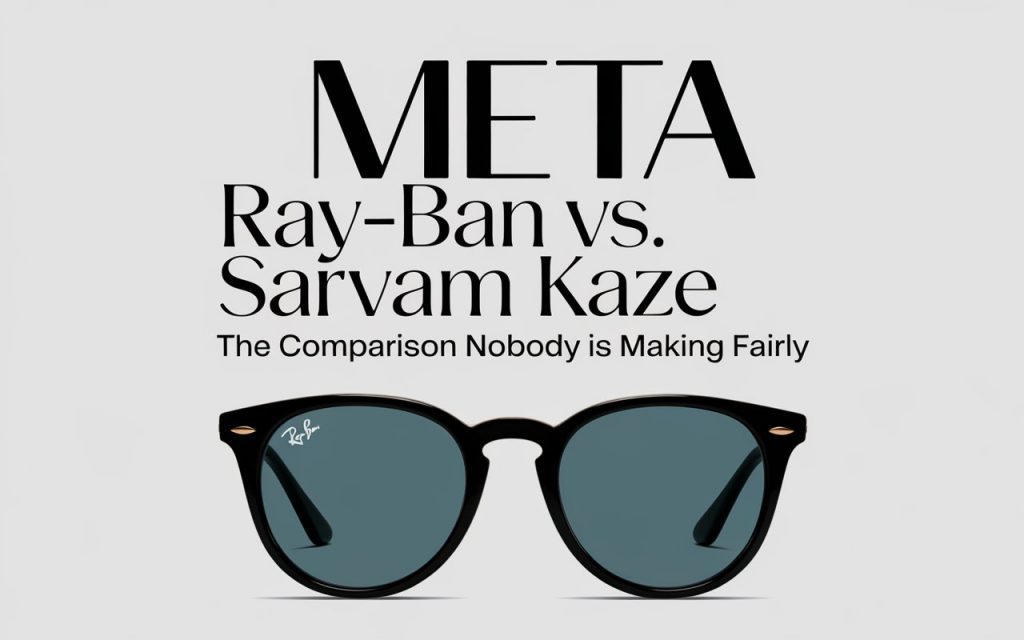
The tech press keeps calling Kaze “India’s answer to Meta Ray-Bans.” That framing is both accurate and misleading. Let me be direct: these are competing for entirely different users.
| Feature | Meta Ray-Ban Smart Glasses | Sarvam Kaze |
|---|---|---|
| Camera | 12MP ultra-wide, 3K ultra HD video | Dual cameras (specs TBD) |
| Battery | Up to 8 hours (Gen 2) | Not disclosed |
| Chip | Qualcomm Snapdragon AR1 Gen1 | TBD |
| AI Platform | Meta AI (English-first, Hindi support added) | Sarvam models (22 Indian languages, native) |
| Storage | 32GB internal | Not disclosed |
| Connectivity | Bluetooth 5.2, Wi-Fi 6 | Not disclosed |
| Price (India) | ₹39,900+ | TBD (May 2026 launch) |
| Language DNA | English-first, translation layer | Indian-native from training |
| On-Device AI | Cloud-dependent | Sarvam Edge (offline capable) |
| Dev Platform | Meta AI API | Open for developers |
The hardware spec gap is real – Meta’s Ray-Bans are a mature, shipping product with two generations behind them. Kaze is a first-gen device from a startup. But look at the bottom half of that table. That’s where Kaze wins.
Meta recently added Hindi support to their Ray-Ban AI, which is a legitimate improvement. But “added Hindi support” is very different from “trained on 2 trillion Indic tokens from the ground up.”
The difference shows up in edge cases: culturally specific queries, regional dialects, code-switching between Hindi and local languages, agricultural and government terminology that rural Bharat actually needs.
The mainstream narrative focuses on hardware specs. But the real story is the AI layer.
Sarvam as Infrastructure: Why This Is Bigger Than Glasses
I want to zoom out for a second, because the Kaze glasses are actually the consumer face of something much larger.
Sarvam AI was selected under India’s IndiaAI Mission to build the country’s first indigenous foundational AI model. The government backing came with 4,000 GPUs for training. That’s a significant state investment – and it explains why Sarvam could afford to build infrastructure at this scale without raising a Series C from US VCs.
At the India AI Impact Summit 2026, Sarvam didn’t just show glasses. They showcased:
- Sarvam 30B and 105B foundational models for enterprise automation
- Text-to-speech, speech-to-text, and translation pipelines across 22 languages
- Vision capabilities – a multimodal model tuned for Indian document types (think: government forms, bank statements in regional scripts)
- Sarvam Edge – the on-device inference layer that Kaze runs on
What strikes me about this stack is how vertical it is. Sarvam isn’t relying on Qualcomm’s AI runtime, Microsoft’s Azure AI infrastructure, or Meta’s Llama as a base. They’re building the model, the inference runtime, and now the hardware endpoint. This is a similar bet to what we’ve seen with the physical AI movement – where the real value accrues to companies that own the full stack from model to device.
And this matters for India’s geopolitical AI position in 2026. When PM Modi tried on the Kaze glasses at the summit, it wasn’t just a photo op. It was a statement: India doesn’t need to depend on US or Chinese AI infrastructure for its next wave of digital adoption.
The Constraint Nobody Is Talking About
Here’s the hard truth about Sarvam Kaze: it’s launching into one of the toughest hardware markets in the world.
Smart glasses, as a category, have a brutal track record. Google Glass was a cultural disaster. Microsoft HoloLens cost $3,500 and found no mass-market traction. Even Meta Ray-Bans – a genuinely good product from a company with $50B+ in resources – haven’t become mainstream. The question isn’t whether Kaze’s technology is impressive. The question is whether the Indian consumer market is ready to pay for AI wearables, and at what price point.
The physics of the problem: putting cameras, speakers, microphones, an on-device AI inference chip, and a battery into a frame light enough to wear comfortably is hard. Really hard. And doing it at a price point accessible to the users most likely to benefit from Indian-language AI – rural and semi-urban India – is a significantly steeper engineering and economics challenge.
Sarvam says May 2026 for the launch. They haven’t said a price. That’s the number I’m waiting for. If Kaze comes in under ₹15,000, it’s a mass-market bet. If it lands above ₹30,000, it’s a premium product competing against Meta’s established brand. Both strategies are viable, but they require completely different go-to-market approaches.
That said, the developer platform angle is smart. If Sarvam opens Kaze to developers before the retail launch – let builders create language-learning apps, agricultural advisory tools, government service interfaces in regional languages – they could bootstrap an ecosystem before hardware demand exists. That’s the same playbook we saw in agentic AI development tools, where the platform bet precedes the consumer adoption curve.
What This Means For India’s AI Future
The India AI Impact Summit 2026 was dominated by global narratives – the MANAV Vision for human-centric AI governance that Modi laid out, the debates about the Global South’s role in shaping AI standards, the familiar parade of US tech CEOs. But the single most Indian thing that happened at the summit was a pair of glasses getting passed to a Prime Minister.
Sarvam Kaze represents a bet that AI hardware can be meaningfully differentiated by the quality of its foundational models, not just its chip specs. In a world where the top-tier hardware platforms (Snapdragon, Apple Silicon) are effectively commodities available to anyone, the moat is the model. Sarvam’s model is trained on Indian data, built for Indian intent, and running on Indian-built inference infrastructure.
That’s not a nationalist argument – it’s a product argument. The 500 million+ Indians who primarily communicate in languages other than English are systematically underserved by every existing AI assistant on every existing platform, including the Meta Ray-Bans with Hindi support. Kaze is the first device specifically built around their reality, not adapted to it.
And that’s worth watching closely.
The Bottom Line
Sarvam Kaze is the most significant Indian AI hardware announcement in years – not because of the specs (which are still undisclosed), but because of the stack beneath it. Native 22-language AI. On-device inference that works offline. An open developer platform. Government-backed infrastructure, government-level attention at launch.
The open questions are real: the price, the battery, the camera quality, and whether a first-gen startup device can compete with Meta’s shipping product. These aren’t small questions.
But here’s what I know: if Sarvam gets the price right and the developer platform pops, Kaze isn’t just a smart glasses launch. It’s the first physical endpoint of an Indian AI ecosystem that’s been building in the background for two years. May 2026 is close. This is one to watch.
FAQ
What are Sarvam Kaze AI glasses?
Sarvam Kaze are India’s first indigenous AI-powered smart glasses, developed by Sarvam AI. They feature dual cameras, microphones, speakers, and run on Sarvam’s own foundational AI models trained for 22 Indian languages. They were unveiled at the India AI Impact Summit 2026.
When will Sarvam Kaze launch and how much will they cost?
The retail launch is planned for May 2026 in India. Sarvam has not yet announced pricing, detailed hardware specifications, or battery life as of the summit announcement in February 2026.
How does Sarvam Kaze compare to Meta Ray-Ban smart glasses?
Meta’s Ray-Bans have more disclosed hardware specs (Snapdragon AR1 Gen1, 12MP cameras, 8-hour battery), but Kaze’s differentiation is its AI stack – models natively trained on 2 trillion Indic tokens across 22 languages, plus Sarvam Edge for offline, on-device AI inference. Meta has added Hindi support, but Sarvam’s approach is architecturally more Indian from the ground up.
What is Sarvam Edge?
Sarvam Edge is a family of compact AI models designed to run locally on consumer devices – smartphones, laptops, and now the Kaze glasses – without requiring an internet connection. This enables lower latency, better data privacy, and functionality in areas with unreliable connectivity.
Who founded Sarvam AI?
Sarvam AI was founded in August 2023 by Dr. Vivek Raghavan and Dr. Pratyush Kumar. The company focuses on building full-stack AI infrastructure for Indian languages, and has been selected under India’s IndiaAI Mission as a key partner for building the country’s first indigenous foundational AI model.
Was PM Modi really the first to try Sarvam Kaze?
Yes. At the India AI Impact Summit 2026, held at Bharat Mandapam in New Delhi, Prime Minister Narendra Modi tried on the Sarvam Kaze glasses, becoming reportedly the first person to demo them publicly. He inaugurated the summit on February 19, 2026.