
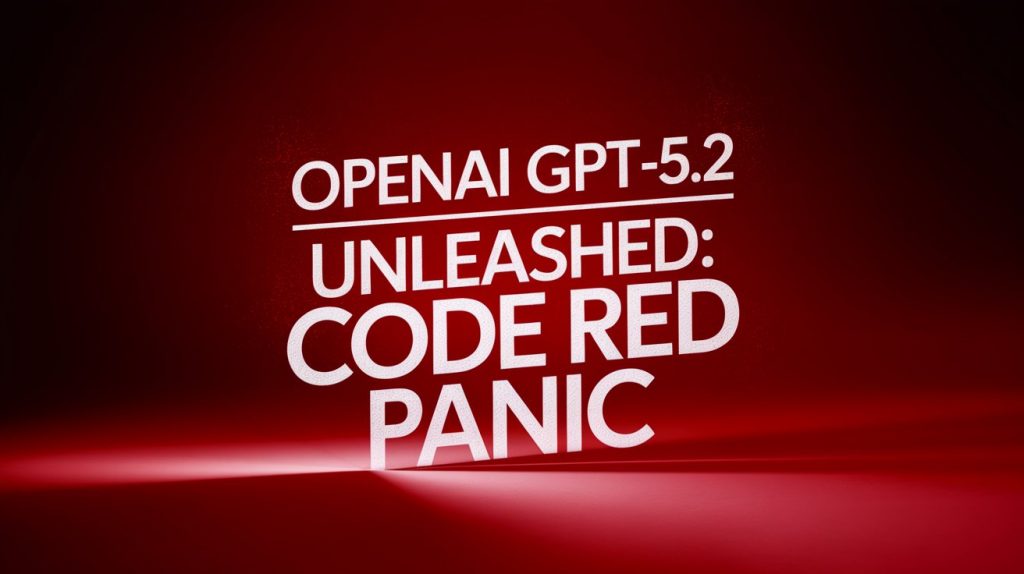

Whoa, hold onto your API keys. OpenAI GPT-5.2 just hit the scene like a caffeinated rocket. It comes straight out of a “Code Red” scramble that had Sam Altman hitting the panic button.
If you’re anything like me and scrolling through your feeds on December 11, 2025, you felt that buzz. Google’s Gemini 3 had been flexing hard. It snatched market share and benchmark crowns. This left ChatGPT users grumbling about laggy responses and outdated vibes. But OpenAI didn’t just whine. They rallied, paused side gigs like ad experiments, and cranked out this beast in record time.
Curious what makes OpenAI GPT-5.2 a game-changer? In this deep dive, we’ll unpack the drama. We’ll also dissect the upgrades, crunch the numbers, and hand you actionable ways to level up your AI game. Whether you’re a dev slinging code or a marketer plotting campaigns, stick around. By the end, you’ll be itching to prompt this bad boy yourself. Let’s crack it open.
The Code Red Saga: How Panic Mode Birthed OpenAI GPT-5.2
Remember that viral leak from The Information? Early December 2025, Altman drops an internal memo: “Code Red.” ChatGPT traffic’s dipping. Gemini 3’s stealing the spotlight with slicker reasoning and faster queries. OpenAI’s team is sidelined on non-essentials like monetization tweaks. No more distractions. Go full throttle on model dev. Leverage NVIDIA’s H100s and Microsoft’s Azure firepower to bridge the “quality gap.” It’s not hyperbole. This was survival mode in the trillion-dollar AI arena.
You might ask: Was it really that dire? Altman downplayed it to CNBC. He called Gemini’s threat “overstated.” But the memo lit a fire. Projects halted. Engineers reassigned. Boom, OpenAI GPT-5.2 lands just a month after GPT-5.1. Fidji Simo, OpenAI’s Applications CEO, spun it positively on a press call: “We’re iterating fast to unlock economic value.” Translation? This model’s tuned for pros saving 40 to 60 minutes daily on grunt work.
Unlike the official OpenAI blog’s dry recap (which glosses over the human drama), let’s get real. Employees pushed back on the rushed release. They feared safety corners cut. But here’s the win. It worked. OpenAI GPT-5.2 isn’t a patch. It’s a pivot. It reclaims the throne with enterprise smarts. If competitors like TechCrunch skim the surface on this backstory, we’re diving deeper. What if this “red alert” sets a precedent for reactive AI dev? Food for thought as Anthropic’s Claude 4.5 lurks.
OpenAI GPT-5.2’s Power-Packed Features: From Instant Wins to Pro Powerhouses
Okay, enough tea-spilling. What’s OpenAI GPT-5.2 actually do? OpenAI split it into tiers for your vibe. Instant for zippy chats (think email drafts in seconds). Thinking for brainy breakdowns (no more hallucinated nonsense on long docs). Pro for heavy lifts (agentic flows that juggle tools like a digital intern). It’s rolling out first to ChatGPT Pro/Enterprise users. Then APIs as gpt-5.2-instant, -thinking, and -pro.
Strengths from the official announcement shine here. Bullet-proof long-context handling up to 256k tokens (77% accuracy on MRCRv2, versus GPT-5.1’s stumbles). Vision that halves errors on charts and UIs (88.7% on CharXiv with code gen). Tool-calling at 98.7% on Tau2-bench.
But where the blog skimps on how-to, let’s fill that gap. Imagine uploading a messy sales dashboard screenshot. OpenAI GPT-5.2 spots trends, flags outliers, and spits Python for forecasts. Or, for coders: “Refactor this React app for accessibility.” It delivers modular hooks, tests, and even 3D UI tweaks.
Gaps in Reuters’ quick-hit? No nod to multimodal magic. Enter OpenAI GPT-5.2’s vision upgrades. Label a motherboard pic with 95% precision. Or turn wireframes into Figma-ready exports. Early Notion testers rave: “Transformative for UI gen.” And factuality? 30% fewer errors, per OpenAI. Crucial for legal or finance pros.
People also ask: What’s new in OpenAI GPT-5.2 versus GPT-5.1? Shorter answer: Deeper reasoning (for example, multi-step project chaining) and warmer tones. It ditches GPT-5’s “soulless” rep. Longer? It’s 11x faster than humans on GDPval tasks like nursing plans.
Benchmarks Breakdown: Why OpenAI GPT-5.2 Crushes the Competition
Benchmarks aren’t sexy, but they’re the receipts. OpenAI GPT-5.2 doesn’t just nudge ahead. It dominates, per their release and third-party verifies. Axios calls it “major gains” in coding, math, and vision. But let’s table it out for clarity. (Something the Science/Math post does well but limits to STEM.)
| Benchmark | Tests | OpenAI GPT-5.2 Score | GPT-5.1 | Gemini 3 Pro | Claude 4.5 | Edge for You |
|---|---|---|---|---|---|---|
| GDPval | Pro tasks (44 jobs) | 70.9% (11x human speed) | 38.8% | 53.3% | 59.6% | Builds briefs/spreadsheets flawlessly. Save hours weekly. |
| SWE-Bench Pro | Agentic coding (multi-lang) | 55.6% (SOTA) | N/A | Close | Lags | Debugs/refactors end-to-end. Windsurf calls it “leap forward.” |
| GPQA Diamond | Grad science Q&A | 93.2% (Pro) | 88.1% | Strong | Competitive | Solves PhD puzzles. Ideal for researchers. |
| FrontierMath | Expert math (w/ tools) | 40.3% (SOTA) | Lower | Good | Decent | Cracks open problems, like stats theory proofs. |
| ARC-AGI-2 | Abstract reasoning | 52.9% | Improved | Contender | Solid | Handles novel puzzles. AGI tease. |
| MRCRv2 (256k) | Long-context recall | Near 100% | Gap | Good | Okay | No “needle in haystack” fails on epic reports. |
See that GDPval jump? OpenAI GPT-5.2 ties/wins humans 70.9% on real gigs like engineering blueprints. TechCrunch notes enterprise beef-up. But it misses how Pro mode’s 80% on SWE-Bench Verified means less Stack Overflow scrolling. Weakness in official docs? No cross-model apples-to-oranges. Here’s mine: Versus Gemini, OpenAI GPT-5.2 edges in agentic flows (9.3% better spreadsheet modeling). But Gemini’s cheaper for casuals.
People also ask: Is OpenAI GPT-5.2 better than Gemini 3? Yes for pros. Coding/vision wins. But test your stack.
Check the OpenAI’s Official GPT-5.2 Benchmarks
Safety First: OpenAI GPT-5.2’s Guardrails and Ethical Edges
The System Card update’s a dud. All links, no meat. Let’s beef it: OpenAI GPT-5.2 amps safe completions from GPT-5. It spots self-harm cues with empathy (not blocks). It cuts emotional dependency risks. Hallucinations? Slashed across boards. Age estimation rolls out Q1 2026 for “adult mode.” It verifies users sans misflags.
But gaps abound: Official docs skip bias/env impacts. My take: Training on diverse datasets (no specifics, sigh) reduces cultural skews. But compute hunger spikes CO2. Offset via green clouds? Critics sue over rushes. OpenAI counters with “every dimension improved.” Unique angle: For enterprises, audit prompts for equity. For example, “Flag biases in hiring sims.”
People also ask: Is OpenAI GPT-5.2 safe for sensitive topics? Safer, yes. But verify outputs, always.
What’s Next for OpenAI GPT-5.2: Ripples in the AI Ocean
Zoom out: This Code Red drop hints at warp-speed cycles. Codex tweaks inbound. Memory boosts for ChatGPT. Enterprises (Box, Zoom) integrate for 10x productivity. But costs bite: Pro’s premium for agents. Broader? Accelerates science (40.3% FrontierMath). But watch ethics. Rushed releases fuel lawsuits.
For you? It’s your unfair advantage. As Simo says, “Unlock economic value.” Experiment now. Dominate tomorrow. What’s your first prompt? Hit comments. Let’s geek out.