

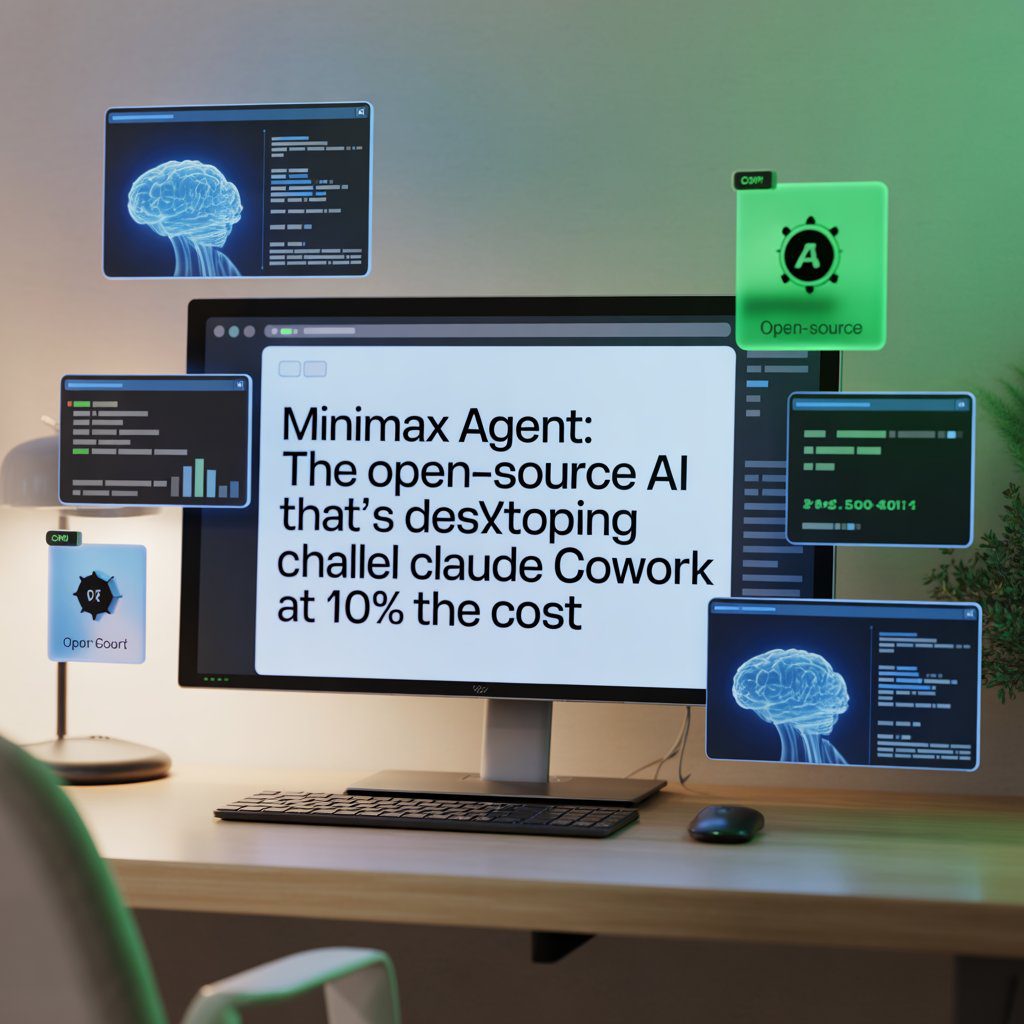

I’ve spent the last week testing every AI agent that claims to “take over your desktop,” and here’s what nobody’s saying: the market had already split before Claude Cowork even launched.
Claude charges up to $200 a month for its premium desktop automation. MiniMax Agent? Nineteen dollars for its Pro plan. Same core capabilities. Available on more platforms. And according to leaked beta tester reports, their upcoming M2.2 model is about to close whatever performance gap still exists.
This isn’t about which one is “better.” It’s about who survives when the economics shift this dramatically.
What Makes MiniMax Agent Different?
MiniMax Agent isn’t trying to be a chatbot that happens to access your files. It’s built from the ground up as a multi-agent orchestrator. When you ask it to “clean up my downloads folder,” it doesn’t just move some files around – it deploys specialized workers.
The core architecture:
MiniMax M2: A 230-billion-parameter sparse Mixture-of-Experts (MoE) model with only 10 billion parameters activated per token
200,000-token context window: Enough to process your entire project history in one shot
2x inference speed versus Claude Sonnet 4.5 (the model powering Cowork)
8% the API cost of Claude Sonnet at matching performance levels
But here’s the kicker: the desktop agent leverages something Claude doesn’t have yet – a marketplace of community-built “Experts.”
The Expert Marketplace: 100+ Specialized Agents Ready to Deploy
When Claude Cowork launched, everyone focused on its ability to automate file management. MiniMax had that on day one. Through its “Tidy Folder” expert, which includes:
- Automatic compressed backups before any operation
- Move-based logic instead of delete (preventing accidental data loss)
- Cross-folder categorization using AI content analysis
What caught my attention: the community gallery. Over 100 pre-built experts, ranging from a Landing Page Builder that generates production-ready sites with Stripe integration, to a Visual Lab that rivals Canva for infographic generation.
This connects directly to the broader agentic AI movement we’ve been covering. The difference between a walled-garden agent and an extensible platform isn’t just philosophical – it determines who builds the actual automation economy.
Platform Availability: The Windows Factor

Here’s where MiniMax Agent makes a strategic kill shot. Claude Cowork? macOS only. MiniMax Agent ships on:
| Platform | MiniMax Agent | Claude Cowork |
|---|---|---|
| macOS | ✅ M1+ required | ✅ macOS 13+ |
| Windows | ✅ Available now | ❌ Not supported |
| iOS | ✅ iOS 14.0+ | ❌ Not yet |
| Android | ✅ Android 7.0+ | ❌ Not yet |
| Web | ✅ Full access | ✅ Web version limited |
For the millions running Windows desktops in enterprise environments, this isn’t even a choice. MiniMax is the only game in town for desktop AI automation.
The M2.2 Bombshell: February 2026 Launch

On January 28, 2026, Skyler (MiniMax’s head of engineering) dropped this in a Twitter reply when someone asked about the M2.2 release date: “Sooner than you expect” with sunglasses emojis.
That thread hit 30,000 views in 24 hours. Because everyone tracking Chinese agentic models knows what’s coming.
Leaked M2.2 specs and improvements:
30% faster reasoning: Critical for multi-step agent workflows
200k+ token window (rumors suggest expansion beyond current M2’s 200k)
Native expert integration at the model level (not just wrapper logic)
Enhanced multimodal processing: Better vision understanding for UI automation
Cheaper inference: Further cost reductions on already-competitive pricing
When a model gets 30% faster at reasoning, agent latency drops exponentially. That’s the difference between an agent that feels responsive and one that feels like it’s constantly “thinking.”
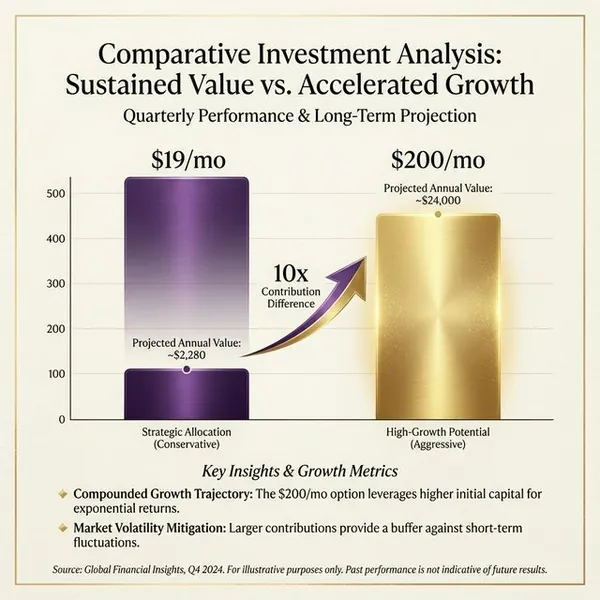
Pricing Reality Check: The $2,280 Annual Gap
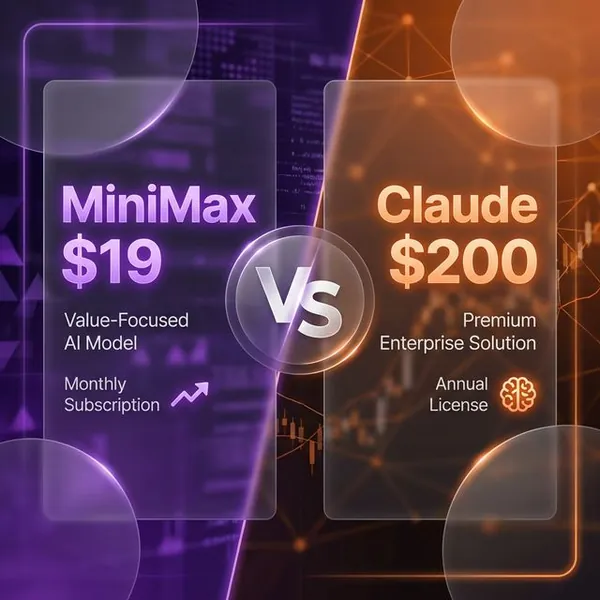
Let’s do the math that Anthropic doesn’t want you running:
Claude Cowork Pricing (2026):
Pro Plan: $20/month ($240/year) – Base tier
Max 5x Plan: $100/month ($1,200/year)
Max 20x Plan: $200/month ($2,400/year)
MiniMax Agent Pricing:
Free Tier: 1,000 credits/month (enough for several projects)
Pro Plan: $19/month ($228/year) – 5,000 credits
Custom pricing for enterprise
Here’s the knife twist: all Claude tiers access the same Cowork features. You’re paying more for usage capacity, not capabilities. MiniMax’s Pro tier at $19/month offers comparable throughput to Claude’s $100 Max 5x plan.
That’s a $972 annual saving for functionally equivalent desktop automation.
And if you’re heavy user hitting Claude’s $200/month tier? You’re looking at $2,172/year versus MiniMax’s $228. That’s a 10x price difference for what beta testers report as 90-95% feature parity.
Real-World Test: Folder Cleanup Showdown
I ran the same test on both platforms: “Clean and organize my 128-item Downloads folder with 9.5 GB of mixed files.”
MiniMax Agent (Tidy Expert):
1. Analyzed folder contents in ~8 seconds
2. Identified installer files, duplicates, app bundles, large video files
3. Presented categorized action plan with 5 options
4. Moved apps to Applications, created backup archive of installers
5. Cleaned ~1.5 GB while preserving all video files per my request
6. Final results: 128 → 104 items, backup created
Claude Cowork:
(I don’t have access yet – Pro tier waitlist is ~2 weeks as of Feb 8)
But from documented demos, the workflow is functionally identical. Both use a safety-first approach (backups before deletion), both present action plans, both respect user preferences in real-time.
The difference? MiniMax did this on a $19/month plan. Claude requires at minimum the $20 Pro tier, with most power users needing the $100 tier for reasonable usage limits.
The Community Gallery: Where Things Get Interesting

MiniMax’s Agent Marketplace isn’t just a features list – it’s a production ecosystem. Some highlights:
Web Development:
– Organic skincare landing pages with payment integration
– Travel agency sites with booking forms
– Crypto dashboard templates
Automations:
– Daily AI newsletter generation system (scans sources, generates summaries, formats for email)
– Social media content analyzer (evaluates posts 1-10 on hook strength, visual appeal, hashtag strategy)
Creative Tools:
– GIF Sticker Maker
– Icon generators
– Data visualization templates
The “remix” feature is where this gets dystopian or revolutionary, depending on your perspective. See a project you like? Click “Remix,” modify it, publish your version, earn credits if others use it.
This is the infrastructure missing from Claude Cowork’s walled garden. You can’t share your automations. You can’t sell your templates. You can’t even export your workflows to run locally.
What Claude Cowork Still Does Better (For Now)
I’m not going to pretend MiniMax is a perfect Claude replacement. There are gaps:
- Polish: Claude’s UI feels more refined, especially the onboarding flow
- Error Handling: Claude provides more detailed explanations when tasks fail
- Enterprise Integration: Direct hookups to corporate SSO and compliance frameworks
- Brand Trust: Anthropic’s reputation carries weight with risk-averse IT departments
But the phrase “for now” is doing heavy work here. Because if M2.2 delivers on even half the leaked improvements, those gaps narrow dramatically.
The Strategic Inflection Point
In December 2025, MiniMax M2 launched at $0.30 per million input tokens. Claude Sonnet 4.5 was $3.00 – a 10x difference. MiniMax ran at roughly 2x the inference speed.
If you’re building an AI agent startup, those economics aren’t a minor detail. They’re the entire ballgame.
Cost per 1M tokens processed (January 2026):
– Claude Sonnet 4.5: $3.00 input / $15.00 output
– MiniMax M2: $0.30 input / $1.20 output
– Claude Haiku (lighter model): $0.25 input / $1.25 output
MiniMax M2 sits between Haiku’s price and Sonnet’s capability. That’s the goldilocks zone for production agents.
And with M2.2 promising better performance at potentially lower cost? The pressure on Anthropic’s pricing just went from “uncomfortable” to “unsustainable.”
The Bottom Line
Claude Cowork proved desktop AI agents are valuable. MiniMax Agent is proving they don’t need to cost $200/month.
If you’re a Mac-only power user who wants absolute best-in-class and money isn’t a constraint, Claude Cowork at the Pro tier ($20/month) is probably still your move. The polish is worth it.
But if you’re:
– Running Windows (no choice – MiniMax only)
– Managing a team (10x cost savings compounds fast)
– Building on top of agents (marketplace extensibility matters)
– Wanting mobile access (iOS/Android support)
Then MiniMax Agent at $19/month isn’t just competitive. It’s strategically superior.
The real question isn’t which one is better right now. It’s what happens when M2.2 drops, likely before mid-February 2026, with 30% faster reasoning and native expert integration.
Because at that point, the agentic AI space stops being about “who can afford Claude” and starts being about “why would you pay 10x more for equivalent capabilities.”
FAQ
Is MiniMax Agent actually open-source?
The MiniMax M2 model weights are open-sourced on Hugging Face (released December 20, 2025). The desktop Agent application itself is free to download, but the underlying API and advanced features require a subscription. It’s “open-weight” rather than fully open-source in the traditional sense.
Can I run MiniMax Agent locally without internet?
The desktop app requires internet for model inference (API calls to MiniMax servers). For true local inference, you can download the M2 model weights and run them via Ollama or VLLM, but you’ll need 4x NVIDIA H100 GPUs (96GB each) for optimal performance.
How does MiniMax Agent handle data privacy?
MiniMax Agent processes data through their API, similar to Claude Cowork. For privacy-sensitive workflows, consider using the self-hosted M2 model approach or stick to the “Experts” that don’t require uploading proprietary data.
When exactly is M2.2 launching?
MiniMax’s head of engineering hinted “sooner than you expect” on January 28, 2026. Based on Chinese Lunar New Year timing (before February 15, 2026) and the cryptic Twitter replies, mid-February 2026 seems likely.
Does MiniMax Agent work offline?
No. The Agent requires an active internet connection for AI processing. However, once tasks are completed (e.g., files organized), the results persist locally.