

If 2025 was the year of “Fast AI”—characterized by the race for lower latency, Groq-style inference chips, and distillation—2026 has officially pivoted. We are now in the era of “Slow AI”.
We aren’t talking about lag. We are talking about System 2 thinking: model architectures explicitly designed with inference-time compute scaling to pause, ponder, plan, and verify before emitting a single token.
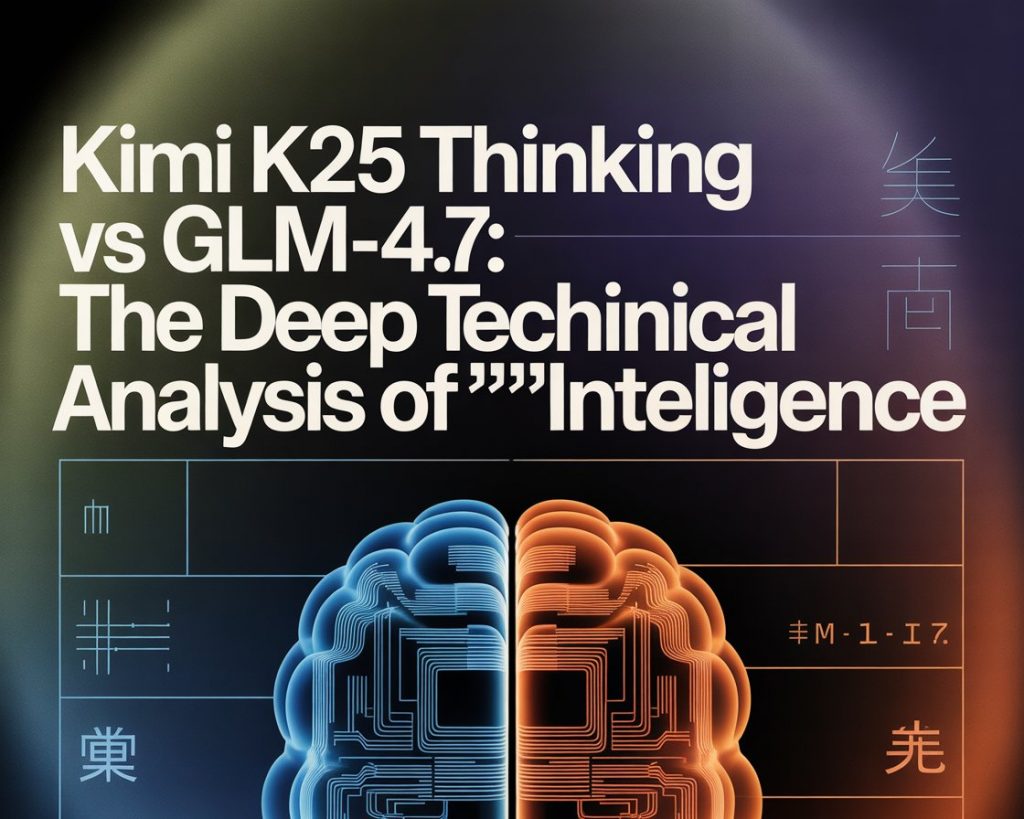
Two heavyweights have just released models that define this new paradigm. In one corner, Moonshot’s Kimi K2.5, a 1-Trillion parameter MoE beast that employs a “Swarm” architecture. In the other, Z.ai’s GLM-4.7, a refined technician championing “Interleaved Thinking.”
Both claim to solve the reasoning bottleneck. But for enterprise architects and ML engineers, the question isn’t “which is smarter?”—it’s “which architecture fits my heavy-lifting workflow?”
In this deep dive, we will tear apart the specs, from MoE routing strategies to attention mechanisms, and analyze the Total Cost of Ownership (TCO) for these new “Thinking” models.
Architectural Deep Dive: The 1 Trillion vs 355 Billion Divide
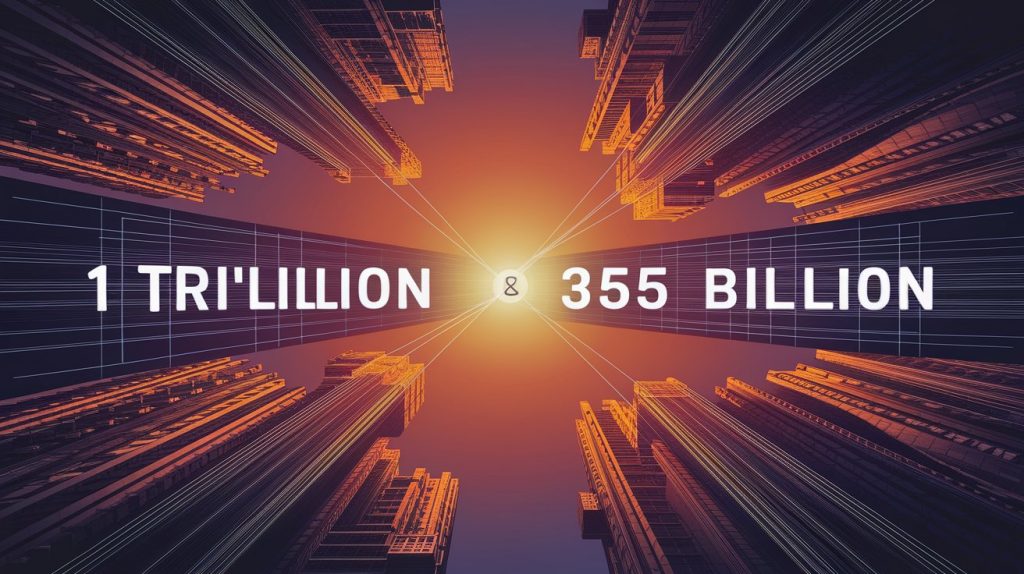
The most immediate technical differentiator is scale. While both use Mixture-of-Experts (MoE) to decouple training size from inference cost, their scaling strategies differ fundamentally.
Kimi K2.5: The “Sparse Giant”
Moonshot has bet big on parameter count.
- Total Parameters: ~1 Trillion (estimated).
- Active Parameters: 32 Billion (per token).
- Routing: Top-8 logical routing across 384 experts.
- Architecture: 61 Layers, SwiGLU activations.
The Kimi architecture is fascinating because of its Top-8 routing. Most efficient MoE models (like Mixtral) use Top-2. By routing to 8 experts per token, Moonshot is prioritizing richness of representation over raw throughput. It’s a “wide” activation strategy. This explains why Kimi K2.5 is excellent at “fuzzy” tasks like creative writing or nuance detection—it’s activating a broader slice of its brain for every concept.
It typically runs on a custom MoonViT vision encoder (400M params), enabling native multimodal token ingestion. This isn’t a “VLM” (Vision-Language Model) where a connector glues a vision tower to an LLM; the 15 trillion token training run was mixed-modal from the start.
GLM-4.7: The “Optimized Precision”
Z.ai (formerly Zhipu) has taken a leaner approach.
- Total Parameters: 355 Billion.
- Active Parameters: 32 Billion (per token).
- Context: 200k (Input) / 128k (Output).
Notice the Active Parameter parity. Both models activate ~32B parameters per token. This is the “sweet spot” for inference on H100 clusters (fitting within specific memory bandwidth envelopes). However, GLM-4.7’s total parameter count is roughly 1/3rd of Kimi’s.
This implies GLM-4.7 is a far more dense expert model. Its experts are likely “generalists” compared to Kimi’s hyperspecialized “specialists.” This architectural choice typically yields better instruction following and stability (less routing noise) but potentially lower “peak” creativity or knowledge retrieval than a 1T model.
The Philosophy of Thought: “Swarm” vs “Interleaved”
This is where the divergence becomes philosophical. How do you implement “System 2” reasoning?
Kimi K2.5: The “Agent Swarm” (Parallel Agent RL)
Kimi’s “Thinking Mode” is built on Parallel Agent Reinforcement Learning (PARL).
Instead of a single chain-of-thought, the model acts as an Orchestrator.
1. Decomposition: The model breaks a prompt into sub-tasks (e.g., “Search history,” “Analyze code,” “Verify facts”).
2. Instantiation: It spins up to 100 sub-agents in parallel.
3. Synthesis: The Orchestrator aggregates the parallel streams.
The Tech Stack: This relies on a “World Model” approach where the context window (256k) acts as a shared memory state for the swarm. It avoids “Serial Collapse” (where agents wait for each other) using staged reward shaping.
Best For: Broad, open-ended research. If you ask “What is the future of Moore’s Law?”, Kimi can check physics papers, financial reports, and news simultaneously.
GLM-4.7: “Interleaved Thinking” (Turn-Level Control)

GLM-4.7 rejects the chaos of swarms for Linear Verification.
Interleaved Reasoning: The model is forced to emit a
- Preserved Reasoning: It caches these thought blocks. In a multi-turn conversation, if you ask a follow-up, it doesn’t re-think the premise; it loads the previous state.
- Slime RLHF: Z.ai uses a specific PPO framework called “slime” to penalize hallucination during these thought steps.
The Tech Stack: This is a classic “Chain-of-Thought” (CoT) implementation but optimized for Tools. It validates logic before executing code (Python/Browser), radically reducing “hallucinated code.”
Best For: Engineering tasks. If you ask “Refactor this SQL query,” you don’t want 100 agents brainstorming; you want one agent verifying the syntax step-by-step.
Inference Dynamics: Speed, Latency, and Cost
For engineers deploying these models, the “Vibe” doesn’t matter. The Time-to-First-Token (TTFT) and Tokens-Per-Second (TPS) do.
| Metric | Kimi K2.5 (Swarm) | GLM-4.7 (Interleaved) | The Winner |
|---|---|---|---|
| Active Params | 32B | 32B | Tie |
| Total Params | ~1T | 355B | GLM (Storage efficiency) |
| Inference Speed | ~86 token/sec | ~153 token/sec | GLM-4.7 (+78% Faster) |
| Output Cost | $3.00 / 1M | $2.20 / 1M | GLM-4.7 (~27% Cheaper) |
| Context Window | 256k | 200k | Kimi (Slight edge) |
Analysis:
GLM-4.7 is significantly faster and cheaper. This is likely due to the Routing Overhead. Routing across 1T parameters (Kimi) is memory-bandwidth intensive. Even if active parameters are the same, the selection process and memory paging for 1T weights create latency. GLM’s smaller footprint allows for more aggressive caching and potentially fits on fewer GPU nodes per instance.
Benchmark Anatomy: Where the “Swarm” Wins
Despite being slower and more expensive, Kimi K2.5 dominates in Complex Reasoning.
HLE-Full (Humanity’s Last Exam): Kimi scores 50.2% vs GLM’s 42.8%.
Why?* HLE requires “out-of-distribution” generalization. Kimi’s “Swarm” can effectively “guess and check” multiple hypotheses in parallel, simulating a tree-search algorithm. GLM’s linear thinking is prone to getting stuck in a local optimum.
BrowseComp: Kimi scores 74.9% vs GLM’s 65.8%.
Why?* Web browsing is messy. A swarm that can open 10 tabs is inherently superior to a single agent clicking one link at a time.
But… The “UI” Factor
GLM-4.7 wins on VideoMMMU (87.6% vs 86.6%) and general UI generation reliability. Z.ai has clearly tuned their RLHF rewards for structure. GLM-4.7 produces cleaner JSON, better-formatted HTML, and more reliable functional calls. It is the “Enterprise Safe” choice.
Conclusion: The TCO Verdict
We are seeing a bifurcation in the “Thinking” model market.
Use Kimi K2.5 (The Researcher) when:
- The problem is undefined. (e.g., “Find market gaps in biotech.”)
- Recall is paramount. The 1T parameter count stores more “long-tail” knowledge.
- Cost is secondary to quality. You are willing to pay the massive inference premium for that +7.4% reasoning boost.
Use GLM-4.7 (The Engineer) when:
- The problem is constrained. (e.g., “Fix this bug”, “Extract data from this PDF.”)
- Latency matters. The 78% speed advantage makes it viable for semi-real-time agents.
3. You are building user-facing apps. The stability of “Interleaved Thinking” prevents the bot from spiraling into a 100-agent philosophical debate.
Ultimately, Kimi K2.5 is a triumph of Architecture (Scale + Swarm). GLM-4.7 is a triumph of Optimization (Efficiency + Control). As we move deeper into 2026, expect the “Swarm” approach to become standard for offline reasoning, while “Interleaved” becomes the standard for interaction.
Which side of the trade-off does your stack sit on? Let us know in the comments.