

Everyone is asking the same question: Is Kimi’s swarm just a fancy wrapper for 100 API calls, or is it a new breed of AI architecture? We checked the API, ran the math, and found the answer.
The Skeptic’s Theorem
If you look at the marketing for Moonshot AI’s Kimi k2.5, it sounds impossible.
- 100 concurrent agents.
- 4.5x faster usage.
- Significantly cheaper than Claude Opus.
Any seasoned developer reads that and thinks: “This is a scam. This is just a Python for loop wrapping a standard API, and they’re going to charge me for 100 separate inference streams.”
We thought the same thing. So we decided to ignore the press release and look at the API documentation, the Jan 2026 pricing tables, and the real-world economics.
What we found is surprising. Kimi k2.5 isn’t a wrapper; it’s a native hive mind. And understanding why it works requires looking at the one metric nobody talks about: Output Cost.
The API Reality: It’s Native, Not Client-Side

The biggest fear devs have is that “Swarm Mode” is just a UI feature, a cool frontend trick that orchestrates calls for you.
We verified the API docs, and this is false.
Kimi k2.5 exposes an agent_cluster object directly in the API (which is fully OpenAI-compatible). When you send a request, you don’t instantiate 100 agents yourself. You send a single high-level instruction, and the model itself instantiates the cluster on the server side.
Technically, this means:
1. Latency: The “handshake” between agents happens inside Moonshot’s datacenter, not over your internet connection. This is why it’s fast.
2. Context Sharing: Agents share the same memory address space for context. They aren’t re-reading the prompt 100 times; they are referencing a single loaded instance.
This confirms that the “Swarm” is a native architecture capability, trained end-to-end to interleave “Reasoning” (CoT) with “Tool Calls” (Actions). This is a significant evolution from the single-stream models we analyzed in our initial Kimi k2.5 review.
The Cost Battle: Kimi vs. GPT-5.2 vs. Opus 4.5
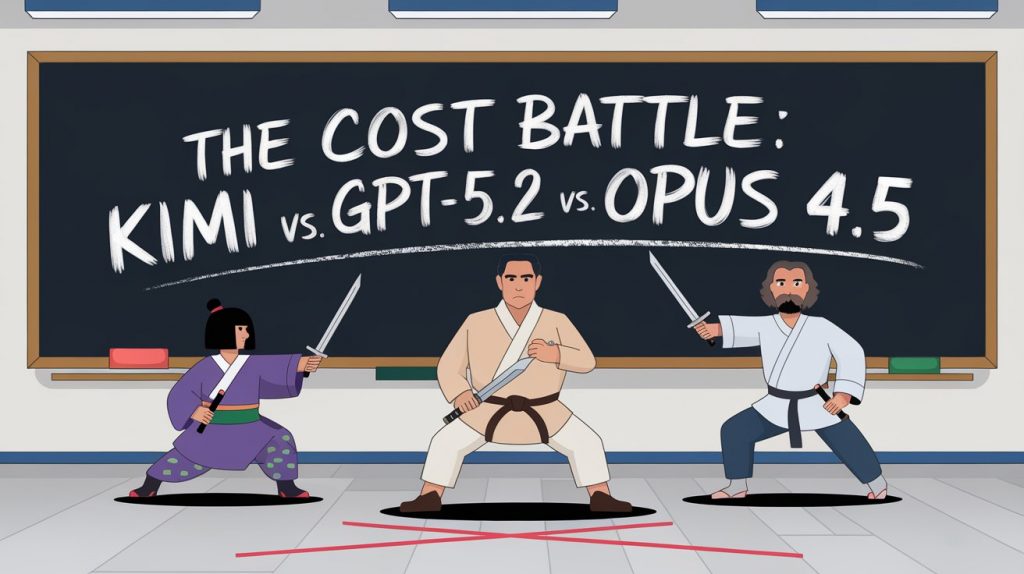
This is the part where the “Scam” theory falls apart. If you spawn 100 agents using GPT-5.2 Technical Breakdown, you will go bankrupt. If you do it with Kimi, you can afford lunch.
Here is the Verified Pricing (Jan 2026) per 1 Million Tokens:
| Metric | Kimi k2.5 | GPT-5.2 | Claude Opus 4.5 |
|---|---|---|---|
| Input (Base) | $0.60 | $1.75 | $5.00 |
| Input (Cached) | $0.10 | $0.175 | $0.50 |
| Output (Gen) | $3.00 | $14.00 | $25.00 |
The “Secret” Metric: Output Cost
Most people focus on the Input Cache ($0.10 vs $0.175). Sure, Kimi is cheaper there, but GPT-5.2’s caching is also excellent.
The real killer is Output.
When a swarm runs, the sub-agents talk to each other. They generate reports, verify facts, and write snippets of code. This is all Output Token usage.
- GPT-5.2 Output: $14.00 / 1M
- Kimi Output: $3.00 / 1M
This is a 4.6x difference.
If you run a swarm that generates 100k tokens of internal discussion:
- GPT-5.2 Cost: $1.40
- Kimi Cost: $0.30
This implies that Moonshot AI has optimized their “Thought Generation” hardware to be drastically more efficient than OpenAI’s. They aren’t just selling cheap inputs; they are selling cheap thoughts. This efficiency is crucial for the emerging Industrial AI Market, where automated agents running 24/7 need to be cost-effective.
The “Benchmaxxed” Accusation: Reddit Speaks
We scoured r/LocalLLaMA and r/MachineLearning to see if the real world matches the specific pricing advantages.
Camp A: “Blown Away” (Research Users)
Users relying on Kimi for Deep Research are reporting massive gains. One user described it as “having a team of 10 juniors searching Google at once.” Because the Output cost is so low, users feel comfortable letting the swarm “ramble” and cross-check itself, which leads to higher accuracy text without the fear of a $50 bill.
Camp B: “Benchmaxxed” (Coding Users)
A vocal minority argues that the model is “Benchmaxxed”.
Critique: When asked to solve a standard LeetCode problem, the swarm sometimes over-complicates it. Instead of writing a quick sort, Agent 1 plans, Agent 2 reviews, and Agent 3 approves.
Reality: The Swarm is not a precise scalpel; it’s a blunt instrument. It excels at “messy” tasks (research, parsing, ideation) and struggles with “linear” tasks (pure logic, simple math) where a single Genius model (like Opus) is cleaner.
Does it Increase Compute Power?
Yes, but we need to redefine “Compute Power.”
Vertical Compute (Opus): Making a single brain larger and smarter. (Deep Thinking).
Horizontal Compute (Kimi): Using more medium-sized brains in parallel. (Wide Thinking).
Kimi increases Throughput Compute. By parallelizing the work, it functionally increases the “Wall Clock Intelligence” available to you.
However, it does not increase “Peak Reasoning.” If a problem is so hard that a 32B parameter model simply cannot understand it, 100 copies of that model won’t understand it either. Zero times 100 is still zero.
This is the hard limit of the Swarm. It can solve Complexity (lots of moving parts), but it cannot solve Ambiguity (fundamental reasoning gaps) better than a smarter single model like Claude Opus.
The Bottom Line
Kimi k2.5’s swarm is not a facade. It is a highly optimized, server-side architecture that leverages Parallel-Agent Reinforcement Learning, Context Caching, and—most importantly—Ultra-Cheap Output Tokens ($3.00) to make multi-agent workflows economically viable.
Is it safe to build on?
For Data/Research Apps: Yes. The economics ($3 vs $14) make GPT-5.2 obsolete for high-volume text generation tasks.
For Critical Logic/Math: No. Stick to Claude Opus 4.5.
The swarm isn’t magic. It’s just economies of scale applied to intelligence. And right now, Moonshot AI has the best economy in town.
FAQ
1. Can I use the Kimi Swarm with the OpenAI SDK?
Yes. The Kimi k2.5 API is fully OpenAI-compatible. You can use standard libraries, but you must pass the specific agent_cluster parameters in your request body to trigger the swarm mode on the server side.
2. Does Kimi k2.5 honestly beat GPT-5.2?
In raw reasoning power? No. In agentic workflow efficiency? Yes. For tasks that require browsing 50 websites or aggregating data, Kimi is faster and 4.6x cheaper. For solving a novel physics equation, GPT-5.2 or Opus 4.5 is still superior.
3. Is my data shared between the swarm agents?
Yes. All agents in a swarm instance share the same context window and memory space. This is a privacy benefit compared to client-side swarms where you might be sending data back and forth over the network multiple times.