

There’s a single company on this planet whose sudden disappearance would collapse the global economy harder than any financial crisis in history. Not Apple. Not NVIDIA. Not Google.
It’s a company most people can’t even name: Taiwan Semiconductor Manufacturing Company – TSMC.
This $1.86 trillion company, the world’s 6th most valuable, generated $122.4 billion in revenue in 2025. It manufactures over 90% of the world’s most advanced semiconductors. Every single NVIDIA GPU powering ChatGPT? Made by TSMC. Every Apple M-series chip? TSMC. Every Qualcomm Snapdragon, every AMD Ryzen, every AI training chip that’s pushing the frontier of artificial intelligence? TSMC.
And here’s the terrifying part: the overwhelming majority of TSMC’s most advanced manufacturing sits on a 14,000-square-mile island just 100 miles from mainland China. The same China that’s been rapidly advancing its own AI capabilities while being systematically cut off from the chips that power them.
I’ve been tracking this story for months, knowing it would eventually become the most important geopolitical article I’d ever write. The question isn’t theoretical anymore. With China’s military exercises around Taiwan intensifying, the Pentagon war-gaming invasion scenarios, and over $300 billion being spent globally to build chip alternatives – we need to understand exactly what’s at stake if China captures Taiwan.
This isn’t just about semiconductors. It’s about whether the AI revolution continues or stops dead.
The Machine That Makes the Machines: ASML’s Monopoly

Before we can understand TSMC’s dominance, we need to understand the company that makes TSMC possible: ASML, a Dutch company headquartered in Veldhoven, Netherlands.
ASML is the sole manufacturer of Extreme Ultraviolet (EUV) lithography machines on Earth. Let that sink in. One company, in one small European country, builds every single machine capable of printing the most advanced semiconductor patterns. There is no second source. There is no alternative. If ASML disappeared tomorrow, no one could make chips below 7nm.
Here’s what makes these machines so impossibly complex:
Cost: A single standard EUV machine (low-NA) costs approximately €170 million ($183 million). The new High-NA EUV machines, like the Twinscan EXE:5200, cost around $380 million each. That’s nearly half a billion dollars for one machine.
Complexity: Each EUV system weighs over 150 metric tons, uses 13.5nm wavelength light (generated by hitting tiny tin droplets with a laser 50,000 times per second), contains the flattest mirrors ever manufactured by humans, and requires a near-perfect vacuum to operate. The machine has over 100,000 components sourced from hundreds of specialized suppliers across Europe, the US, and Japan.
Production: ASML shipped 48 EUV systems in 2025 and has shipped approximately 285 EUV systems total across its lifetime. It has a record backlog of €38.8 billion, with EUV systems accounting for 65% of that. The company reported annual revenue of €32.7 billion ($39 billion) in 2025.
Geographic Presence: ASML operates in 16 countries, including Taiwan, South Korea, the US, Netherlands, Japan, Germany, Belgium, France, Ireland, Israel, Italy, and the UK. But the machines themselves are primarily installed in just a handful of locations: Taiwan (TSMC), South Korea (Samsung, SK Hynix), the United States (Intel, TSMC Arizona), and a few fabs in China (though export restrictions are tightening).
So here’s the picture: one company (ASML) builds the machines, and one company (TSMC) operates the majority of them. TSMC’s share of global installed EUV systems has grown to 56% between 2020 and 2023, meaning more than half of every EUV machine ever made is sitting in Taiwan. TSMC is estimated to operate approximately 200 EUV machines across its fabs – the single largest concentration of this technology anywhere on the planet.
TSMC: The Silicon Heart of Civilization
Let’s talk about what TSMC actually does and why no one else comes close.
TSMC is a “pure-play” foundry, meaning it doesn’t design its own chips. Instead, it manufactures chips designed by other companies. This is a crucial distinction. The semiconductor industry split into two halves decades ago:
Chip Designers (Fabless):
- Apple designs A-series and M-series chips
- NVIDIA designs GPUs (H100, H200, B200, GB200)
- AMD designs Ryzen CPUs and Radeon GPUs (went fabless in 2009 by spinning off GlobalFoundries)
- Qualcomm designs Snapdragon mobile processors
- Broadcom, MediaTek, Marvell, and dozens more
Chip Manufacturers (Foundries):
- TSMC – 70-75% market share
- Samsung Foundry – ~7% market share
- SMIC (China) – ~5% market share
- GlobalFoundries – ~4% market share
- Intel Foundry – not in top 10
Every major fabless chip designer depends on TSMC. There’s no backup plan that matches TSMC’s scale. According to TrendForce data, TSMC’s Q2 2025 market share reached 70.2%, up from 67.6% in Q1. Some projections for 2026 put its share as high as 75%. We covered China’s agentic AI models running locally on consumer hardware – but even those models were initially trained on chips made by TSMC.
Here’s what strikes me about these numbers: Samsung, the world’s second largest foundry, has just ~7% share. That’s a 10:1 ratio. In most industries, the gap between #1 and #2 is maybe 2:1 or 3:1. In advanced semiconductor manufacturing, it’s closer to a monopoly than a market.
And the gap is widening, not shrinking. Samsung’s foundry share actually dropped from 8.1% in Q4 2024 to 6.8% in Q3 2025. Samsung aims for 20% by 2027, but that looks like wishful thinking given its yield issues on leading-edge nodes.
What Makes TSMC Irreplaceable?
It isn’t just about having the machines. Here’s what most people miss: TSMC has three decades of institutional knowledge baked into its processes. You can’t buy that. You can’t replicate it with money alone.
TSMC’s process technologies span from 2 microns all the way down to 3 nanometers, with 2nm (N2) ramping in 2025-2026 and sub-2nm “Angstrom” nodes on the roadmap. Each new node requires thousands of process optimization steps, millions of hours of engineering, and yields that competitors struggle to match even with identical equipment.
Think of it this way: Samsung bought the same ASML EUV machines. Samsung has brilliant engineers. Samsung has enormous resources. And Samsung still can’t match TSMC’s yields on 3nm, let alone compete on volume. That’s because manufacturing at this scale isn’t just engineering – it’s accumulated trial-and-error knowledge spanning decades, with thousands of tiny process adjustments that exist only in TSMC engineers’ heads and internal databases.
Where Are TSMC’s Fabs? (And Why It Matters)
TSMC’s manufacturing footprint tells the whole story of why this is a geopolitical crisis:
| Location | Node Capability | Status | Strategic Importance |
|---|---|---|---|
| Hsinchu, Taiwan | Leading edge (3nm, 2nm) | Operational | HQ, primary R&D |
| Tainan, Taiwan | 3nm, 5nm | Operational | Largest production hub |
| Taichung, Taiwan | 7nm, 10nm | Operational | Major fab cluster |
| Kaohsiung, Taiwan | 2nm (ramping) | Equipment install, 2026 | Next-gen production |
| Arizona, USA (Fab 21) | 4nm | Production started late 2024 | US supply diversification |
| Arizona, USA (Fab 2) | 2nm-class | Production ~2028 | Advanced US capacity |
| Kumamoto, Japan (JASM) | 12nm-28nm | Operational | Japanese auto/industrial |
| Kumamoto, Japan (Fab 2) | 6nm-7nm | Under construction | Upgraded Japan capacity |
| Nanjing, China | 16nm, 28nm | Operational | Mature node for China market |
| Dresden, Germany | 12nm-28nm | Under construction, 2027-2028 | European supply security |
Look at that table carefully. Every leading-edge fab (3nm, 2nm) is in Taiwan. The Arizona fab is doing 4nm – one generation behind. Japan is getting mature nodes. Germany is getting mature nodes. The crown jewels of semiconductor manufacturing – the fabs that make every cutting-edge AI chip, every iPhone processor, every next-generation GPU – are all within cruise missile range of the Chinese mainland.
Building a New TSMC: The Decade-Long, $200+ Billion Problem
“So just build another one somewhere else.” I hear this all the time. Here’s why it’s not that simple.
Time: Building an advanced fab in Taiwan takes approximately 19-20 months from groundbreaking to wafer production. That same fab in the US? About 38 months – double the time. Europe averages 34 months. Southeast Asia (Singapore, Malaysia) about 23 months.
TSMC’s first Arizona fab, Fab 21, took nearly five years from groundbreaking to production start. Five years. And that was with the US government offering $6.6 billion in grants and $5 billion in loans under the CHIPS Act.
Cost: Each advanced fab costs $20 billion or more. TSMC’s total US investment is now projected at a staggering $165 billion. Construction alone requires millions of work hours, tens of thousands of tons of steel, thousands of miles of electrical wiring, and ultra-clean environments that make hospital operating rooms look dirty.
Each fab houses 1,200 to 2,000 multimillion-dollar tools. After physical construction and equipment installation, another 6 to 12 months are needed to qualify production lines and ramp up manufacturing.
Workforce: This is the hardest part to replicate. TSMC moved Taiwanese engineers to Arizona and ran into massive cultural and logistical challenges. The specialized workforce that operates these fabs takes years to train, and there simply aren’t enough experienced semiconductor engineers worldwide to staff multiple new advanced fabs simultaneously.
Bottom line: Even with unlimited money and maximum political will, replicating TSMC’s current Taiwan capacity would take a minimum of 7-10 years and well over $200 billion. And you’d still be behind, because TSMC in Taiwan would have moved to the next node by then.
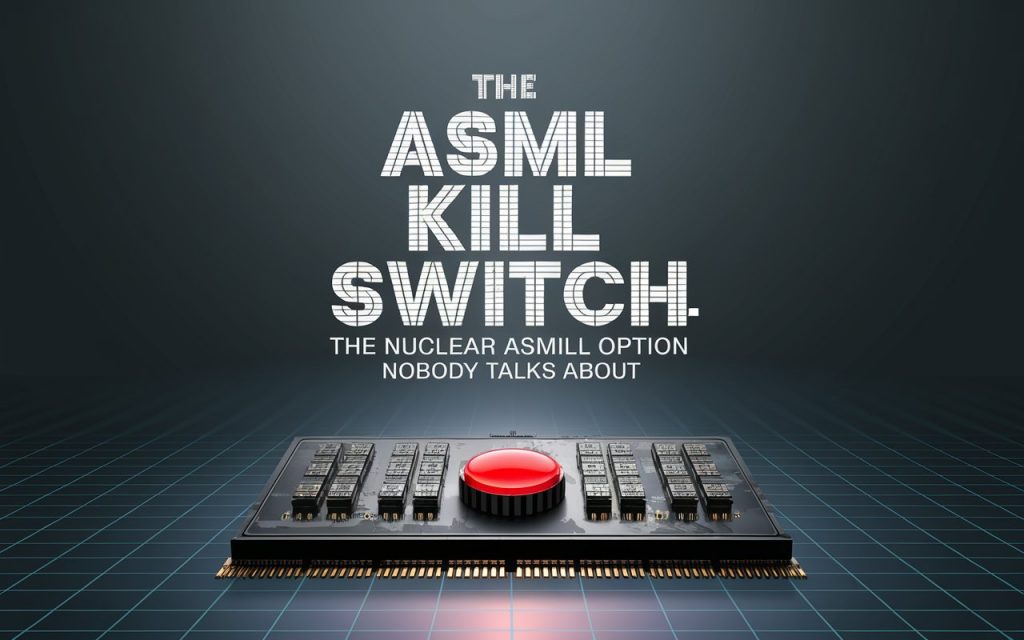
The ASML Kill Switch: The Nuclear Option Nobody Talks About
Here’s a detail that changes the entire geopolitical calculation, and most people don’t know about it.
ASML has the ability to remotely disable its EUV machines. That’s right – these $183 million machines have a kill switch.
The specifics, according to industry reporting: ASML can trigger a remote shut-off of its EUV systems. The capability exists because these machines require constant servicing, software updates, and maintenance from ASML’s engineers. Without that ongoing support, the machines would degrade and eventually become non-functional anyway.
ASML has reportedly reassured Dutch government officials about this capability. The Netherlands has even conducted simulations to assess the scenario of a Taiwan invasion and what would happen to the EUV machines.
TSMC Chairman Mark Liu himself stated publicly: “Nobody can control TSMC by force.” He added that any invasion would “render TSMC’s factory non-operable.”
This is sometimes called the “scorched earth” or “broken nest” strategy. The idea is straightforward: even if China physically captures TSMC’s fabs, the machines inside them become useless. Because:
- ASML can remotely disable the EUV systems
- Without ASML’s constant maintenance and parts, machines degrade within months
- The software and process recipes that make these fabs work require constant updates from TSMC’s R&D teams – most of whom would have fled
- Western nations would immediately impose total technology sanctions, cutting off all spare parts, chemicals, and materials
China would capture a building full of extraordinarily expensive, rapidly depreciating paperweights.
China’s Chip Ambitions: How Far Behind Is SMIC?
But what about China’s own semiconductor capabilities? Let’s look at what SMIC – China’s largest foundry – can actually do.
SMIC has successfully achieved mass production at the 7nm node, notably without EUV lithography. They accomplished this using older DUV (Deep Ultraviolet) equipment with a technique called multi-patterning – essentially doing multiple exposures to create smaller features. It works, but it’s slow, expensive, and has lower yields.
The Huawei Kirin 9000S chip in the Mate 60 Pro was manufactured using SMIC’s 7nm process, which stunned Western analysts in 2023 when it was first discovered.
For 5nm, the picture is less clear. SMIC is reportedly working on 5nm using DUV with Self-Aligned Quadruple Patterning (SAQP). But the cost is devastating: production costs are estimated at 40-50% higher than TSMC’s equivalent, with yields roughly one-third of what TSMC achieves.
Let me frame this with numbers. If TSMC produces 100 working 5nm chips from a wafer, SMIC might produce 33, at nearly double the cost per wafer. That’s not commercially competitive. It’s a strategic capability, not an economic one.
China’s broader semiconductor self-sufficiency goals tell the same story. The “Made in China 2025” initiative targeted 70% self-sufficiency. The reality? Goldman Sachs estimated that in 2024, domestic suppliers met approximately 14% of China’s semiconductor demand by value. TrendForce projected about 50% by 2025, but that includes mature nodes (28nm+), not the cutting-edge chips that power AI.
China has poured over $38 billion into its chip industry in 2024 alone, and its total semiconductor output reached a record 484.3 billion units. But producing a lot of mature-node chips is wildly different from producing leading-edge AI chips.
China can make the chips that go in washing machines. It cannot, as of today, make the chips that go in data centres training frontier AI models. As we explored in our India semiconductor strategy analysis, even countries with serious ambitions are finding out that catching up in chip manufacturing is a multi-decade, multi-hundred-billion-dollar problem.
The $10.6 Trillion Question: What Happens If China Invades?
Multiple research institutions have modeled the economic impact of a Taiwan conflict. The numbers are apocalyptic.
According to analysis from Bloomberg Economics and the Hague Centre for Strategic Studies (HCSS):
- Full invasion scenario: $10.6 trillion in global GDP loss in the first year – equivalent to 9.6% of global GDP. For context, the 2008 financial crisis caused a ~5% GDP contraction. COVID-19 caused approximately 3.4%. A Taiwan conflict would be worse than both combined.
- Naval blockade scenario (without invasion): $2.7 trillion in global costs, with a 2.8% decline in global economic output in the first year.
- The Taiwan Strait: This narrow waterway carries roughly half of the global container fleet. Any disruption, even without combat, would cascade through every supply chain on Earth.
But the numbers don’t capture the full picture. Let me walk through what would actually happen in stages:
Week 1: TSMC halts all production. ASML remotely disables EUV machines. Taiwan activates semiconductor industry shutdown protocols. TSMC engineers begin evacuating to the US and Japan.
Month 1: Global chip shortages begin. Not the annoying 2021-2022 shortages where you couldn’t buy a PS5. Something far worse. Every major customer – Apple, NVIDIA, AMD, Qualcomm – loses access to their primary manufacturer for leading-edge chips.
Month 3-6: Automotive production collapses. Smartphone production drops by 50-60%. AI training clusters can’t be expanded. Cloud computing costs spike. Defense industries across NATO realize they can’t procure advanced chips for weapons systems.
Year 1-2: Samsung and Intel attempt to absorb demand but can only handle a fraction. Samsung’s 7% market share can’t suddenly become 70%. Even with every alternative fab running 24/7, the world faces a structural deficit of cutting-edge chips that lasts years.
Year 3-5: This is where it gets truly strategic. The country that controls advanced chip manufacturing controls the AI race. If China somehow gets TSMC’s know-how working (unlikely, given the kill switches and loss of expertise), it could create a scenario where China has advanced chips and the rest of the world doesn’t.
Could China Use Chips as Leverage, Like Rare Earth Metals?
This is the question that keeps defense strategists up at night. China already demonstrated this playbook with rare earth metals, placing export bans on materials critical to US defence and technology. Could it do the same with semiconductors?
The scenarios break down like this:
Scenario 1: China captures and operates the fabs (unlikely)
Even if China physically controls the fabs, without ASML parts, Western chemicals, and TSMC expertise, the fabs would degrade within months. This scenario is the least likely to result in a Chinese chip monopoly.
Scenario 2: China blockades Taiwan without invading (more dangerous)
A blockade doesn’t trigger the kill-switch scenario but gradually starves TSMC of materials, employees, and customers. This is the slow-burn nightmare – it doesn’t destroy capability, it holds it hostage. China could selectively allow chip exports to “friendly” nations while cutting off the US and allies.
Scenario 3: China threatens invasion to extract concessions (most likely)
The credible threat of invasion, combined with increasing military exercises, could be used as leverage to weaken export controls, force technology transfers, or split Western alliances. This is arguably already happening.
The rare earth metals analogy is instructive but imperfect. China controls ~60% of rare earth mining and 90% of processing. It imposed restrictions on gallium and germanium exports to the US in 2023, expanded to antimony and other minerals in 2024-2025. The US scrambled to find alternatives.
Semiconductors would be exponentially worse. You can find alternative sources of rare earth metals (it takes years and costs billions, but it’s physically possible). You cannot find alternative sources of cutting-edge chips, because there are no alternative sources. TSMC is it. The whole game is TSMC.
The Global Response: Can $300+ Billion Fix This?
The world is not sitting idle. The response has been the largest industrial policy mobilization since World War II:
United States – CHIPS Act:
- $52 billion in semiconductor subsidies (part of a larger $280 billion package)
- Intel: $8.5 billion in grants + $11 billion in loans for fabs in Arizona, New Mexico, Ohio, Oregon
- TSMC: $6.6 billion in grants + $5 billion in loans for Arizona fabs ($165 billion total US investment)
- Samsung: $6.4 billion for a $37-44 billion fab in Taylor, Texas
European Union – EU Chips Act:
- €43 billion in public investment, targeting €86 billion total with private matching
- Goal: double Europe’s share from 10% to 20% of global production by 2030
- Reality check: projections suggest Europe will only reach ~11.7% by 2030
- Key projects: TSMC’s €10 billion fab in Dresden, GlobalFoundries’ €1.1 billion Dresden expansion
- Intel’s €17 billion Magdeburg fab was reportedly cancelled in mid-2025
Japan:
- ~$26 billion in chip subsidies since 2021
- Rapidus consortium targeting 2nm production by 2027, backed by almost €12.5 billion in government grants (partnering with IBM)
- TSMC’s JASM joint venture with Sony and Denso in Kumamoto
- Goal: triple semiconductor sales by 2030
This is an enormous amount of money. But here’s the cold truth: even with $300+ billion in global subsidies, the world cannot replicate TSMC’s Taiwan capacity within this decade. The Arizona fab produces 4nm chips. TSMC Taiwan is already at 3nm and ramping 2nm. By the time US and European fabs reach leading-edge capability, TSMC Taiwan will be at sub-2nm Angstrom nodes.
We’re not building a replacement. We’re building a partial backup that’s perpetually one generation behind. The mass automation and job displacement that AI enables – all of that depends on chips that, right now, only one island can make at the required scale.
TSMC: The Foundation for World War III?
I want to be careful with this framing, but the parallels are uncomfortable. Taiwan’s semiconductor industry functions as what strategists call a “silicon shield” – the idea that Taiwan’s critical importance to the global economy deters Chinese aggression because major powers would intervene to protect their chip supply.
But there’s a dangerous paradox here. The more TSMC diversifies manufacturing to Arizona, Japan, and Germany, the weaker the silicon shield becomes. If the most advanced fabs are no longer exclusively in Taiwan, the West’s strategic incentive to defend Taiwan militarily decreases. Some analysts argue TSMC’s geographic diversification, while economically rational, is geopolitically destabilizing.
The counterargument is that diversification makes a conflict less likely because it reduces the strategic value of capturing Taiwan’s fabs. But that assumes China’s interest in Taiwan is purely about semiconductors, which it isn’t – it’s deeply tied to national identity, territorial claims, and regime legitimacy.
Here’s what I think most analysis gets wrong: the question isn’t whether Taiwan’s chips could trigger World War III. The question is whether Taiwan’s chips are the most important single asset that the current world order needs to protect. And the answer, uncomfortably, might be yes.
Think about what’s downstream of TSMC: every AI model, every smartphone, every cloud server, every autonomous vehicle, every military drone, every satellite, every medical device with an advanced processor. If you control TSMC’s output – or can deny it to others – you control the technological trajectory of civilization.
No oil field, no gold mine, no rare earth deposit comes close to that level of strategic importance.
Through the Expert’s Lens: What the Analysis Misses
After writing this entire analysis, I stepped back and re-read it through two lenses: that of a geopolitical strategist and that of someone with a deep background in computer science and AI systems. Here are the questions that came up and the answers that most coverage ignores.
Q: Is the “kill switch” really foolproof?
From an engineering perspective: no single software mechanism is ever 100% reliable. Remote kill switches can potentially be blocked by physically isolating machines from external networks (air-gapping). However, EUV machines are so complex that they require continuous calibration, parts replacement, and software updates.
Even without a kill switch, an EUV system without ASML service contracts would degrade to non-functionality within 6-12 months. The machine’s laser source alone requires regular maintenance and tin droplet replenishment. So the kill switch is a first line of defense, but the real defense is the machine’s inherent complexity and dependency on the ASML supply chain.
Q: Could China reverse-engineer EUV technology?
This is where the CS/physics lens matters. EUV lithography isn’t a software problem you can brute-force. It requires optics polished to sub-nanometer precision (the Zeiss mirrors are the flattest surfaces ever manufactured by humans), a laser system capable of hitting tin droplets at 50,000 pulses per second, vacuum systems, contamination control, and alignment precision measured in fractions of nanometers.
China is reportedly developing its own lithography using laser-induced discharge plasma (LDP)-based approaches, but mass production is targeted for 2026 at earliest, and it would likely start at DUV-level capability, not EUV. The consensus among semiconductor physicists: indigenous Chinese EUV is 8-15 years away.
Q: If training is the bottleneck, do chips matter less once models are trained?
This is a critical AI-specific question. The answer is nuanced. Yes, once a model like GPT-5 or Gemini 3 is trained, the inference chips needed to run it are less advanced than training chips. But the AI field is moving so fast that today’s frontier model is tomorrow’s baseline.
The real power comes from continuous training, fine-tuning, and developing next-generation architectures. Countries locked out of leading-edge chips wouldn’t just lose training capability: they’d lose the ability to participate in the next 3-5 years of AI breakthroughs. And inference at scale still requires enormous chip quantities – just ask any company running AI at production scale.
Q: What happens to open-source AI if TSMC goes down?
Open-source models like Llama, DeepSeek, and Qwen exist as weights that can run on existing hardware. They wouldn’t disappear. But the hardware to run them at scale – GPUs, TPUs, AI accelerators – all come from TSMC-made chips. So existing open-source models would still work on current hardware, but the ability to train new ones, or run them at scale for millions of users, would be severely constrained. The open-source AI movement’s greatest vulnerability isn’t its code – it’s the silicon beneath it.
Q: Is the real risk not invasion but gradual technological decoupling?
From a geopolitical perspective, yes. The most realistic scenario isn’t a dramatic invasion – it’s what we’re already seeing: tightening export controls, retaliatory restrictions, parallel technology ecosystems forming.
China building its own chip stack (even if inferior), the US building fabs on domestic soil, Europe and Japan doing the same. The result isn’t a single catastrophic event but a slow bifurcation of the global technology stack into two incompatible ecosystems. That’s arguably more damaging to global innovation than a short conflict, because it permanently fragments the knowledge base and reduces collaboration.
The Bottom Line
The semiconductor supply chain is the most fragile, most critical, and most concentrated strategic vulnerability in human history. One company (ASML) makes the machines. One company (TSMC) operates most of them. And the majority of the world’s most advanced chipmaking sits on one island in one of the most geopolitically volatile regions on Earth.
Can the world survive without TSMC? Yes – eventually. The lights won’t go out permanently. ASML can ship machines elsewhere. Samsung, Intel, and Rapidus can scale up. But “eventually” means 7-10 years of severe disruption, trillions in economic damage, and a potential fracturing of the AI revolution into regional technology blocs.
The global chip subsidy race ($300+ billion and counting) is the world’s insurance policy. But like all insurance, it pays out after the disaster, not before. And the premiums – measured in years and hundreds of billions of dollars – are staggering.
If I’m being honest, the most likely scenario isn’t a dramatic invasion. It’s a slow, grinding escalation of pressure: military exercises, trade restrictions, diplomatic coercion, and the gradual erosion of Taiwan’s autonomy. Death by a thousand cuts, not a single blow.
But the contingency built into every EUV machine, that remote kill switch sitting quietly in every $183 million lithographic system in Taiwan, tells you everything about how seriously the world takes this threat. When you build a self-destruct button into the most advanced technology humans have ever created, you’re acknowledging a reality that no amount of diplomacy has been able to resolve.
TSMC isn’t just a company. It’s the foundation on which the entire modern technology stack rests. And that foundation is sitting in the most dangerous neighbourhood on Earth.
FAQ
Can ASML build EUV machines outside the Netherlands?
ASML is headquartered in Veldhoven, Netherlands, but its supply chain spans hundreds of companies across Europe, the US, and Japan. Key optics come from Carl Zeiss (Germany), light sources from Cymer (a US subsidiary of ASML).
The company has facilities in 16 countries. While ASML could theoretically shift some assembly, the specialized supply chain makes rapid relocation extremely difficult. The real bottleneck isn’t where ASML assembles – it’s the dozens of ultra-specialized suppliers that each represent single points of failure.
How long before SMIC catches up to TSMC?
At current trajectories, SMIC is 2-3 generations behind TSMC on leading-edge nodes and the gap is widening, not closing. SMIC can produce 7nm chips without EUV, but at lower yields and higher costs. Without access to EUV lithography (blocked by export controls), SMIC’s path to 5nm and below involves increasingly complex and costly workarounds.
Most industry analysts estimate SMIC would need 10-15 years and successful development of indigenous EUV technology (which China is actively pursuing but has not demonstrated) to reach parity with TSMC’s current capabilities.
Could Intel Foundry replace TSMC?
Intel Foundry Services is building significant capacity and targeting leading-edge production with its 18A node (expected 2026-2027). However, Intel Foundry doesn’t currently rank in the top 10 foundries by market share, and its external foundry business has yet to attract major customers at scale. Intel also reported operating losses of $2.5 billion in Q4 2025 for its foundry division. While Intel is a critical piece of the diversification puzzle, it’s years away from being able to absorb even a fraction of TSMC’s volume. The honest assessment: Intel could become a meaningful alternative for some customers by 2028-2030, but not a TSMC replacement.
What about Rapidus in Japan?
Rapidus, backed by approximately €12.5 billion in Japanese government grants and partnering with IBM on process technology, is targeting 2nm production by 2027. If successful, it would represent a significant breakthrough for Japanese semiconductor sovereignty. But Rapidus is building from near-zero – it’s a new entity without decades of manufacturing experience. The 2027 target is ambitious, and even if met, initial volumes will be tiny compared to TSMC’s output. Think of Rapidus as a strategic insurance policy, not a replacement.
If TSMC is so critical, why isn’t it the most valuable company?
TSMC’s $1.86 trillion market cap makes it the 6th most valuable company globally. But its revenue of $122.4 billion in 2025 is just a fraction of Apple’s (~$400B) or NVIDIA’s massive valuation. The reason is structural: foundries operate on thinner margins than the chip designers they serve.
NVIDIA designs a $40,000 GPU and keeps most of the profit. TSMC manufactures it for a fraction of that price. The irony is that the company capturing the most value (NVIDIA) is entirely dependent on the company capturing less value (TSMC) for its existence.
Would China really invade just for chips?
No – and that framing misses the point. Taiwan’s status is fundamentally about Chinese national identity and territorial sovereignty, not semiconductors. The chip angle is relevant because it shapes the global response to any conflict. Semiconductors make Taiwan strategically vital to the US, Japan, and Europe in ways that go beyond traditional alliance politics. The chips don’t cause the conflict – they determine who shows up to fight it.