

OpenAI just retired GPT-4o nine days ago. Anthropic dropped Claude Sonnet 4.6 five days ago. And somewhere in Abilene, Texas, 400,000 NVIDIA Blackwell chips are warming up inside the first Project Stargate data center.
The next generation of AI models – GPT-6 and Claude Opus 5 – aren’t hypothetical anymore. They’re being built right now, on infrastructure that didn’t exist a year ago, with architectural ideas that would’ve gotten you laughed out of a lab meeting in 2024.
The question everyone’s asking is the wrong one. “Which will be smarter?” doesn’t matter when both labs are fundamentally changing how models think. The real war is over System 2 reasoning – the shift from models that reflexively predict tokens to models that sit, deliberate, check their own work, and only then give you an answer.
Here’s everything we actually know, verified against official sources, prediction markets, and community intel, as of today.
What GPT-6 Actually Is (And Isn’t)
Let me kill the noise first.
Sam Altman flew to India this month for the AI Impact Summit, met PM Modi, and dropped several hints. The most revealing: memory is his “favorite feature” for GPT-6, and he expects AI systems that can “figure out novel insights” to arrive by 2026. He’s been saying this consistently since late 2025.
Here’s the verified timeline from official statements, prediction markets, and credible leaks:
The GPT-5.x family is the current battlefield. OpenAI has been shipping iteratively: GPT-5 (August 2025), GPT-5.1 with Instant and Thinking modes (November 2025), GPT-5.2 as the flagship reasoning model (December 2025), and GPT-5.3-Codex just three weeks ago on February 5. They retired GPT-4o from ChatGPT entirely on February 13. The latest ChatGPT context window is 256k tokens. This isn’t incremental – it’s a sprint.
GPT-6 is training now. The infrastructure tells the story. Project Stargate – a $500 billion JV between OpenAI, SoftBank, Oracle, and MGX – is building exactly for this moment. The Abilene, Texas site houses 400,000 Blackwell chips, a 20x increase over the ~20,000 used for GPT-4 training. Oracle began supplying Nvidia GB200 racks in June 2025, with early training workloads already running. Five additional Stargate sites are planned, targeting seven gigawatts of capacity. The first gigawatt of NVIDIA Vera Rubin infrastructure comes online in H2 2026.
The internal codename history matters. “Orion” was GPT-4.5, OpenAI’s final non-chain-of-thought model. “Strawberry” became the o1 reasoning family. GPT-5.5 is reportedly codenamed “Garlic” and is being tested internally, already outperforming Gemini 3 and Opus 4.5 in coding and logic benchmarks according to January 2026 reports.
| Fact | Status | Source |
|---|---|---|
| GPT-6 won’t ship before June 2026 | High confidence | Manifold: 17% chance before June 1 |
| GPT-6 ships in 2026 | Likely (78%) | Manifold prediction market |
| Memory is the core GPT-6 feature | Confirmed | Altman: multiple interviews, India AI Summit |
| 100,000+ NVIDIA chips for training | Confirmed | Project Stargate official, LifeArchitect.ai |
| GPT-5.5 “Garlic” in internal testing | Rumored | YouTube leaks, Jan 2026 |
The honest picture? GPT-6 is likely a late 2026 release. The gap from GPT-5 (Aug 2025) would be 12-16 months, which matches Altman’s hint of a “shorter gap” than the 28 months between GPT-4 and GPT-5. But OpenAI isn’t just sitting idle – they’re iterating the GPT-5.x family so aggressively that you’re already getting pieces of GPT-6’s architecture before the model itself ships.
GPT-5’s Unified Router: System 2 Is Already Here
This is what most analysis pieces miss. System 2 reasoning isn’t a future feature. It shipped inside GPT-5 in August 2025.
GPT-5 contains a “real-time router” – an internal system that assesses the complexity, type, and intent of your request and dynamically selects the processing pathway. Simple question? System 1 – fast, token-prediction, instant response. Complex coding architecture problem? System 2 – slower, deliberate reasoning with an internal scratchpad, the same mechanics as the o3 and o4-mini models.
This is Kahneman’s dual-process theory running in production. The router doesn’t just pick a mode; it’s the architectural innovation. Because the question “How smart is this model?” is the wrong one. The right question is: “How much compute does the router allocate to this specific query?”
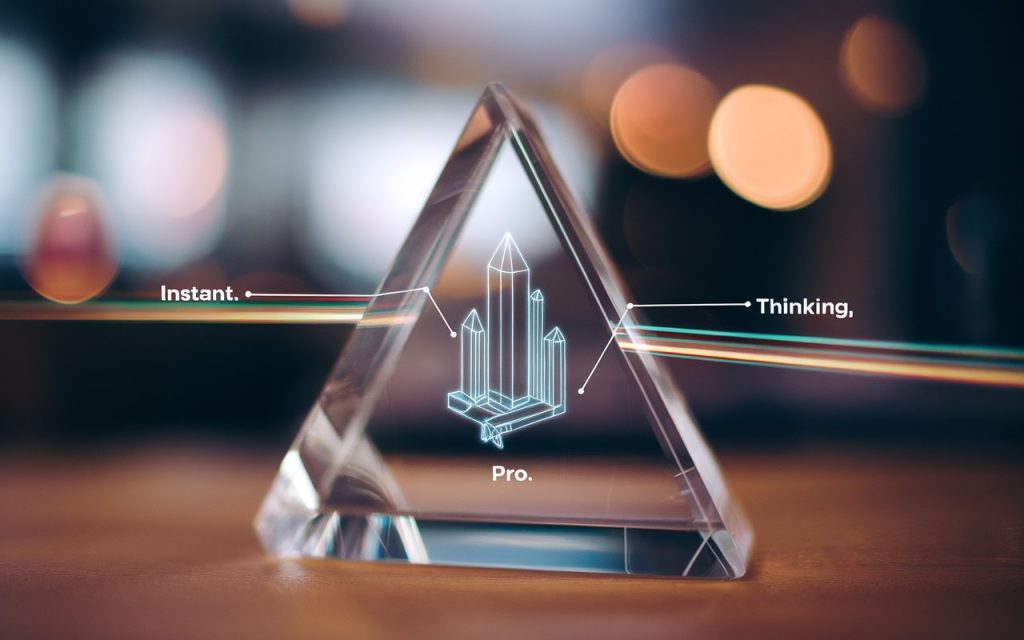
GPT-5.2 made this explicit with three modes:
- Instant: Fast, conversational. Think System 1.
- Thinking: Deep reasoning with visible chain-of-thought. System 2 at medium effort.
- Pro: Maximum compute allocation with “xhigh” reasoning effort. System 2 at full throttle.
The hidden cost? OpenAI’s reasoning tokens – the internal tokens the model generates to “think” before responding – are billed as output tokens. Their documentation recommends reserving 25,000 tokens for reasoning workloads. A single complex refactoring query can burn thousands of tokens you never see. That’s the real cost of System 2.
Anthropic’s War Chest: $380B, 16 Agents, One C Compiler
Anthropic is playing a different game. While OpenAI builds infrastructure, Anthropic is proving that intelligence can be orchestrated rather than trained.
The numbers that matter:
- $30 billion raised in Series G, announced February 12, 2026
- $380 billion post-money valuation
- $14 billion annualized revenue (10x growth year-over-year for three straight years)
- 8 of the Fortune 10 are now Claude customers
- Led by GIC and Coatue, with Founders Fund, D.E. Shaw, and MGX co-leading
Those aren’t startup numbers. That’s a company preparing infrastructure for frontier models.
Claude Opus 4.6 dropped February 5 with two features that matter more than benchmarks. Adaptive Thinking dynamically calibrates reasoning depth – four effort levels (low, medium, high, max) with interleaved thinking for agentic workflows.
Context Compaction automatically summarizes older conversation context as it approaches the 1M-token window limit, enabling what Anthropic calls “effectively infinite conversations.” Both features are System 2 mechanisms disguised as product improvements.
Claude Sonnet 4.6 – leaked under its internal codename “Fennec” with model identifiers like claude-sonnet-5@20260203 appearing in Google Vertex AI logs – officially launched February 17. The specs:
- 82.1% SWE-bench (beats Opus 4.5)
- 1M token context window
- $3/$15 per million tokens (80% cheaper than Opus 4.5)
- Default model for Claude.ai free tier, Claude Code, and Claude Cowork
But the most explosive demonstration came from Anthropic researcher Nicholas Carlini, who ran 16 Claude Opus 4.6 agents in parallel to build a C compiler from scratch. The result: 100,000 lines of Rust code, compiled via approximately 2,000 Claude Code sessions over two weeks, for about $20,000 in API costs.
The compiler successfully compiled the Linux 6.9 kernel across x86, ARM, and RISC-V architectures, plus FFmpeg, Redis, PostgreSQL, and QEMU. It hit 99% on the GCC torture test suite.
For context: a human team doing the same work would cost millions and take months. Sixteen agents, coordinating through a shared Git repo, did it for the price of a used Honda Civic.
What Claude 5 / Opus 5 Will Look Like
Dario Amodei isn’t being subtle about where this is going. He’s publicly predicted that by summer 2026, frontier AI users will feel like they’re living in a “parallel world” compared to non-users. He’s predicted the first billion-dollar solopreneur enabled by AI in 2026. He’s said AI could perform most tasks currently done by software engineers within 6-12 months.
The Claude 5 family – Opus 5, Sonnet 5, and Haiku 5 – is expected between May and September 2026 based on Reddit leaks and Anthropic’s historical release cadence. The key anticipated feature is the “Dev Team” mode:
- A single prompt initiates multi-agent collaboration
- An orchestrator agent breaks complex tasks into sub-tasks
- Specialized sub-agents tackle each piece independently
- Built-in verification and peer-review between agents
- All automated behind a single API call
This isn’t theoretical. The 16-agent C compiler demo was the proof of concept. Dev Team mode productizes it. Instead of manually orchestrating Claude Code sessions, you describe what you want built, and a team of Claude agents architects, codes, tests, and delivers it.
The broader Anthropic product roadmap for 2026, revealed in their official communications, centers on a vision where human developers orchestrate AI agent systems while the AI handles implementation. “Democratization of coding” isn’t a marketing phrase for them – it’s the business model.
The Real Divergence: Architect vs. Brute Force
Here’s my actual take on the rivalry.
OpenAI is betting on scale. $500 billion in compute infrastructure. 400,000 Blackwell chips. A unified router that dynamically allocates reasoning compute. GPT-6’s persistent cross-session memory means the model learns your codebase quirks over weeks. The thesis: build a single, massive intelligence that can do everything.
Anthropic is betting on orchestration. $30 billion in capital for a company whose most impressive demo used 16 agents coordinating through Git. Adaptive Thinking that calibrates effort per query. Context Compaction for infinite conversations. The thesis: build many specialized intelligences that collaborate, with humans directing strategy.
Both approaches need System 2 reasoning. But they implement it differently:
| Dimension | OpenAI (GPT-6) | Anthropic (Claude 5) |
|---|---|---|
| System 2 Strategy | Unified router inside one model | Multi-agent orchestration |
| Memory | Persistent cross-session (core feature) | Context Compaction (1M→infinite via summarization) |
| Key Infra | Project Stargate ($500B, 400k chips) | $30B Series G, cloud-native |
| Agentic Focus | Single model doing multi-step tasks | Agent teams with specialization |
| Release Window | Late 2026 (78% per Manifold) | Q2-Q3 2026 for Claude 5 family |
| Energy Profile | Massive compute per model | Distribute compute across agents |
What This Means for Developers Right Now
Stop waiting for GPT-6 or Opus 5 to change your workflow. The tools are already here.
1. The reasoning budget is the new prompt. GPT-5.2’s reasoning_effort parameter (low/medium/high/xhigh) and Claude’s four effort levels mean you’re no longer just writing prompts – you’re allocating compute budgets. Simple classification? Low effort, fast, cheap. Complex architecture review? Max effort, slow, expensive. This is the new skill: knowing when a task deserves System 2 treatment.
2. Multi-agent is production-ready. If 16 Claude agents can build a C compiler that compiles the Linux kernel, your team can build agent pipelines for your CI/CD, your code reviews, your test generation. Claude Code’s Agent Teams feature is available today. OpenAI’s Codex agent does multi-step autonomous coding. Start building orchestration, not writing longer prompts.
3. Zero-shot is not dead – it’s the default for reasoning models. This is counterintuitive but verified directly from OpenAI’s documentation: for o-series reasoning models, simpler zero-shot prompts outperform elaborate chain-of-thought instructions. The model has internalized reasoning. Adding “think step by step” is now redundant and wastes tokens. Instead, define evaluation criteria and constraints, not step-by-step procedures.
4. The energy constraint is real. A standard GPT query: ~0.34 Wh. An o3-level System 2 reasoning query: 7-40 Wh. That’s up to 100x the energy per prompt. Inference already consumes 70-90% of an LLM’s lifecycle energy, and inference spending officially surpassed training spending globally in early 2026. This is the throttle on universal System 2 adoption.
The Bottom Line
GPT-6 and Claude Opus 5 are coming in 2026. That’s not the news. The news is that the race between them isn’t about parameter counts – it’s about two fundamentally different architectures for machine reasoning. OpenAI wants one brain that does everything. Anthropic wants a team of specialists that collaborate. Both are betting everything on System 2.
The winner won’t be the model that scores highest on benchmarks. It’ll be the one that developers can actually integrate into their workflows without burning through their entire cloud budget on hidden reasoning tokens. Watch this space.
FAQ
When will GPT-6 actually release?
Prediction markets give a 78% probability for 2026, but only 17% before June. The most likely window is H2 2026, based on Altman’s statements about a shorter gap than GPT-4→GPT-5 (28 months) and the Project Stargate infrastructure timeline. OpenAI is currently iterating the GPT-5.x ecosystem aggressively.
Is Claude Sonnet 5 the same as Claude Sonnet 4.6?
Yes. What was leaked as “Claude Sonnet 5” with codename “Fennec” was officially released as Claude Sonnet 4.6 on February 17, 2026. Anthropic seems to be reserving the “5” numbering for the next generation, expected Q2-Q3 2026.
What’s the real difference between System 1 and System 2 in AI?
System 1 is standard autoregressive token prediction – fast, cheap, instinctive. System 2 uses internal reasoning tokens (scratchpads, chain-of-thought, verification loops) before generating a visible response. GPT-5’s unified router and Claude’s Adaptive Thinking both dynamically choose between these modes based on query complexity.
How much does System 2 reasoning actually cost?
It varies enormously. A low-effort GPT-5.2 query costs fractions of a cent. A max-effort reasoning query using o3-level compute can burn thousands of hidden tokens and cost $0.10-$0.50+ per request. The key insight: you’re paying for thinking tokens that you never see in the output.
What was the 16-agent C compiler experiment?
Anthropic researcher Nicholas Carlini ran 16 Claude Opus 4.6 instances in parallel using Claude Code. They built a 100,000-line Rust C compiler in two weeks for ~$20,000 in API costs. It compiled the Linux 6.9 kernel and hit 99% on the GCC torture test suite. It’s the most compelling demonstration of multi-agent AI development to date.