

The AI industry is restructuring. Violently.
While everyone fixates on Anthropic’s aggressive moves against third-party API tools and the quiet rise of hyper-optimized Chinese agentic models, the real battle for enterprise dominance is happening at the absolute frontier.
February 2026. Two heavyweight models launched within weeks of each other.
Anthropic’s Claude Opus 4.6 dropped on Feb 5. Google’s Gemini 3.1 Pro hit preview on Feb 19. Both claim a 1-million token context window. Both promise to transform how enterprises build with AI.
Here’s the question nobody is asking: What good is a million tokens if the model loses the plot halfway through?
Throwing 100,000 lines of code into a context window—without the reasoning capacity to understand it—is like giving a toddler a library card. The constraint isn’t storage. It’s active reasoning. And the way Anthropic and Google solve that problem is fundamentally different.
The Context: How We Got Here
Context windows have been ballooning. Fast.
We went from 32K to 128K. Now 1M is table stakes. You’re seeing this trajectory everywhere—including GitHub Copilot’s deep adoption of GPT-5.3-Codex.
But here’s the problem nobody advertises: more context doesn’t scale linearly with intelligence.
In fact, it exposes a critical flaw in traditional LLM architectures. The “Lost in the Middle” bias. When you flood a model with millions of tokens, it is statistically likely to misweight information buried in the center of the prompt. Think of it as short-term memory decay, but for transformers at scale.
The Desk and The Reader. That’s the analogy I want you to hold onto.
A 1-million token context window is a desk the size of a football field. You can lay out 10,000 documents simultaneously. But if the reader forgets the first document by the time they reach the last, the desk size is irrelevant. The constraint is the reader, not the desk.
The Constraint: Physics, Memory, and Compaction
So how does each lab solve the reader problem?
Anthropic’s answer: Adaptive Thinking. Claude Opus 4.6 lets developers dial model effort across four explicit levels—low, medium, high, max. Think of it like a car transmission. You don’t need fourth gear in a parking lot. But you do need it during a complex, multi-file refactor on a 500,000-line monorepo.
The real unlock is Context Compaction. It’s a beta feature that automatically summarizes older segments of a long-running agent loop. Rather than letting the model drown in stale tokens, it prunes the desk. Keeps the most important information front and center. This is a direct evolution of Anthropic’s programmatic tool calling architecture—memory management as a core capability, not an afterthought.
Google’s answer is completely different.
Gemini 3.1 Pro is natively multimodal. It doesn’t just read text. Within that 1M window, it processes up to 8.4 hours of audio or 45 minutes of video. It uses Google DeepMind’s specialized routing infrastructure to scan cross-modal inputs at speed. Google isn’t just growing the desk—it’s building a different kind of desk entirely. One that can hold audio transcripts, video frames, code, and prose simultaneously.
The constraint for Google isn’t reasoning depth. It’s multimodal throughput.
The Breakthrough: Terminal-Bench vs SWE-Bench
The benchmark wars are getting messy. Really messy.
Claude Opus 4.6 launched with a 65.4% score on Terminal-Bench 2.0. Anthropic celebrated. Two weeks later, Gemini 3.1 Pro scored 68.5% on the exact same eval. Google looked like the winner.
But look closer.
On SWE-bench Verified—the gold standard for real-world agentic coding that is rigorously filtered for contamination—Opus 4.6 holds an 80.8% accuracy rate. Gemini 3.1 Pro’s SWE-bench Pro number? A comparatively modest 54.2% but notice it is for SWE-Bench pro not swe bench on which Opus is 22.7%.
That’s not a small gap. That’s a structural difference in capability.
| Feature | Gemini 3.1 Pro | Claude Opus 4.6 |
|---|---|---|
| Context Window | 1M tokens | 1M tokens (Beta) |
| SWE-bench | 54.2% (Pro) | 80.8% (Verified) |
| Terminal-Bench 2.0 | 68.5% | 65.4% |
| ARC-AGI 2 | 77.1% | 68.8% |
| Key Native Feature | SVG Generation, Video/Audio | Context Compaction, Adaptive Thinking |
| Price per 1M (In/Out) | Unavailable (Preview) | $5 / $25 |
Google’s model is dominant on abstract-reasoning benchmarks like ARC-AGI 2. It’s genuinely impressive at algorithmic generation and terminal navigation. But Anthropic’s model is built to survive the friction of real, messy, enterprise software. It’s a different category of job.
The developer community has noticed. I’ve been tracking r/LocalLLaMA and the pattern is consistent: “Gemini falls over a lot when actually trying to get things done, despite the high scores.” Meanwhile, Opus 4.6 is already being deployed alongside Claude’s new modular agent architectures—and the reports are far more stable.
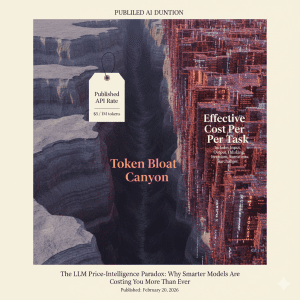
The Real-Time Cost of Intelligence: A Look at the Data
Benchmarks tell you accuracy. Cost data tells you the truth.
The Artificial Analysis Intelligence Index measures actual real-time model behavior—intelligence score, cost to evaluate, and output token volume. The data reveals the exact tradeoff both labs are making.
Claude Opus 4.6 (max) — at full Adaptive Thinking capacity — scores an elite ~64 on the Intelligence Index. That is the highest of any model currently on the market. But it costs $2,486 to run the benchmark suite. It generates 58 million output tokens—of which nearly 50 million are pure reasoning tokens burned internally before the model outputs a single word.
Dial it back to standard mode. Claude Opus 4.6 drops to the mid-40s on intelligence, but costs $1,451 and generates 11 million tokens. Still expensive. But the delta is significant.
Now look at Gemini 3.1 Pro Preview. It scores ~57 on the Intelligence Index—extraordinarily close to Opus’s max mode. And it costs only $892 to run. Yes, it also generates 57 million tokens (53 million reasoning). But Google’s infrastructure pricing makes it nearly 3x cheaper to operate at that intelligence level.
This confirms the core thesis: Opus 4.6 is the precision scalpel. You reach for it when failure isn’t an option and you need maximum cognitive power for a critical, one-shot task. Gemini 3.1 Pro is the baseline workhorse. Fast, smart, and economically viable at the scale enterprise teams actually need.
The Implication: Agentic Workflows at Scale
The era of question-and-answer AI is over. We are now in the era of cognitive workers.
If you are building automation scripts—or need a model to natively parse 6 hours of conference footage and extract structured insights—Gemini 3.1 Pro is the tool. Its multimodal throughput is unmatched. Its cost profile is production-ready. It feels fast. Because it is.
But if you are deploying autonomous coding agents against a production monorepo, you need Opus 4.6. The kind of agents that plan multi-step refactors before touching a file. That self-correct when tests fail. That stay coherent across 200,000-token reasoning chains. The Adaptive Thinking and Context Compaction stack makes that reliability possible. Even at the premium $5 input / $25 output pricing tier.
These are not interchangeable tools. They’re complements. Use the Claude Opus 4.6 vs Sonnet 4.6 breakdown to decide which Anthropic tier makes sense for your use case—then layer Gemini in for your multimodal and high-throughput workflows.
The Bottom Line
Google built the biggest desk. Anthropic built the smartest reader.
Gemini 3.1 Pro is a technically staggering piece of infrastructure—multimodal-native, cost-efficient at scale, and genuinely dangerous in the intelligence/cost quadrant. It belongs in your stack. For the right jobs.
Claude Opus 4.6 is in a different league when it comes to complex, stateful, agentic work. The cognitive scaffolding Anthropic has built—compaction, adaptive thinking, precise reasoning budgets—turns raw intelligence into reliable output. That matters far more than benchmark points when you’re deploying agents into production.
Gemini is your researcher. Opus is your lead engineer. Neither can replace the other. As models like xAI’s Grok 4.20 and OpenAI’s Codex variants continue to evolve, the real differentiator won’t be token capacity. It will be who built the better reader for that massive desk.
FAQ
Does Gemini 3.1 Pro actually beat Claude Opus 4.6 in coding?
On Terminal-Bench 2.0, yes (68.5% vs 65.4%). On SWE-bench Verified—a far more rigorous real-world coding eval—Claude Opus 4.6 wins decisively at 80.8% versus Gemini 3.1 Pro’s 54.2%.
What is Context Compaction in Claude Opus 4.6?
It’s a beta feature that auto-summarizes older conversation segments during long agentic loops. It prevents the model from hitting token limits or succumbing to the “Lost in the Middle” bias during complex, multi-hour coding sessions.
Which model is more cost-efficient for enterprise use?
Gemini 3.1 Pro Preview scores nearly as high as Claude Opus 4.6 (max) on the Artificial Analysis Intelligence Index but costs roughly 3x less to run. For high-volume workloads, Gemini wins on cost. For mission-critical agentic tasks, Opus 4.6’s precision justifies the premium. Check model leaderboards like LMSYS Chatbot Arena for ongoing real-world comparisons.