
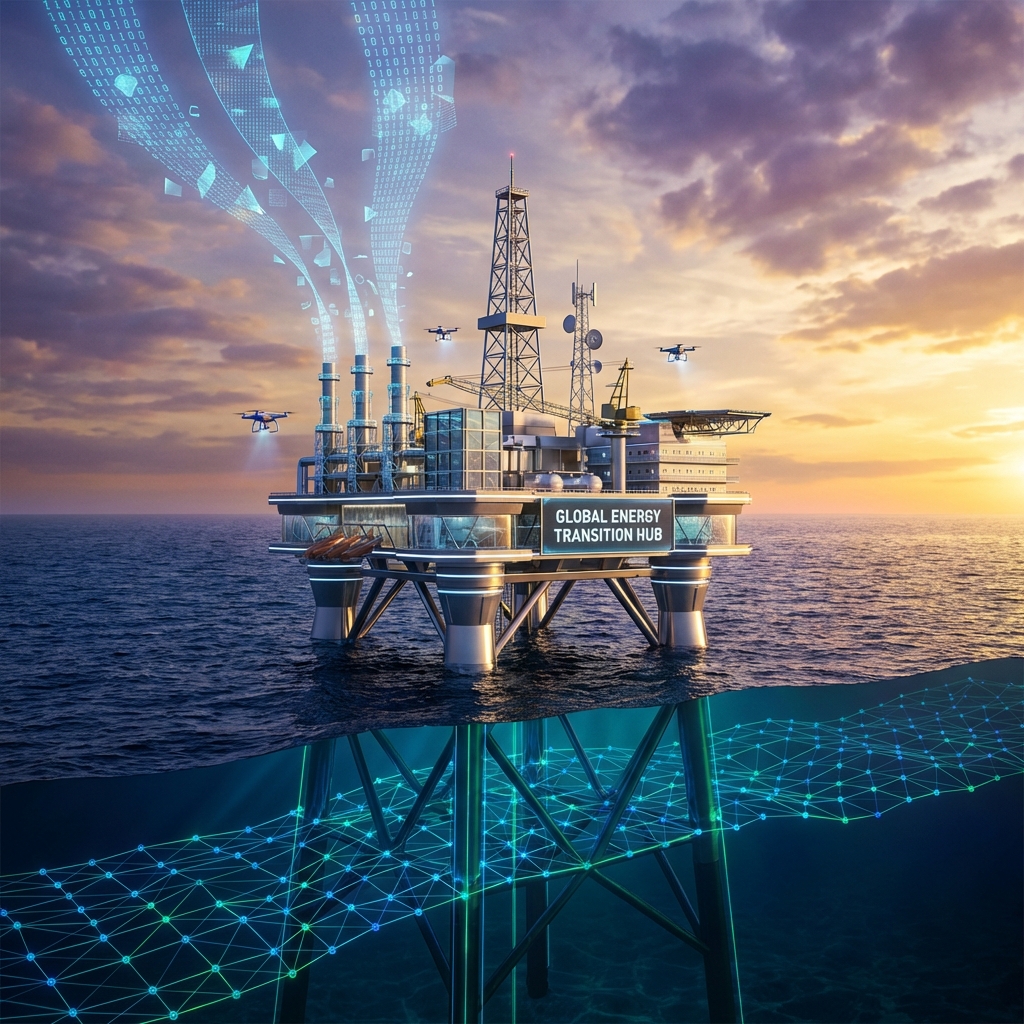

For a century, the oil industry was defined by “Roughnecks”—tough men covered in grease, wrestling steel pipe on a heaving offshore rig. Innovation meant bigger drills and deeper wells.
In January 2026, the Roughneck has been replaced by the “Prompt Engineer.”
The Global Oil & Gas industry is undergoing its most radical transformation since the invention of the fracking drill bit. Faced with immense pressure to decarbonize while simultaneously meeting the energy demands of AI data centers, specialized giants like SLB (formerly Schlumberger), Shell, and BP are turning to Generative AI to squeeze every last drop of efficiency out of the ground.
These aren’t just chatbots writing emails. These are “Physics-Informed Neural Networks” (PINNs) that interpret seismic data 100x faster than humans. They are “Autonomous Directional Drilling” robots that steer drill bits through rock miles underground with the precision of a surgeon. This article explores the partnership between SLB and NVIDIA, the rise of the “Digital Twin” oil field, and how algorithms are extending the life of the fossil fuel age.
Scenario: The North Sea Ghost Rig
To verify the reality of this shift, look at the “Valhalla II” platform in the North Sea.
The Crew: In 2015, a rig this size housed 120 people. Today, it houses 15.
The Operation: The rig is running in “Semi-Autonomous Mode.” Deep underground, a diamond-tipped drill bit is chewing through granite. It encounters a pocket of hard basalt.
Old Way: The vibration travels up the pipe. The driller sees a gauge spike. He manually slows the RPM. Reactive.
New Way (2026): Sensors on the bit transmit data to an Edge AI server on the rig. The AI detects the change in rock density in 5 milliseconds. It automatically adjusts the torque and weight-on-bit before* the vibration even starts. The human supervisor in Aberdeen (500 miles away) just gets a notification: “Drilling parameters optimized for Basalt formation.”
The Technical Deep Dive: Generative Seismology
The biggest cost in oil is “Dry Holes”—drilling where there is no oil. It costs $100 million to drill a deep-water well. If you miss, you burn that cash.
The “Seismic Interpretation” Bottleneck
To find oil, ships tow miles-long cables (streamers) that blast sound waves into the ocean floor. The echoes create a 3D map of the subsurface.
The Old Way: A team of geophysicists would stare at these squiggly lines for 9 months, trying to spot the subtle difference between a salt dome (no oil) and a sandstone trap (oil).
The New Way (Shell & SparkCognition): Shell is using Generative AI to “denoise” and interpret these images. The AI, trained on petabytes of historical geology data, can generate high-fidelity subsurface maps from sparse data.
The Result*: What took 9 months now takes 9 days. The AI identifies “sweet spots” that human eyes missed, reducing the exploration cycle time by 97%.
SLB + NVIDIA NeMo
The Titan of this space is SLB. They have partnered with NVIDIA to build a custom Large Language Model (LLM) for the subsurface.
- Domain Specificity: You can’t ask ChatGPT, “What is the porosity of the Permian Basin?” It hallucinates. SLB trained their model on 100 years of well logs, technical papers, and production data.
- The Application: An engineer can ask, “Show me all wells in West Texas that had a casing failure at 5,000 feet.” The AI retrieves the data instantly, allowing the engineer to design a safer well in minutes rather than weeks.
Market & Industry Analysis: The Efficiency Supercycle
The oil industry isn’t growing by drilling more; it’s growing by drilling smarter.
The $25 Billion Market
The global “AI in Oil & Gas” market is projected to reach $25.24 billion by 2034.
- The Driver: It’s not high oil prices; it’s CAPEX Discipline. Wall Street refuses to fund massive new moonshot exploration projects. They want “Free Cash Flow.” AI allows companies to get more oil out of existing reservoirs (Enhanced Oil Recovery) without spending billions on new infrastructure.
- The Winners: Service companies like SLB and Halliburton are pivoting to become “SaaS” (Software as a Service) companies. They don’t just rent you a drill; they rent you the AI that runs the drill.
The “CCUS” Pivot: AI for Carbon Capture
Paradoxically, AI is the key to going green. The exact same algorithms used to find oil are now being used to bury Carbon Dioxide.
The Challenge: To inject CO2 underground for Carbon Capture, Utilization, and Storage (CCUS), you need to find porous rock formations that won’t leak. If the CO2 leaks, the project is a failure.
The AI Solution: Generative AI models simulate the flow of CO2 through the rock over 1000 years. They predict plume migration with 99% accuracy. This “Storage Assurance” is what allows banks to finance these billion-dollar green projects.
The Safety Revolution: Computer Vision on Decks
Safety is religion in oil & gas. Even one accident can cost billions (re: Deepwater Horizon).
- The Sentinel AI: Rigs are now covered in cameras running CV (Computer Vision) models. They monitor the “Red Zone” (the dangerous area near the pipe).
- The Intervention: If a worker steps into the Red Zone without a hard hat or while the pipe is spinning, the AI doesn’t just sound an alarm; it cuts the power to the machine instantly. It reacts faster than any human safety officer.
- Predictive Maintenance: Instead of fixing a pump when it breaks, the AI listens to it. It analyzes the acoustic signature of the bearings. It detects the specific frequency of a “micro-fracture” weeks before it becomes a catastrophic failure, allowing for planned downtime instead of emergency repairs.
The Offshore Logistics Web
An offshore platform is a city at sea. Feeding it is a logistical nightmare.
- The Supply Boat Algorithm: AI agents now schedule the fleet of supply boats. They optimize the routes based on weather, fuel consumption, and urgency of cargo.
- The Helicopter Uber: Moving crews back and forth is expensive. AI scheduling has reduced “Empty Seat” flights by 40%, saving millions in aviation fuel and reducing the risk of helicopter transit (statistically the most dangerous part of the job).
Future of Geopolitics: The Petro-Dollar vs. The Compute-Dollar
AI is fundamentally altering the balance of power between energy producers and consumers.
The Compute-Energy Nexus
For 50 years, the global reserve currency was backed by oil (the Petro-Dollar). In 2026, we are seeing the rise of the Compute-Dollar.
The Trade: Saudi Arabia is trading oil not just for cash, but for GPUs*. They are leveraging their energy dominance to build AI dominance. The deal is simple: “We give you cheap energy for your data centers; you give us access to your most advanced models.”
Energy Sovereignty: Nations are realizing that “Data Sovereignty” requires “Energy Sovereignty.” You cannot have a sovereign AI cloud if you rely on imported LNG to power it. This is driving a massive push for domestic energy production, supercharged by AI efficiency.
Future Outlook (2026-2030): The Autonomous Field
By 2030, the “Digital Twin” will be the primary asset.
Remote Operations Centers (ROCs)
We are moving to a model where the “Rig” is just a robot arm. The “Brain” is in Houston or London.
The Vision: A single room of engineers in Houston monitors 50 rigs globally. The AI handles the second-by-second steering. The humans only intervene for “Black Swan” events.
Closed-Loop Optimization
The ultimate goal is the “Closed Loop.” The reservoir simulator talks to the production valve. If the simulator predicts a water breakthrough, it tells the valve to choke back production automatically. No human meeting required.
Glossary of Terms
- PINN (Physics-Informed Neural Network): A type of AI that obeys the laws of physics (like fluid dynamics) rather than just finding statistical patterns. Essential for simulations that must be physically possibilities.
- ADD (Autonomous Directional Drilling): A rotary steerable system that uses AI to adjust the drill bit’s path automatically to stay within the target rock formation.
- CCUS (Carbon Capture, Utilization, and Storage): The process of capturing CO2 emissions and injecting them underground. AI is used to model the long-term stability of the storage reservoir.
- Digital Twin: A virtual replica of a physical asset (like a pump or a reservoir) that runs in real-time, allowing operators to test “what-if” scenarios.
- Seismic Denoising: Using AI to remove the “noise” (waves, ship engines) from sonar data to create a clearer picture of the subsurface.
FAQ
Q: Will AI replace the roughnecks?
A: Not entirely. You still need hands to fix a broken pipe. But the “Driller” (the guy operating the joystick) is moving from the rig floor to an air-conditioned office in the city.
Q: Is this greenwashing?
A: Partly. Using AI to pump more oil is still pumping oil. However, the efficiency gains (less flaring, fewer dry holes, better leak detection) do objectively lower the carbon intensity per barrel.
Q: Who leads this text?
A: SLB (Schlumberger) is the clear leader. They pivoted to “Digital” five years ago and are now effectively a tech company disguised as an oil company.
The era of “Drill, Baby, Drill” is over. The era of “Compute, Baby, Compute” has begun. In the oil patch of 2026, the most valuable resource isn’t the black gold; it’s the code.