

Every time you ask Claude or GPT to “think step by step,” you’re burning through significantly more electricity than a standard response.
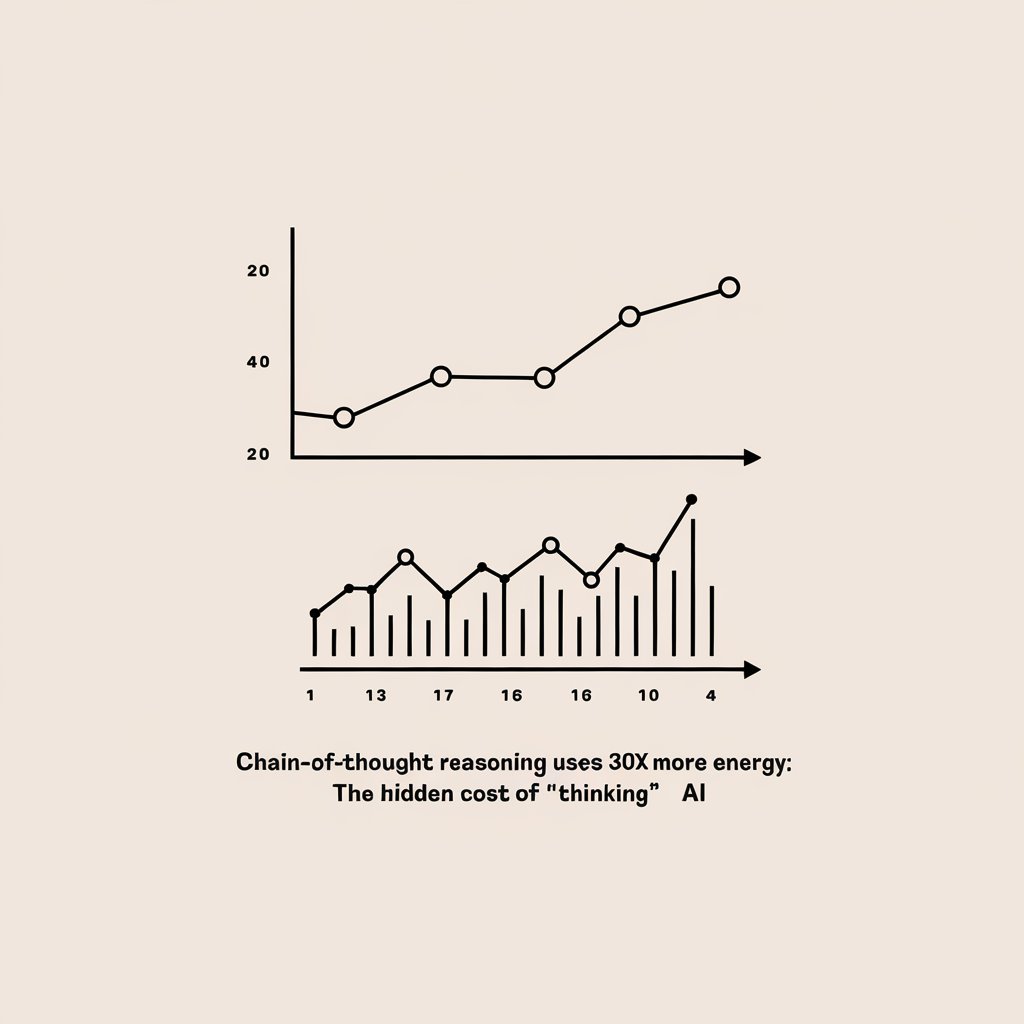
New research in 2025 quantifies what many suspected: Chain-of-Thought (CoT) reasoning dramatically increases AI energy consumption. On average, reasoning models use 30 times more energy than non-reasoning responses. In extreme cases, that multiplier hits 700x.
This isn’t about marginal efficiency. It’s about whether AI reasoning is sustainable at scale.
The Numbers
Research from multiple sources paints a consistent picture:
| Metric | Without CoT | With CoT |
|---|---|---|
| Average Energy | 1x (baseline) | 30x |
| Worst Case Energy | 1x | 700x |
| Cost Multiplier | 1x | 4-6x per request |
The math is straightforward. CoT prompting makes models generate extensive intermediate reasoning—verbose text that walks through logic steps before reaching a final answer. More text = more tokens = more computation = more energy.
A simple question like “What’s 17 × 23?” might generate a one-token answer without CoT. With CoT, the same question spawns dozens of tokens explaining the multiplication process.
Scale that across millions of queries per day, and you have a sustainability problem.
Why CoT Exists (And Why It Works)
Chain-of-Thought prompting emerged from Google research showing that LLMs perform dramatically better on complex reasoning tasks when asked to “think step by step.”
The technique works because:
- Breaking problems into steps reduces the cognitive load per step
- Intermediate reasoning helps the model catch errors
- Complex dependencies become explicit rather than implicit
For mathematical problems, logical reasoning, and multi-step decision-making, CoT can transform a failing model into a capable one. OpenAI’s o1, o3, and similar reasoning models essentially have CoT baked into their architecture.
But that capability comes at a price—literally.
The Production Cost Reality
In real-world deployments, CoT creates significant cost pressure:
Token economics: Most API pricing is per-token (input + output). CoT dramatically increases output tokens. A request that would cost $0.01 might cost $0.04-0.06 with reasoning—often with minimal accuracy improvement.
Latency impact: More tokens means more inference time. User experience suffers when “thinking” takes seconds instead of milliseconds.
Infrastructure requirements: CoT workloads need more GPU memory and compute. Data centers face higher power density requirements.
This connects directly to the infrastructure crisis we’ve been covering. If reasoning models become standard, power consumption for AI inference could multiply—at the exact moment data centers are already struggling to find electricity.
When CoT Is Worth It
The research isn’t saying “never use CoT.” It’s saying “use it strategically.”
CoT makes sense for:
- Complex mathematical problems
- Multi-step logical reasoning
- Legal or medical analysis requiring explicit justification
- Tasks where accuracy matters more than speed
CoT is overkill for:
- Simple factual queries
- Classification tasks
- Quick lookups and retrieval
- High-volume, low-stakes automation
The problem is that many deployments use reasoning models for everything, regardless of whether the task requires complex reasoning.
The Energy Efficiency Arms Race
2025 saw the emergence of the “AI Energy Score project” aiming to standardize energy efficiency benchmarks. The goal: help users and developers understand the real-world cost of different AI approaches.
Some techniques to reduce CoT energy consumption:
| Approach | Trade-off |
|---|---|
| Chain-of-Draft (CoD) | Shorter reasoning sequences, ~50% token reduction |
| Selective reasoning | Only apply CoT to questions that need it |
| Hybrid models | Fast model for triage, reasoning model for complex cases |
| Model distillation | Smaller models trained on reasoning outputs |
vLLM and TensorRT-LLM optimizations help at the inference level, but they can’t eliminate the fundamental truth: more tokens = more energy.
Implications for AI Development
The energy cost of reasoning creates pressure toward more efficient architectures:
For researchers: Novel approaches that achieve CoT-level accuracy with fewer tokens are high-value targets.
For companies: Production systems need routing logic that matches query complexity to model capability.
For regulators: AI energy consumption could become a policy target, especially in regions with carbon commitments.
For users: “Thinking” AI is a luxury, not a default. Use it when you need it.
The Bottom Line
Chain-of-Thought reasoning uses 30x more energy on average, with some cases hitting 700x. As reasoning models become mainstream, this creates serious sustainability and cost pressures. The AI industry is only beginning to grapple with the environmental implications.
The best reasoning isn’t always the most thinking. Sometimes it’s knowing when not to think at all.
FAQ
Why does CoT use so much more energy?
CoT generates many more output tokens—intermediate reasoning steps—than direct answers. More tokens means more GPU computation and energy.
Are reasoning models always worse for the environment?
No. For complex tasks requiring multi-step reasoning, CoT may be more energy-efficient than running multiple simpler queries. But for simple questions, it’s wasteful.
How can developers reduce reasoning energy costs?
Use routing systems that only apply reasoning models to complex queries. For simple tasks, use faster, smaller models.