

For the last three years, enterprise AI has been stuck in a frustrating loop: paste data, get text, manually copy text elsewhere. We’ve been treating state-of-the-art neural networks like extremely articulate search boxes. But Anthropic’s quiet rollout of a massive Co-Work platform update entirely shatters that paradigm.
They aren’t just giving Claude a larger context window; they are giving it hands.
With three key additions—Plug-in Management, New Connectors, and Cross-App Orchestration—Anthropic is moving beyond the “chatbot with integrations” era. This is a deliberate pivot toward an agentic operating system. And frankly, it’s the most aggressive enterprise play we’ve seen since Google banned OpenClaw.
The “Employee Badge” Analogy
To understand why this matters, we have to look at how integrations usually work. Standard AI tool calling is like giving a model a tightly controlled mail slot. You push a specific request in, and it pushes a formatted JSON response out. It’s rigid.
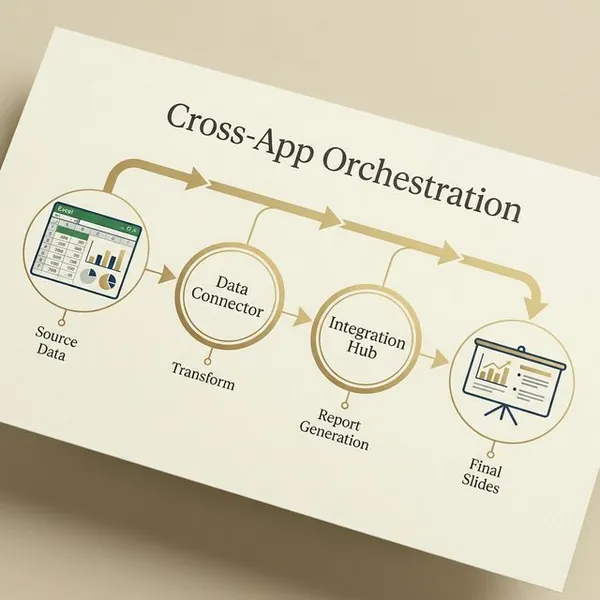
Co-Work’s new Cross-App Orchestration is fundamentally different. It’s like giving the AI an employee badge and a desk. The model doesn’t just answer questions; it executes full, asynchronous human workflows.
Picture this: Claude runs a financial analysis in Microsoft Excel, automatically passes that exact context over to PowerPoint, and builds the slide deck. No human copy-pasting required. This level of coordination across entirely different software environments is why Claude Opus 4.6 has been dominating enterprise benchmarks. It’s not just bench maxing; it actually knows how to use the tools. This deep multi-agent coordination mirrors the shift we noted in Grok 4.20’s architecture, but applied directly to white-collar tasks.
Private Plug-in Marketplaces

But what does this mean for businesses with proprietary data? You can’t just hand an AI raw access to your entire backend.
Anthropic solved this with Private Plug-in Marketplaces. Companies can now build custom plugins internally, distribute them across specific teams (HR, Finance, Engineering), and let admins control access. Anthropic specifically describes these plugins as “portable file systems that you own.” This is a massive olive branch to enterprise CISOs. The plugins aren’t locked to Anthropic’s proprietary ecosystem, meaning you maintain sovereignty over your integration logic.
Admins can automatically install these tools, restrict permissions natively, and—currently in private beta—source plugins directly from private GitHub repositories. This level of control echoes the shift we saw when Anthropic launched Claude Code’s Remote Control, proving they want to own the entire asynchronous software and data lifecycle.
The Expanded Ecosystem
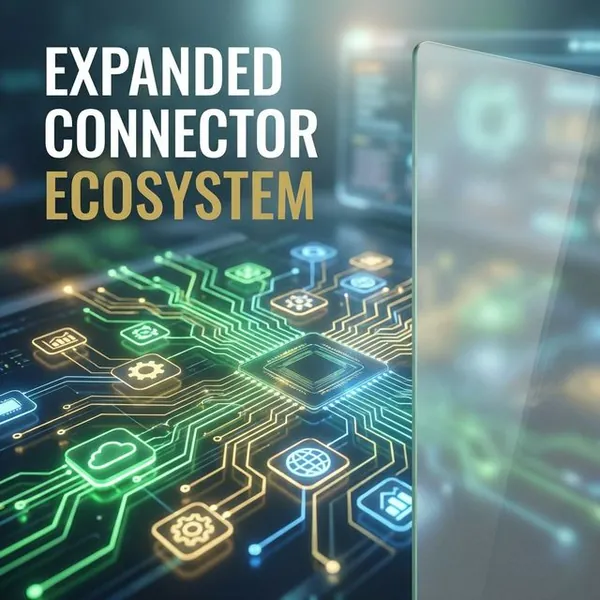
A platform is only as good as its ecosystem. Anthropic also significantly expanded its connector directory and revamped the UI. A unified “Customize” admin menu now consolidates Plugins, Skills, and Connectors, fixing the previously scattered interface.
They’ve added heavy-hitting integrations:
- Google Workspace (Drive, Gmail, Calendar)
- DocuSign
- Apollo and Outreach for sales
- SimilarWeb for marketing
- MSCI and Clay for deep data enrichment
- LegalZoom for compliance
To accelerate adoption, they aren’t just shipping empty pipes. Anthropic now provides domain-specific templates for HR, private equity, brand voice, and engineering.
The claim here is bold: these workflows reflect actual practitioner needs, not generic AI behavior. And honestly? Looking at their focus on financial analysis and investment banking templates, it’s clear they are directly targeting high-margin Wall Street deployments.
The Bottom Line
This isn’t just a feature update. By introducing cross-app orchestration, Anthropic is turning Co-Work into a system-level agent. While competitors bicker over API pricing—something Anthropic itself wrestled with during the OpenClaw ban saga—Anthropic is quietly building the infrastructure to replace entire back-office workflows. The agentic era isn’t coming; it’s already here, executing your Excel macros.
FAQ
What does Cross-App Orchestration actually do?
It allows Claude to coordinate tasks between different software applications autonomously, such as pulling data from Excel and formatting it into a PowerPoint presentation without human intervention.
Are these plugins locked to Anthropic?
No. Anthropic describes them as “portable file systems that you own,” emphasizing that enterprises retain control over their plugin logic and can source them from private repositories.
Is this available to everyone?
The core features like the new admin interface and expanded connectors are rolling out to Co-Work enterprise users, but advanced features like GitHub integration and full cross-app orchestration are currently labeled as an early research preview.