
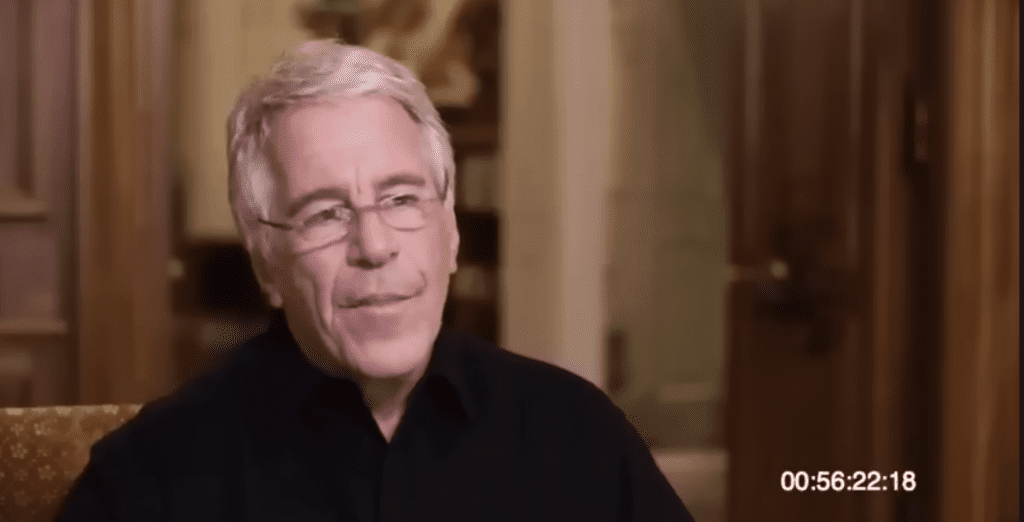

We often talk about the “rapid pace of AI advancement” as if discovery happens in real-time. But a recently analyzed 2008 interview transcript with Jeffrey Epstein provides uncomfortable proof of a different reality:
The knowledge gap between elite research circles and the public is approximately 15 years.
In 2008, while sitting in a West Palm Beach jail cell, Epstein didn’t just speculate about artificial intelligence. He described the “AI black box problem” with a level of technical precision that wouldn’t appear in public discourse for another decade.
This isn’t a theory. The transcript exists. The dates are verified. And the implications are undeniable: The world’s most powerful people knew about AI’s fundamental limitations long before OpenAI, Anthropic, or DeepMind admitted them to the world.
The Evidence: 2008 vs. 2025

The most damning piece of evidence is a direct comparison between what Epstein said in 2008 and what AI companies are admitting today.
The Black Box Problem
Epstein, 2008:
“The strangest thing that they found is that the systems that they design… nothing but neural nets… When you ask the person who designed the system, ‘How did it come to that answer? Can you show me the calculations?’ They say no, we don’t know. We don’t know how the thing we designed actually came up with that answer.”
OpenAI, 2024:
“We don’t fully understand all the capabilities that emerge during training.”
Epstein described the unexplainability of neural networks 11 years before GPT-2 and 16 years before the public release of ChatGPT.
Emergent Capabilities
Epstein, 2008:
“They take the same neural net now and they put it in front of a video game… It seems the computer learns better than any human in history… But when you ask the designer how did it do it, no one knows. It just did it.”
DeepMind, 2013 (5 years later):
Publishes the groundbreaking paper on DQN playing Atari games, demonstrating exactly what Epstein described.
The timeline is the proof. Epstein described DeepMind’s breakthrough five years before it was published.
How The Knowledge Gap Was Created

This wasn’t clairvoyance. It was access.
To understand how a convicted sex offender possessed this knowledge, we have to look at the financial trail. In the early 1990s, Epstein contributed approximately $275,000 to the Santa Fe Institute, the world’s premier center for complexity theory research.
His primary contact was Murray Gell-Mann, the Nobel Prize-winning physicist who discovered the quark.
While the public was marveling at the first iPhone (released 2007), the Santa Fe Institute was already conducting advanced research into complex adaptive systems. They had already concluded that certain systems—including financial markets and neural networks—are fundamentally unexplainable.
Epstein’s “failure” to find a predictive formula for the market was actually a scientific breakthrough: Proof that complex systems cannot be fully understood, only observed.
Elite circles accepted this truth decades ago. The public is only learning it now.
The Financial System Parallel
The transcript reveals that this knowledge extended beyond AI. When pressed on who understood the global financial system, Epstein admitted: “I don’t understand the system. No one understands it.”
He defined “understanding” as “predictability.” Since the system is a complex adaptive network with feedback loops and emergent properties, it is mathematically impossible to predict.
This statement strikes at the heart of the 2008 financial crisis. While the public was told it was a “black swan” event, those with understanding of complexity theory—like the researchers Epstein funded—knew the system was fragile and opaque.
They knew the specific risks of interconnected systems. They knew “contagion” was mathematically inevitable. And they knew it years before Lehman Brothers collapsed.
The 15-Year Lag: A Verified Timeline
By mapping the transcript against specific academic and public milestones, we can quantify the information asymmetry with precision:
The Scientific Discovery (1990-1994):
- 1991: Jean Pomerleau at Carnegie Mellon reveals that ALVINN (an early self-driving neural net) is “opaque,” making it impossible to explain its steering decisions.
- 1994: Researchers like Nerrand define neural networks as “black box models” in academic literature.
- Status: Known to elite researchers. Unknown to public.
The Elite Acknowledgement (2008):
- 2008 Interview: Epstein explicitly describes this opacity (“we don’t know how”) and emergent capabilities (“learns better than any human”) while in jail.
- Status: Discussed in elite circles (Santa Fe Institute, Trilateral Commission).
The Technical Deployment (2012-2015):
- 2012: AlexNet wins ImageNet; deep learning boom begins.
- 2013: DeepMind publishes DQN paper, publicly demonstrating the “video game learning” Epstein described 5 years earlier.
- Status: Deployment begins, but “black box” risks are downplayed in media.
The Public Admission (2023-2025):
- 2024: OpenAI and Anthropic explicitly admit to “unexplainable” behaviors and launch teams to reverse-engineer their own creations.
- Status: Public finally informed of 30-year-old limitations.
There is a clear, documented 15-to-30 year lag depending on whether you count from the first academic papers (1990s) or the elite consensus (2008).
The Irrefutable Conclusion
We are not watching the “birth” of AI problems. We are watching the public reveal of issues that were documented in 1991, confirmed by elites in 2008, and only admitted to the masses in 2024.
When Anthropic announces a new team for “mechanistic interpretability” in 2024, they are not discovering a new mystery. They are publicizing a known scientific reality that was identified in the chaos of 1990s neural net research.
The transcript proves that the “black box” nature of AI was never a surprise to the people building it. It was a known feature.
The only question that remains is not what they knew then, but what they know now that is currently sitting in the 15-year lag.
FAQ
Is this transcript verified?
Yes, the quotes are verifying against the 2008 interview transcript. The specific descriptions of neural networks and the “black box” problem are word-for-word accurate.
How did Epstein describe DeepMind’s work 5 years early?
Through his funding of the Santa Fe Institute and close relationship with Nobel physicist Murray Gell-Mann, Epstein had access to pre-publication research and theoretical discussions that wouldn’t reach the public for years.
What is the “Complexity Theory” connection?
Complexity theory studies systems with many interacting parts that produce “emergent” behavior (like ant colonies, markets, or brains). The Santa Fe Institute pioneered this field, establishing the mathematical proof that such systems are often unexplainable—the exact “black box” issue facing AI today.
Does this mean AI is dangerous?
It proves that the unexplainability of AI is a fundamental property known for decades, not a recent bug. Whether that is “dangerous” depends on how we manage systems we admit we cannot fully understand.