


Elon Musk isn’t just building rockets anymore. He’s building the first orbital AI cloud.
On February 3rd, 2026, the tech industry hit a new high-water mark: SpaceX officially acquired xAI in a $50 billion mega-merger. This isn’t just a financial consolidation—it’s the birth of a vertically integrated “Innovation Engine” that spans from terrestrial GPUs to orbital silicon. While everyone else is fighting for rack space in Northern Virginia, SpaceX is looking at the ultimate heat sink: the vacuum of space.
The goal? A $50 billion IPO to fund a one-million-satellite constellation designed not for just internet, but for Orbital Reasoning. The recent FCC filing outlines a massive shift from simple communication to space-based high-density compute and it is very important for us to understand how it is gonna affect us.
The Vision: ESCAPING THE TERRESTRIAL WALL
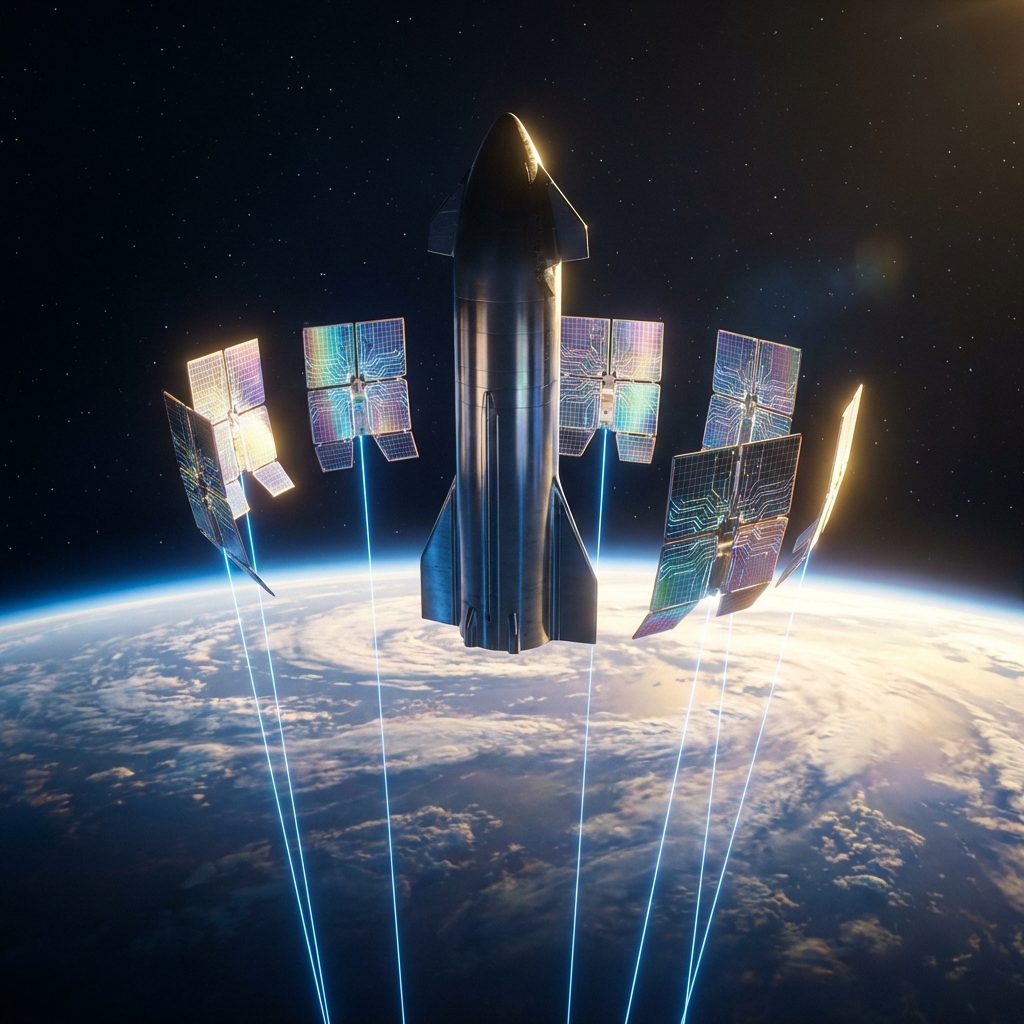
Terrestrial data centers are hitting a physical wall. We’ve reached the point where the cost of cooling and energy grid constraints are the primary bottlenecks for AI scaling. By moving high-density compute into orbit, Musk is attempting to leverage two massive natural advantages:
- Unlimited Solar Energy: No more grid negotiations or nuclear permitting.
- Vacuum Cooling: Space offers a unique (though tricky) thermal environment that, if harnessed correctly, could eventually lower the cost of a “Thinking Token” by 10x over the next three years.
SpaceX has already sought FCC approval for a million-satellite constellation. These aren’t just Starlinks; they are moving compute nodes. Imagine a Grok instance that lives in the sky, powered by the sun, and connected directly to every terminal on Earth with latency that rivals local fiber.
The Synergy: STARLINK + GROK + STARSHIP
This merger creates a closed-loop orbital economy.
| Layer | Component | Function |
|---|---|---|
| Transport | Starship | Heavy lifting of H200/B300 chips into orbit at fraction of current costs. |
| Network | Starlink | Low-latency data mesh for decentralized agent coordination. |
| Intelligence | Grok (xAI) | The reasoning engine distributed across the satellite mesh. (See xAI’s Pentagon Contract) |
| Information | X | The real-time data ingestion loop for training and RAG. |
By integrating xAI’s reasoning models natively into the Starlink network, SpaceX is creating a “Global Brain” that doesn’t rely on terrestrial infrastructure. This follows a broader trend of massive infrastructure bets, much like Amazon’s $10 Billion OpenAI investment, but with a distinct orbital twist. If a fiber optic cable is cut on the ocean floor, Grok doesn’t notice. It stays online, processing data at the speed of light in a vacuum.
What This Means For You
For developers and enterprises, this is the beginning of Sovereign Orbital Compute.
If you are building agentic workflows, the bottleneck has always been the “terrestrial lag”—the hop between your local machine, the ISP, and the data center. A satellite-native AI eliminates the middleman. We are looking at a future where your local Edge AI (like a phone or a drone) “negotiates” with an orbital hive mind for high-level reasoning tasks.
The Practitioner’s View: Low-Orbit Inference
import spacex_compute

client = spacex_compute.OrbitalCore(orbit="LEO", constellation="Starlink-Grok-v4")

def run_orbital_task(data):
    result = client.infer(
        prompt="Analyze maritime traffic in Sector 7 and cross-reference with X sentiment.",
        priority="high_bandwidth_satlink"
    )
    return result
Figure 1: A conceptual example of how developers might interface with the SpaceX Global Brain.
The Bottom Line
Is it a $50 billion gamble? Yes. A massive one. The engineering challenges of radiation-hardening GPUs and managing thermal dissipation in a vacuum are non-trivial. But Elon has never played a safe game.
SpaceX swallowing xAI signals the end of the “data center” era as we know it. The next frontier for the Intelligence Explosion isn’t on land—it’s 550 kilometers above our heads.
FAQ
Why acquire xAI now?
xAI has a high cash burn rate, while SpaceX has the infrastructure (Starship/Starlink) to enable xAI to scale beyond the limits of terrestrial electricity and cooling.
What happens to Tesla?
Musk hasn’t ruled out a future merger with Tesla, but for now, the priority is the SpaceX-xAI orbital infrastructure pairing.
Will this increase Starlink prices?
Unlikely. The consumer internet side of Starlink is the cash flow engine that fuels the compute side. If anything, the AI data centers might subsidize consumer rates.