
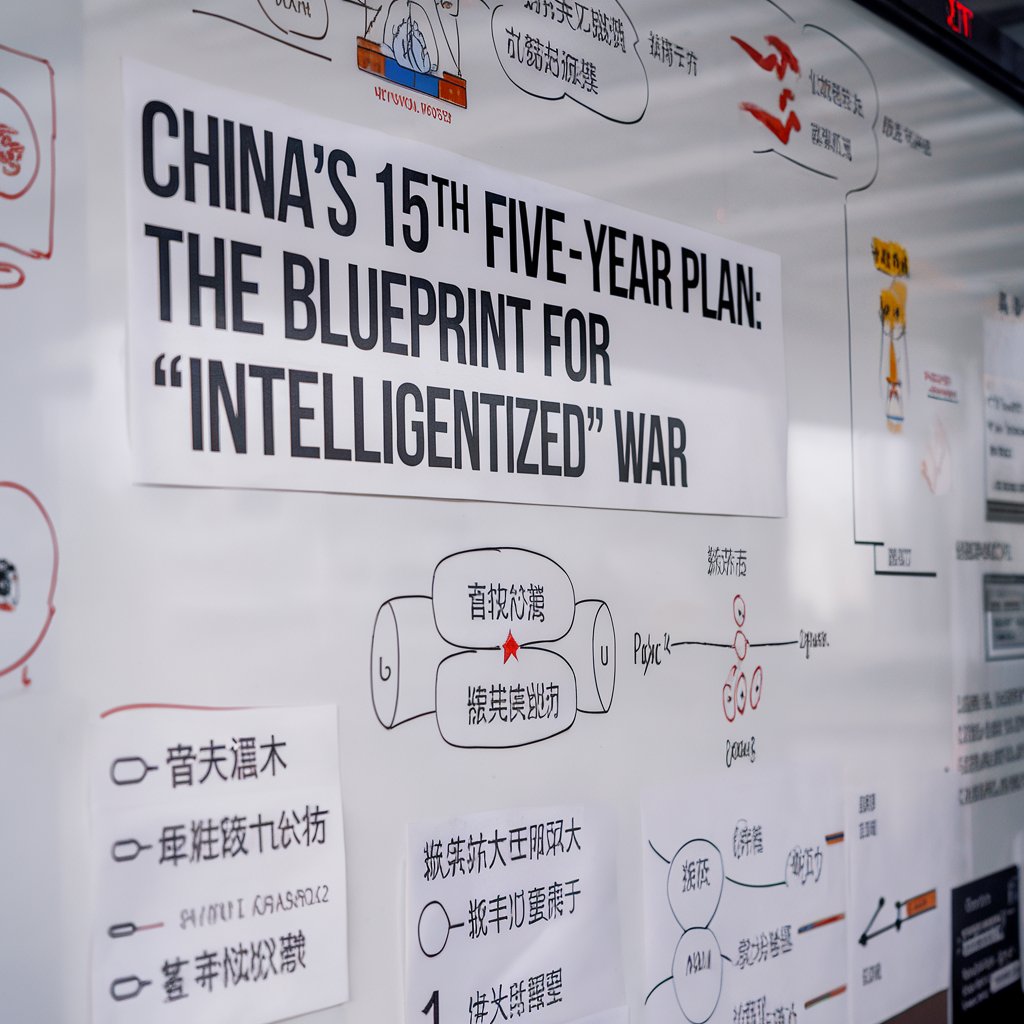

Five-Year Plans are usually boring lists of GDP targets and coal quotas. Not this one. The 15th Five-Year Plan (2026-2030), details of which have been circulating in intelligence summaries this week, has a military sub-text that is shouting, not whispering.
The headline isn’t economic growth. It is “Intelligentized Warfare.”
This is the term the People’s Liberation Army (PLA) uses for the singularity of AI and kinetics. They are no longer planning to catch up to the US military’s hardware. They are planning to leapfrog it with software.
In this deep dive, we unpack the three pillars of the plan: the “New Quality Productive Forces”doctrine, the Counter-Hypersonic AI algorithms, and the massive build-out of Nuclear-Powered Data Centers.
Pillar 1: “New Quality Productive Forces” (NQPF)
To understand the military threat, you have to understand the economic dogma. President Xi Jinping’s new slogan, “New Quality Productive Forces,” sounds like Marxist jargon, but it is actually a directive for Civil-Military Fusion.
The End of Low-End Tech
The plan explicitly de-prioritizes traditional manufacturing (textiles, assembly) in favor of “Strategic Emerging Industries.”
- The Mandate: Every civilian AI breakthrough must be “dual-use ready.”
- The Application: The same algorithm that Baidu uses to route autonomous taxis in Beijing is being hard-coded into the PLA’s logistical “Iron River.” The swarm logic developed for drone light shows in Shenzhen is directly transferable to the Swarm Soldier program.
This is a Total War economy in peacetime disguise. The 15th Plan aims to make the defense industrial base immune to sanctions by forcing the entire civilian tech sector to serve national security goals first, and profit second.
Pillar 2: The “Counter-Hypersonic” Shield
The scariest technical revelation in the new plan is the focus on AI-driven Missile Defense. Hypersonic missiles (flying at Mach 5+) are famously hard to stop because they maneuver unpredictably. A standard radar tracking a ballistic arc will lose a hypersonic glider.
The Trajectory Prediction AI
Intelligence suggests the PLA has employed Deep Learning models capable of “Trajectory Intention Prediction.”
The Capability: Instead of tracking where the missile is, the AI predicts where the missile wants to go*. By analyzing micro-adjustments in the glider’s control surfaces in real-time, the AI can forecast the target impact zone with 90% confidence 3 minutes before impact.
The Lead Time: A 3-minute warning doesn’t sound like much, but for a laser or railgun interception system, it is an eternity. It changes the equation from “impossible” to “probable.”
The plan allocates billions to “Early Warning AI”—systems that process raw radar data at the edge (on the satellite or radar dish) to detect the faint plasma signature of a hypersonic glide vehicle before a human operator even sees a blip.
Pillar 3: The “Data-Compute-Energy” Trinity
AI eats electricity. The 15th Plan acknowledges a brutal reality: You cannot win an AI war with a fragile power grid.
Nuclear-Powered Compute
The plan calls for the construction of geo-distributed, nuclear-powered data centers.
- Inland Fortresses: These centers are being built deep in China’s interior (Guizhou, Sichuan), far from the coast and hardened against conventional strikes.
- Small Modular Reactors (SMRs): The strategy explicitly links SMR deployment to AI infrastructure. The goal is “Grid-Independent Intelligence.” Even if the national grid goes down in a cyber-attack, the PLA’s brain stays online.
This infrastructure is being built to support Trillion-Parameter Models dedicated solely to military tasks—wargaming, logistics optimization, and cyber-offense. While the US debatest permitting for new transmission lines, China is pouring concrete for nuclear-powered server farms.
The “Lithography Breakout”
Underpinning all of this is the chip war. The 15th Plan represents the final “all-in” bet on domestic lithography.
- The Goal: Complete independence from Western tools (ASML, Applied Materials) by 2030.
- The Method: “Whole-of-Nation” funding. The plan essentially writes a blank check to SMEE (Shanghai Micro Electronics Equipment) and others to master EUV (Extreme Ultraviolet) lithography.
If they succeed, the US strategy of “containing” China’s AI progress via export controls (like the H100 ban) collapses. A China that can print its own 5nm / 3nm chips is a China that can scale its “Intelligentized Warfare” indefinitely.
Strategic Implications: The “Metaverse War”
The final, and most esoteric, part of the plan discusses “Meta-War” (Metaverse Warfare).
This isn’t about VR headsets. It’s about high-fidelity Synthetic Training Environments.
- Sim-to-Real: The PLA wants to fight the war 10,000 times in a digital twin of the Pacific before firing a real shot.
- Cognitive Domination: By using AI to model US political and social responses, they aim to win the “Cognitive Domain”—breaking the enemy’s will to fight without necessarily destroying their forces.
What This Means For the West
For Policy Makers:
The window of “technological superiority” is closing faster than predicted. The US strategy of “offset” (using tech to counter mass) is being mirrored by China. We are now in a “Symmetric AI Arms Race.”
For Defense Investors:
Watch the “Counter-Hypersonic” sector. If China’s AI detection claims are true, the US will need to invest heavily in AI-driven electronic warfare (to jam the detection) and swarm decoys (to overwhelm the prediction algorithms).
For the Tech Sector:
The “Civil-Military Fusion” mandated by the 15th Plan means that any collaboration with a Chinese tech firm is effectively a collaboration with the PLA. The firewall between “commercial” and “military” in China has evaporated.
The Bottom Line
China is betting the house on AI. They believe that the next war won’t be decided by the tonnage of ships, but by the speed of algorithms. The 15th Five-Year Plan isn’t just an economic document; it is a declaration of intent to build the world’s first fully “Intelligentized” military.
FAQ
What is “Intelligentized Warfare”?
It is the PLA’s successor to “Mechanized” (tanks/ships) and “Informatized” (networks/GPS) warfare. It prioritizes AI as the central nervous system of the military, driving decision-making and autonomous execution.
When does this plan start?
It covers the period 2026-2030. This coincides with the so-called “Davidson Window”—the timeframe US admirals have warned is most likely for a conflict over Taiwan.
Are the nuclear data centers real?
Yes. Satellite imagery and provincial construction contracts confirm massive excavation projects in Guizhou province consistent with hardened, high-power compute facilities often located near hydro or planned nuclear power sources.