

The era of “clicking and dragging” into a digital cart is dying. You just don’t know it yet. For years, the dream of “agentic commerce”—AI that doesn’t just suggest a product but actually buys it for you—has been stalled by a boring, technical bottleneck: the N×N integration problem. Every AI agent needed a bespoke way to talk to every different retail checkout system.
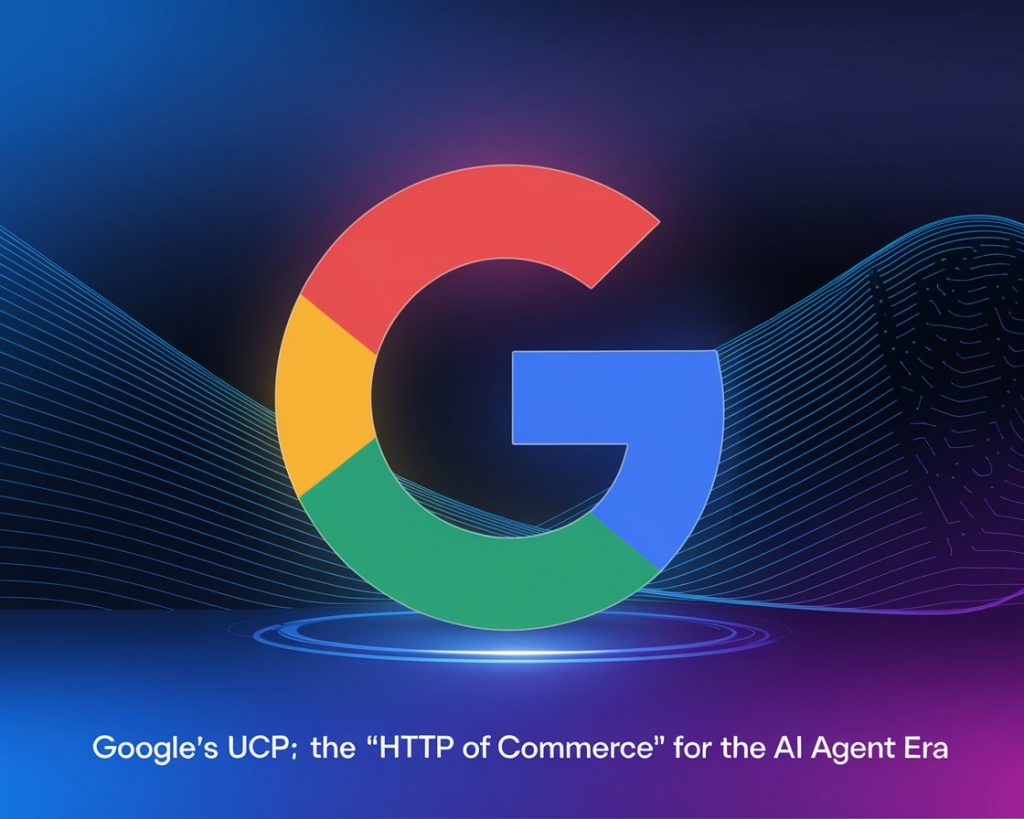
But at the NRF conference this week, Google dropped the hammer. The Universal Commerce Protocol (UCP) isn’t just another API; it’s an open standard designed to be the “HTTP of Commerce.” Co-developed with giants like Shopify, Walmart, and Target, UCP provides a shared language that allows any AI agent to handle product discovery, price negotiation, and secure checkout across the entire web. It’s the final piece of the agentic AI puzzle we’ve been tracking, and it shifts the focus from “Search” to “Action.”
What is UCP? (Standardizing Agentic Shopping)
At its core, UCP is a REST-based standard that abstracts away the complexity of retail backends. Instead of an AI like Gemini or Claude needing to figure out how to navigate a custom React-based checkout form on a boutique site, it simply queries a standardized endpoint: /.well-known/ucp.
This endpoint exposes the merchant’s capabilities, real-time inventory, and price-adjustment logic. Because UCP is built to be compatible with the Model Context Protocol (MCP), AI agents can now “see” a store’s backend with the same clarity they have when reading a local file. This connects directly to the massive Gemini 3 Flash rollout we saw recently—those 1M context windows aren’t just for reading PDFs; they’re for keeping a “world state” of every available product in a category while your agent negotiates the best deal.
The $N \times N$ Problem: Why We Needed an Open Standard
Before UCP, if you wanted an AI agent to buy you a pair of running shoes, that agent needed a custom integration for Nike, another for Adidas, and another for the local mom-and-pop shop. If you have 100 agents and 1,000 stores, you need 100,000 integrations. That’s the N×N nightmare.
UCP collapses this into a 1+1 problem. Retailers implement UCP once; agents implement UCP once. Suddenly, they all speak the same language. It’s why the “Rainbow Coalition”—the partnership between Apple and Google we discussed last month—is so potent. By baking UCP into Siri and Gemini, they’ve essentially created a global shopping mall where every store is agent-accessible from day one.
Security vs. Friction: The New Attack Surface

Look, let’s be direct: exposing your checkout logic via a public REST endpoint is a security person’s nightmare. UCP introduces a brand new attack surface. We aren’t just talking about bot detection anymore; we’re talking about “logic injection.”
If an agent can request a price adjustment based on “loyalty status,” what happens when a malicious agent spoofing that status hits your pricing engine 10,000 times a second? Retailers will need to pivot their security stacks toward API gateways and specialized “Agent Vitals” monitoring.
It’s reminiscent of the NVIDIA Tool Orchestra blueprint for agent swarms—without a central orchestrator managing the security of these transactions, the system collapses under the weight of its own efficiency.
GEO: Why “Agent Vitals” are the New SEO

If agents are doing the buying, your shiny storefront doesn’t matter. What matters is Generative Engine Optimization (GEO). In the UCP world, your “Agent Vitals”—API latency, data fidelity, and the machine-readability of your product attributes—are what determine whether an agent selects your store or your competitor’s.
I’ve been watching this shift for months. SEO used to be about gaming keywords; now it’s about ensuring your UCP endpoint returns a 200 OK faster than anyone else. If your agentic plan isn’t ready for this, you’re invisible.
The Bottom Line
Google UCP is the foundational infrastructure that turns AI from a “research assistant” into a “buying agent.” By standardizing how money moves through the prompt, Google has effectively built the plumbing for the next decade of retail. The “Rainbow Coalition” of Apple, Google, and Shopify is now a fortress. If you’re a retailer, it’s time to stop worrying about your mobile app and start worrying about your /.well-known/ucp endpoint.
FAQ
Does UCP replace Google Pay?
No. UCP is the transport layer for the transaction logic. Google Pay (and eventually PayPal) remains the payment handler that actually moves the tokens.
Is UCP open to non-Google agents?
Yes. Although Google is the primary driver, it is an open standard. Any AI agent, whether it’s an open-source Llama model or a custom enterprise agent, can utilize UCP if the retailer supports it.
How does this affect my data privacy?
Google claims retailers remain the “Merchant of Record,” meaning they own the customer relationship. However, the pre-purchase data (what you searched for before the agent bought it) stays with the agent provider.