


Here’s a number that should keep every Indian policymaker awake at night: 69%. That’s how much of India’s AI Mission budget went unspent in 2024-25. While the world sprints ahead in the global AI race, our government couldn’t even figure out how to spend the money it had already allocated. This isn’t just administrative incompetence—it’s a betrayal of 1.4 billion people’s future.
The question isn’t whether India can compete with China and the US in artificial intelligence. The question is whether we’ve already surrendered before the battle began. And the evidence suggests we have.
Stick with me and I’ll show you exactly how India’s AI ambitions collapsed under the weight of bureaucratic apathy, ministerial incompetence, and a fundamental lack of vision. We’ll examine the IndiaAI Mission’s spectacular failures, the uncomfortable truth about Microsoft and Google’s billion-dollar “investments,” and why a country that was once colonized for its raw materials is now being colonized for its data.
The IndiaAI Mission: A ₹10,371 Crore Embarrassment
On March 7, 2024, the Modi government announced the IndiaAI Mission with great fanfare. The promise? ₹10,371.92 crore (roughly $1.25 billion) over five years to transform India into an AI powerhouse. The mission would deploy 10,000+ GPUs, build indigenous AI models, and train a million Indians in AI skills.
Sounds impressive, right? Let’s look at what actually happened.
The Budget Scandal Nobody’s Talking About
According to MediaNama’s analysis of government data, the IndiaAI Mission’s budget estimate for FY 2024-25 was ₹551.75 crore. The revised estimate? A pathetic ₹173 crore. That’s a 69% decrease—not because the money wasn’t available, but because the ministry couldn’t spend it.
The Parliamentary Standing Committee on IT didn’t mince words. They noted that surrendering funds beyond 50% reflects “improper planning by the Ministry.” In semiconductor development alone, the ministry allocated ₹1,503.36 crore but spent only ₹681.11 crore—surrendering 55% of the budget.
“If you can’t spend money when you have it, you don’t deserve more of it.” — My personal Opinion
GPU Claims vs. Reality
The government loves to trumpet its GPU numbers. According to official claims, India has “onboarded” 34,333 GPUs. But here’s what they don’t tell you: only about 17,300 GPUs have actually been installed. That’s roughly 50% deployment of what was proposed.
For context, Meta and Microsoft each operate clusters with 10,000+ high-performance GPUs—just for their AI research divisions. India’s entire national AI compute infrastructure doesn’t match what a single American tech company has for one project.
The AI Now Institute’s analysis was damning: India’s AIRAWAT supercomputer has only 656 GPUs. Their verdict? “India is not competitive in compute.”
Ashwini Vaishnaw: The Minister Who Couldn’t Deliver
Every failure needs a face, and in India’s AI catastrophe, that face belongs to IT Minister Ashwini Vaishnaw. His track record isn’t just disappointing—it’s a masterclass in how not to lead a technology ministry.
The Regulatory Flip-Flop That Embarrassed India Globally
In March 2024, Vaishnaw’s ministry issued an advisory requiring government approval before any AI model could be launched in India. The tech world erupted. Aravind Srinivas, CEO of Perplexity AI (an Indian-origin founder), called it a “bad move.” Martin Casado of a16z was more blunt: “Good fucking lord. What a travesty.“
Fourteen days later, the ministry quietly walked back the advisory. This wasn’t nimble policymaking—it was chaos. The AI Now Institute described India’s AI regulatory efforts as “cursory and often contradictory.”
Promises Made, Promises Broken
Let’s review Vaishnaw’s greatest hits:
- “India will be among top five nations in AI for capability, use and talent” — We’re currently ranked 10th in the Tortoise Global AI Index.
- “India to produce first indigenous chip by year-end” — Still waiting.
- “India to join top 5 semiconductor nations in 5 years” — The Vedanta-Foxconn $19.5 billion chip venture collapsed on his watch.
- “Target: 1 million people trained in AI tools” — NASSCOM data shows AI adoption index moved from 2.45 to 2.47 between 2022-2024. That’s statistical noise, not progress.
Under Vaishnaw’s leadership, India doesn’t have a coherent AI strategy—it has press releases.
Microsoft’s $17.5 Billion and Google’s $15 Billion: Salvation or Colonization?
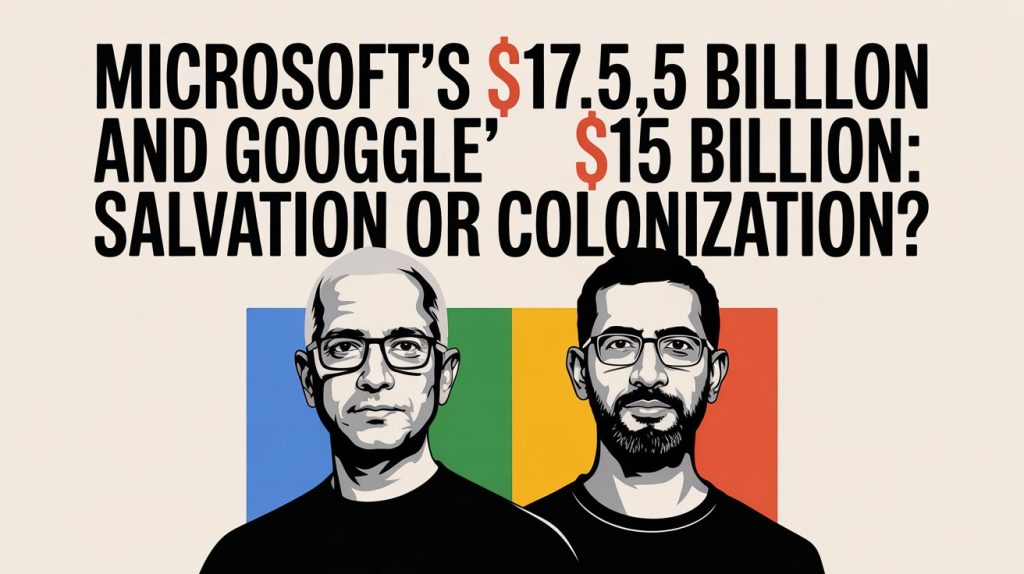
In December 2025, Microsoft announced a $17.5 billion investment in India—its largest ever in Asia. Google had already committed $15 billion for an AI hub in Visakhapatnam. The government celebrated. Headlines screamed about India becoming an “AI superpower.”
But here’s the question nobody’s asking: What exactly are we getting?
Breaking Down the “Investment”
Microsoft’s money is going toward data centers, Azure cloud infrastructure, and “AI skilling” programs. Google’s investment? Same story—data centers and cloud services.
Notice what’s missing? There’s no investment in Indian AI research labs. No funding for indigenous model development. No technology transfer. These billions will build infrastructure that runs on American AI, serving American companies, with Indian data.
As Counterpoint Research noted, Microsoft’s investment “gives Microsoft first-mover advantage in GPU-rich data centers while making Azure the preferred platform for India’s AI workloads.” S. Krishnan, MeitY Secretary, inadvertently admitted the truth: “India’s opportunity lies more in developing applications“—not foundational models.
Translation: India will be the customer, not the creator.
The Investment Gap India Won’t Acknowledge
| Country | AI Investment (2024-25) |
| United States | $109B private + $500B Stargate Project |
| China | $84-98 billion |
| Saudi Arabia | $100+ billion commitment |
| UAE | $147+ billion since 2024 |
| India | $1.25 billion (IndiaAI Mission) |
Digital Colonialism: History Repeating Itself
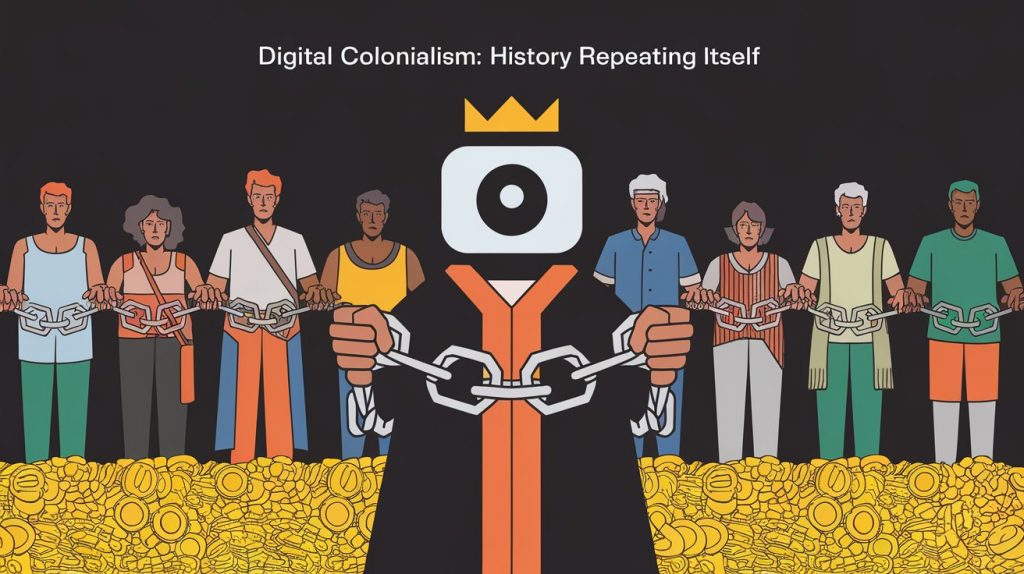
In the 18th century, the East India Company extracted India’s raw materials—cotton, spices, indigo—processed them in British factories, and sold finished goods back to Indians at premium prices. The colony provided resources; the colonizer provided “value addition.”
Sound familiar?
Today, India generates nearly 20% of the world’s data but holds just 3% of global storage capacity. American tech giants—Meta, Google, Microsoft, OpenAI—harvest this data, process it in their AI systems abroad, and sell AI services back to us. The raw material has changed from cotton to data. The colonizers have changed from the British Crown to Silicon Valley. The dynamic remains identical.
“If we don’t develop sovereign AI capabilities, we have a major risk of having all of our activities, languages and cultures being processed by AI systems that don’t understand India. It will take it to a different place—a kind of digital colonialism that we should avoid.” — N. Chandrasekaran, Tata Group Chairman, February 2025
Chandrasekaran—who runs India’s largest private conglomerate—isn’t some fringe critic. When the chairman of Tata warns about digital colonialism, perhaps the government should listen.
Where Are India’s LLMs? The Embarrassing Answer

China has DeepSeek, Baidu’s ERNIE, and Alibaba’s Qwen. France has Mistral. Even South Korea and the UAE are building competitive models. India has… what exactly?
Krutrim: The Unicorn That Can’t Prove Itself
Ola’s Krutrim became India’s first AI unicorn by claiming to outperform GPT-4 on Indic language benchmarks. The problem? No independent third-party benchmarks have ever been published. No research papers. No training datasets released. Most features remain invite-only. A billion-dollar valuation built on trust-me-bro claims.
Sarvam AI: 23 Downloads and Counting
Sarvam AI was selected under the IndiaAI Mission to build India’s “sovereign LLM.” They received 4,096 NVIDIA H100 GPUs and ₹98.68 crore in subsidies. The result? Their flagship model, Sarvam-M, recorded just 23 downloads two days after launch.
For comparison, Korea’s Dia model had 160,000+ downloads in the same timeframe. India’s government-backed sovereign AI model couldn’t crack 25.
The government’s own Param 1 LLM—trained on 5 trillion words—has just 12 downloads. These aren’t products; they’re press releases with download buttons.
Why Can’t India Build Competitive AI?
The reasons are structural and damning:
- Funding Collapse: Indian AI startups raised just $166 million in 2024—down from $518.2 million in 2022. A 68% drop while the rest of the world is pouring billions into AI.
- Export Controls: US export restrictions cap GPU imports to India at approximately 50,000 advanced chips through 2027. You can’t build frontier AI models without frontier compute.
- Data Poverty: Less than 1% of global digital content exists in Indian languages. Training Indic language models means starting with a data deficit.
- Industry Surrender: Nandan Nilekani says “let the big boys in Silicon Valley do it.” TCS CEO Krithivasan argues India doesn’t need its own LLMs. When your tech leaders have given up, what hope remains?
The Brain Drain Emergency
Here’s the most painful statistic in this entire analysis: In 2019, nearly 100% of India’s elite AI researchers left the country. By 2022, that number had improved to… 80%. We’re hemorrhaging our best minds at catastrophic rates.
India’s share of top-tier AI talent in Asia-Pacific collapsed from 18.6% in 2019 to just 8.2% in 2022. Meanwhile, China’s share grew from 67.2% to 81.9%. They’re gaining the talent we’re losing.
Why are they leaving? Money. An entry-level ML engineer in India earns ₹6-8 lakh annually ($7,000-10,000). The same role in the US pays $120,000-160,000. That’s a 15-20x difference. OpenAI invests approximately $1 million annually per AI researcher. No Indian company can compete.
India trains the talent. America and China benefit from the innovation. We’ve become an AI talent factory for countries that will use that talent to dominate us.
When UAE, Singapore, and Israel Make India Look Foolish
Want to feel truly depressed about India’s AI failures? Look at what smaller countries have accomplished:
- UAE: Appointed the world’s first Minister of AI in 2017. Committed $147+ billion since 2024. Ranks 5th globally in Stanford’s AI index. Population: 10 million.
- Singapore: Ranks 3rd globally in AI readiness. Attracts 75% of ASEAN’s AI investment. Has committed $27+ billion to AI. Population: 6 million.
- Israel: Has 342 GenAI startups that have collectively raised $20+ billion. Military-trained talent pipeline produces world-class AI engineers. Population: 9 million.
- Saudi Arabia: Jumped from 31st to 14th in global AI rankings. Ranks 1st globally in government AI strategy. Population: 36 million.
India has 1.4 billion people, the world’s third-largest pool of STEM graduates, and a thriving IT services industry. And we’re being outmaneuvered by countries with populations smaller than Mumbai’s.
What India Must Do (But Probably Won’t)
The path forward exists. Whether India’s leadership has the vision and will to take it is another question entirely.
- Actually spend the budget: A 69% underspend is inexcusable. Fire whoever is responsible for this bureaucratic paralysis and bring in people who can execute.
- Stop celebrating foreign data centers as “AI investment”: Microsoft building Azure infrastructure in India makes India a better customer for Microsoft. It doesn’t make India an AI power.
- Fund AI research at serious levels: The AI Centres of Excellence receive roughly $7 million per year per center. That’s a rounding error in global AI research. Multiply it by 100 or stop pretending.
- Reverse the brain drain with real money: Create compensation packages that can actually compete internationally. Yes, it’s expensive. Losing the AI race is more expensive.
- Replace leaders who can’t deliver: Ashwini Vaishnaw has had years to demonstrate competence. The results speak for themselves. India needs technology leadership that understands technology.
The Verdict: India Hasn’t Just Lost the AI Race—It Refused to Run
The global AI race isn’t a sprint; it’s a marathon that started years ago. China began investing heavily in AI in 2015. The UAE appointed an AI minister in 2017. America’s tech giants have been building AI capabilities for over a decade.
India showed up in 2024 with a ₹10,371 crore budget it couldn’t spend, a regulatory framework it reversed within two weeks, and a strategy that amounts to “let Silicon Valley build it and we’ll use it.”
A country that was once colonized for its cotton and spices is now offering up its data and talent for a new form of extraction. The British East India Company has been replaced by Microsoft, Google, and OpenAI. The raw materials have changed, but the dependency hasn’t.
India didn’t lose the India AI race. India never seriously entered it. And until the government stops confusing press releases with policy and foreign data centers with indigenous capability, that won’t change.
The tragedy isn’t that India can’t compete. It’s that India chose not to.
Frequently Asked Questions
Why is India losing the AI race?
India is losing due to chronic budget underspending (69% in FY 2024-25), severe brain drain (80% of elite AI talent leaves), lack of indigenous LLM development, and a government strategy that prioritizes consuming foreign AI over building domestic capabilities.
What is the IndiaAI Mission?
The IndiaAI Mission is a ₹10,371.92 crore ($1.25 billion) government initiative launched in March 2024 to develop AI infrastructure, fund startups, build indigenous models, and train AI talent over five years. However, significant budget underutilization has limited its impact.
Does India have its own LLM?
India has attempted indigenous LLMs like Krutrim (Ola), Sarvam AI’s Sarvam-M, and the government’s Param 1. However, none have achieved significant adoption—Sarvam-M recorded just 23 downloads at launch, and Param 1 has only 12 downloads despite being trained on 5 trillion words.
How much is Microsoft investing in India?
Microsoft announced a $17.5 billion investment in India in December 2025, following an earlier $3 billion commitment in January 2025. This is Microsoft’s largest investment in Asia. However, critics note the investment primarily builds cloud infrastructure rather than indigenous AI research capabilities.
How does India compare to China in AI?
China invests $84-98 billion annually in AI compared to India’s $1.25 billion. China’s share of top-tier AI talent grew from 67.2% to 81.9% (2019-2022) while India’s fell from 18.6% to 8.2%. China has competitive LLMs like DeepSeek and ERNIE; India has no globally competitive model.