

Let me ask you something uncomfortable: Why does a company with virtually unlimited resources keep releasing impressive-but-irrelevant AI models while its competitors run away with the actual AI crown?
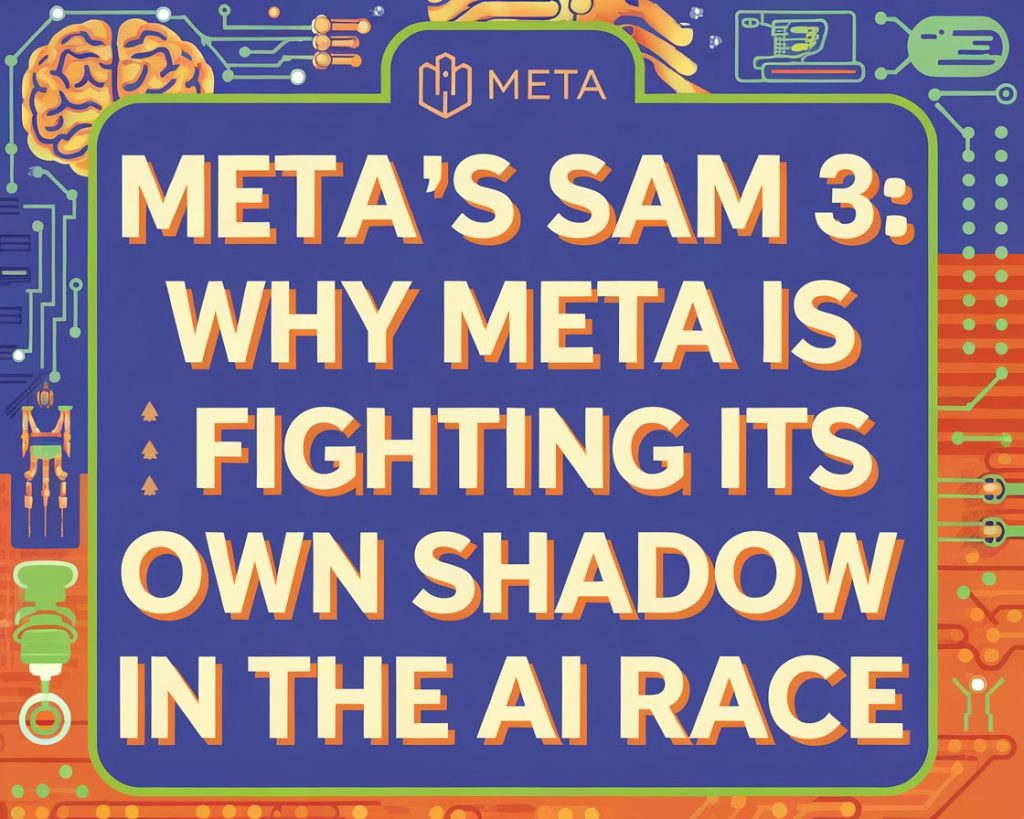
That’s the question Meta’s SAM 3 (Segment Anything Model 3), released in November 2025, forces us to confront. Make no mistake—SAM 3 is technically brilliant. It introduces “Promptable Concept Segmentation” (PCS), allowing users to segment every instance of a visual concept across images and videos using nothing but text prompts. Revolutionary for computer vision? Absolutely. The missing piece Meta needs to beat OpenAI and Google in the generative AI race? Not even close.
In this analysis, we’ll unpack what SAM 3 actually does, examine its genuine strengths and glaring limitations, and—more critically—explore why it represents everything wrong with Meta’s AI strategy. Because while Meta keeps building prettier segmentation tools, video generators, and AR glasses, its competitors are busy building the AI that will power the next era of human civilization.
Let’s get into it.
What Is Meta’s SAM 3? A Technical Breakdown
Meta’s Segment Anything Model 3 (SAM 3) represents the third evolution of the company’s open-source segmentation family. Unlike its predecessors, SAM 3 moves beyond the “digital scalpel” approach—where you had to click or box each individual object—to something far more powerful: a “cognitive search engine” for the visual world.
The Core Innovation: Promptable Concept Segmentation (PCS)
With PCS, you simply type “yellow school bus” or “striped cat wearing a collar,” and SAM 3 finds and segments every matching instance across your entire image or video. No manual clicking. No bounding boxes. Just natural language understanding applied to visual segmentation.
Key Features at a Glance
| Feature | What It Does | Why It Matters |
|---|---|---|
| Promptable Concept Segmentation | Segments all instances of a concept using text/image prompts | Eliminates frame-by-frame manual work |
| Unified Architecture | Combines detection, segmentation, and tracking into one model | Simplifies complex computer vision pipelines |
| Open-Vocabulary | Not limited to predefined object classes | Works with any noun phrase you can imagine |
| 2x Performance Gain | Doubles previous benchmark scores | Best-in-class for concept segmentation |
| SAM 3D Integration | Generates 3D objects from single images | Extends into 3D reconstruction |
| Open-Source | Free access to weights and inference code | Democratizes access to advanced CV tools |
The Training Data Behind SAM 3
Meta trained SAM 3 on their massive “Segment Anything with Concepts” (SA-Co) dataset—containing over 4 million unique concept labels and 52 million masks. This wasn’t cheap. It required a sophisticated “data engine” combining AI annotators with human verifiers, massively boosting throughput while maintaining label quality.
SAM 3 vs. Competitors: A Brutally Honest Comparison
Here’s where we separate the hype from reality. SAM 3 is genuinely impressive—but it’s not without serious limitations that Meta’s competitors don’t share.
SAM 3 vs. YOLO Models
(Hint) Winner: YOLO for speed, SAM 3 for flexibility
YOLO models (YOLOv8-seg, YOLO11n-seg) remain faster and smaller—perfect for real-time edge applications. They’re closed-set, meaning they only work with categories they’ve been trained on, but for production deployments with known classes, YOLO still wins.
SAM 3’s edge: Open-vocabulary segmentation with text prompts. You can segment concepts YOLO has never seen.
SAM 3 vs. Florence-2 (Microsoft)
Winner: Context-dependent
Florence-2 produces stronger results for broader vision-language tasks like captioning and visual Q&A. SAM 3 produces higher-quality instance masks but lacks deep semantic understanding.
SAM 3 vs. Grounded-SAM Hybrids
Winner: Hybrids in complex scenarios
Systems that combine SAM with external classifiers (like GroundingDINO) often outperform pure SAM pipelines when you need to identify what objects are, not just where they are. This is a crucial distinction that Meta’s marketing conveniently glosses over.
The Uncomfortable Truth
SAM 3 excels at telling you where something is. But it doesn’t inherently know what that something is—and for many real-world applications, that’s the more valuable capability. As one technical review bluntly stated: SAM 3 is “evolution, not revolution.”
Why Meta’s SAM 3 Represents a Distracted Strategy
Now we get to the heart of the matter. SAM 3 isn’t Meta’s problem—it’s a symptom of a much larger strategic confusion.
1. Spreading Too Thin While Competitors Focus
Look at what Meta has released in 2025:
- SAM 3 – Advanced image segmentation
- Movie Gen – AI video generation (16-second clips)
- Llama 4 – Large language models
- Orion – AR glasses prototypes
- Limitless acquisition – Conversational AI pendant
Now compare that to OpenAI’s singular focus on ChatGPT and AGI development, or Google DeepMind‘s methodical march toward a cohesive AI ecosystem.
Meta is fighting on five fronts simultaneously while its competitors concentrated their forces. That’s not strategy—that’s chaos.
2. The Talent Drain Is Real
Here’s something Meta doesn’t want you to know: the company is hemorrhaging AI talent. Top researchers and engineers are leaving for OpenAI, Anthropic, and Google at alarming rates. Why? Multiple reports cite internal frustration with Meta’s fragmented AI strategy and lack of clear direction.
The response? Aggressive hiring with eye-popping compensation packages. But throwing money at a strategic problem doesn’t fix the strategy—it just delays the reckoning.
Read more: Is Llama 4 Open Source? The Truth Behind the Lie
3. Llama’s Silent Struggles
Let’s be honest about Llama. Meta’s open-source language models are good—sometimes even competitive with GPT-4 on specific benchmarks. But “sometimes competitive on specific benchmarks” isn’t winning. It’s participation.
| Benchmark | Llama 4 Maverick | GPT-4o | Winner |
|---|---|---|---|
| General Reasoning (MMLU) | Strong | Superior | GPT-4o |
| Coding (HumanEval) | Strong | Comparable | Tie |
| Multilingual | Strong | Superior | GPT-4o |
| Multimodal Integration | Developing | Mature | GPT-4o |
| Image Generation | Limited | DALL·E Integrated | GPT-4o |
The pattern is clear: Llama wins battles but loses wars. And Meta’s recent moves toward closed-source models (reportedly codenamed “Avocado”) suggest even they’ve lost faith in their open-source strategy generating returns.
Explore: Claude Sonnet 4.5 vs GPT-5: Which AI Coding Assistant Actually Delivers in 2025?
The Video Generation Gamble: Shiny Distraction or Strategic Masterstroke?
Meta’s Movie Gen can generate 16-second video clips from text prompts—complete with synchronized audio. Impressive for Instagram Reels. But is this really where generative AI’s future lies?
What Movie Gen Actually Does:
- Generates short video clips from text/image prompts
- Produces synchronized audio
- Animates still images of people
- Targets consumer content creation
What Movie Gen Doesn’t Do:
- Compete with ChatGPT’s conversational dominance
- Advance Meta toward AGI
- Generate meaningful enterprise revenue
- Solve any of Meta’s actual competitive problems
The harsh reality: Movie Gen is a product feature, not a strategic weapon. While Meta builds fun tools for Instagram creators, OpenAI is building the operating system for the AI age. These are not equivalent achievements.
Meta’s Hardware Obsession: A Futile Fight?
Perhaps nothing illustrates Meta’s strategic confusion more than its hardware ambitions. The company has poured billions into wearables and AR devices:
The Hardware Portfolio:
- Ray-Ban Meta AI Glasses – Commercial success, but fundamentally a novelty
- Orion AR Prototypes – Advanced tech, but consumer version not expected until 2027
- Limitless Pendant – Acquired AI wearable startup for conversation recording
- Quest VR Headsets – Solid products that haven’t moved the strategic needle
Why This Strategy Is Doomed
Here’s the fundamental problem: We’re entering the age of AGI, not the age of wearables.
The companies that will dominate the next decade are those building superintelligent AI systems, not those building slightly smarter glasses. Apple has decades of hardware expertise, ironclad brand loyalty, and an ecosystem Meta can only dream of replicating. The Vision Pro may be expensive, but it establishes a premium standard.
Meta trying to out-hardware Apple is like trying to out-search Google in 2005. The war is already lost—Meta just hasn’t admitted it yet.
The AGI Timeline Gap: Meta’s Desperate Catch-Up
Let’s examine where each major player stands on achieving Artificial General Intelligence:
| Company | AGI Timeline | Current Position | Key Advantage |
|---|---|---|---|
| OpenAI | 2025–2027 | Leading | ChatGPT market dominance, o1/o3 reasoning models |
| Google DeepMind | 2030 | Strong second | Deep AI research heritage, massive compute infrastructure |
| Anthropic | Conservative | Rising | Safety-focused approach, strong enterprise traction with Claude |
| Meta | 2027 (internal target) | Catching up | Open-source community, platform distribution |
Notice something? Meta’s internal target of AGI by 2027 exists while the company simultaneously releases segmentation models and AR glasses. You can’t chase AGI while building wearables. The cognitive dissonance is staggering.
Even more damning: Meta’s own Chief AI Scientist, Yann LeCun, publicly suggests AGI is still “years, if not decades, away.” When your own technical leadership contradicts your strategic timeline, you have a credibility problem.
SAM 3’s Actual Limitations (That No One Talks About)
Now that we’ve established the strategic context, let’s examine SAM 3’s technical limitations honestly:
1. Computational Requirements
SAM 3 has 848 million parameters and requires a CUDA-compatible GPU for efficient inference. For many developers and organizations, that’s a significant barrier. The model achieves real-time performance on H200 GPUs—enterprise hardware most users don’t have.
2. Prompt Complexity Limitations
SAM 3 works beautifully with simple noun phrases like “red cars” or “brown dogs.” It struggles badly with complex logical descriptions: “the second to last book from the right on the top shelf.” For these cases, Meta suggests combining SAM 3 with Llama or Gemini—essentially admitting the model can’t handle complex reasoning alone.
3. Domain Specialization Gaps
Medical imaging, highly technical fields, specialized industrial applications—SAM 3 hasn’t seen these domains during training. Fine-tuning is often required, adding cost and complexity to real-world deployments.
4. Semantic Understanding Is Missing
This is the big one. SAM 3 doesn’t understand what it’s segmenting—it just knows where things are. Ask it to segment “dinner items” in an image, and it might give you perfect masks around plates and forks without understanding whether there’s actually food on those plates.
What Meta Should Do Instead (But Won’t)
If Meta wants to stop fighting shadows and actually compete in the AI race, here’s what needs to change:
1. Consolidate Focus on Llama
Meta’s open-source strategy with Llama is genuinely their strongest competitive differentiator. Instead of spreading resources across SAM, Movie Gen, and hardware, go all-in on making Llama the undisputed open-source AI standard.
2. Deprioritize Niche Models
SAM 3 is cool. It’s not going to define the next computing era. Those researchers and engineers should be working on reasoning capabilities, agent frameworks, and the core AI that actually competes with ChatGPT.
3. Accept Hardware Reality
Meta cannot out-Apple Apple. The Vision Pro exists. Apple’s ecosystem advantage is insurmountable. Redirect that capital and talent toward AI infrastructure and model development where Meta might actually compete.
4. Build an Unified Experience
Instead of releasing separate tools (SAM for vision, Llama for text, Movie Gen for video), build a unified AI platform that competes with ChatGPT’s seamless, integrated experience. Users don’t want separate apps—they want one AI that does everything.
Now if you still have questions about Meta SAM 3 then here we Go:
What is Meta SAM 3?
Meta SAM 3 (Segment Anything Model 3) is an open-source AI model that detects, segments, and tracks visual concepts across images and videos using text or image prompts.
When was Meta SAM 3 released?
Meta released SAM 3 on November 19-20, 2025.
Is Meta SAM 3 free to use?
Yes. Meta provides free access to model weights, inference code, and evaluation benchmarks under an open-source license.
How is SAM 3 different from SAM 2?
SAM 3 introduces Promptable Concept Segmentation (PCS), enabling it to segment all instances of a concept with a single text prompt—unlike SAM 2, which required individual visual prompts for each object.
What hardware does SAM 3 require?
SAM 3 requires GPU resources for efficient inference. It runs on hardware with 16 GB VRAM and achieves optimal performance on enterprise GPUs like the H200.
Can SAM 3 understand complex prompts?
Not well. SAM 3 handles simple noun phrases effectively but struggles with complex logical descriptions. Meta recommends pairing it with language models like Llama or Gemini for sophisticated prompts.
The Bottom Line: Brilliant Technology, Broken Strategy
Let me be direct: Meta’s SAM 3 is a technical achievement that demonstrates strategic confusion.
The model works. It works well, actually. Promptable Concept Segmentation is a genuine advancement for computer vision. The open-source availability democratizes access. The performance benchmarks are impressive.
But none of that matters if Meta keeps spreading its resources across segmentation tools, video generators, VR headsets, AR glasses, and conversational pendants while OpenAI and Google focus relentlessly on building the AI systems that will define the next decade of computing.
SAM 3 won’t help Meta beat ChatGPT. Movie Gen won’t help Meta achieve AGI. Orion glasses won’t help Meta escape Apple’s shadow. These are distractions—expensive, technically impressive distractions that make for great press releases while Meta’s actual competitive position erodes.
The question isn’t whether Meta can innovate. They clearly can. The question is whether they’ll ever stop fighting their own shadow and start fighting the actual war.
Based on SAM 3? I wouldn’t bet on it.